
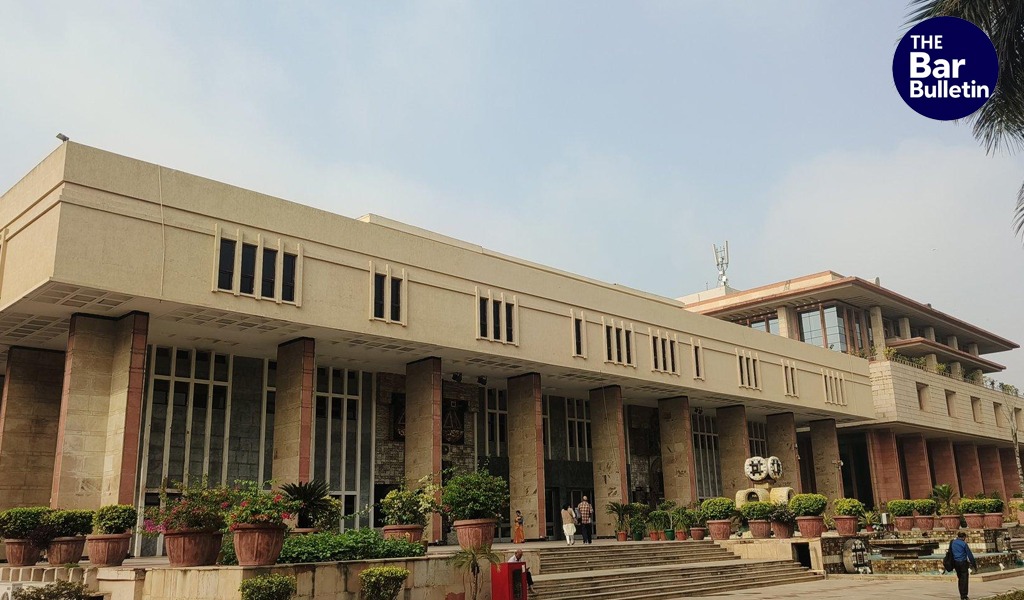

The Delhi High Court has asserted that in contractual and tender matters involving the State or its instrumentalities, the writ court does not examine the commercial merits of termination but only the legality of the decision-making process, and where the contract itself expressly reserves a power of termination, such power may be exercised in accordance with the contractual terms unless the decision is shown to be arbitrary, mala fide, biased, or violative of statutory or constitutional mandates.
The Court further held that a contractor who has knowingly accepted a contractual termination clause in a commercial tender cannot, after availing benefits under the contract, claim a vested right to continue till the end of the tenure or assail the clause merely because its operation causes commercial prejudice; in such circumstances, the proper remedy is ordinarily damages and not enforcement of the contract through writ jurisdiction.
Accordingly, the Court upheld the impugned termination, found no constitutional or public law infirmity in the action of NHAI, and dismissed the writ petition as devoid of merit.
The Division Bench comprising Justice Anil Kshetarpal and Justice Amit Mahajan reiterated that judicial review in contractual and tender matters under Article 226 is limited to examining the decision-making process and not the merits of the commercial decision itself. Interference is warranted only where the action is arbitrary, mala fide, irrational, or violative of statutory or constitutional mandates.
From the material on record, the Bench found that toll collections crossed the 40% threshold in June 2025 itself, i.e., in the same month in which the petitioner took over operations. It held that once Clause 35(6) formed part of the contractual framework accepted by the parties, the controversy whether the plaza was “new” lost much of its significance, particularly when the respondents treated it as a new fee plaza and asserted that it was less than one year old at the time of award.
The Bench held that once the contract reserved in favour of NHAI an express right of termination, the contractor could not claim an indefeasible right to continue till expiry of the contractual tenure. A party that entered into the contract with full knowledge could not later challenge the termination mechanism merely because its operation resulted in commercial disadvantage.
The Bench observed that the doctrine of unfair contractual terms, as explained in Central Inland Water Transport Corporation Ltd. v. Brojo Nath Ganguly [AIR 1986 SC 1571], was inapplicable to the present case, which arose from a commercial tender between business entities in a competitive market. It also noted that the contract had safeguards in favour of the contractor as well, including premature termination provisions under Clause 35(5).
The decision-making process satisfied procedural fairness because NHAI issued prior notice, considered the petitioner’s reply, afforded a personal hearing, and thereafter terminated the contract, added the Bench, while rejecting the contention that simultaneous issuance of a fresh tender established mala fides, holding that continuity planning in toll collection is connected with safeguarding public revenue and constitutes prudent governance.
The Bench also observed that the petitioner was an experienced contractor associated with NHAI since 2020 and had operated more than 80 fee plazas, and was therefore estopped from challenging Clause 35(6) after availing benefits under the contract for nearly nine months out of twelve months. It further held that the relief sought was in substance enforcement of a commercial contract in the nature of specific performance, whereas the appropriate remedy, if any, would lie in damages or compensation in accordance with law.
At the same time, the Bench recorded that NHAI had delayed invoking Clause 35(6), and that such delay in contracts involving public revenue could result in avoidable loss to the public exchequer. It noted the ASG’s submission that there had been significant delay, that a senior official had been issued a show cause notice, and that NHAI was introducing an automated monitoring mechanism to identify “windfall gain” situations in real time. The Bench therefore directed NHAI to place on record the ultimate decision in the disciplinary proceedings, to be concluded as far as practicable within six months.
Briefly, the petitioner challenged an order dated April 08, 2026 and the show cause notice dated April 02, 2026 by which the NHAI terminated, before expiry, the contract dated May 26, 2025 for collection of user fee at Pawangaon Fee Plaza. The petitioner also challenged the fresh tender dated April 02, 2026 issued for appointment of a new fee collecting agency for three months. The petitioner’s case was that the contract was valid till June 17, 2026 and that no breach was attributable to it.
In the background, the NHAI had invited bids for engagement of a user fee collection agency for Pawangaon Fee Plaza for one year, and the petitioner emerged as the successful bidder with a daily remittance of Rs. 2.62 lakhs. Thereafter, the contract was executed for the period from June 17, 2025 till June 17, 2026, and the petitioner furnished performance security and commenced toll collection operations.
Clause 35 of the contract governed termination. Clause 35(2) enabled termination upon seven days’ notice without assigning reasons, while Clause 35(6) contemplated termination in case of “windfall gain” at new fee plazas where the moving average of ETC and cash collections for the preceding fifteen days exceeded forty percent of the existing remittance being paid by the toll agency. On April 02, 2026, NHAI issued a show cause notice-cum-seven days’ termination notice invoking Clauses 35(2) and 35(6), and on April 08, 2026 the contract was terminated.
The petitioner contended that Clause 35(6) was inapplicable because Pawangaon Fee Plaza was an existing and already operational fee plaza and not a “new user fee plaza”, and further alleged that the action was arbitrary, pre-determined, non-speaking, and violative of Article 14, especially since a fresh tender was floated on the same date. The petitioner also argued that its reply dated April 04, 2026 was not considered and that the overstay policy circular dated March 26, 2025 had been wrongly applied during the contractual period.
The respondents relied on data showing that toll collections had substantially increased month after month and had crossed the 40% threshold as early as June 2025. According to NHAI, continuation of the existing arrangement despite such escalation caused an estimated loss of approximately Rs. 7.50 lakhs per day to the public exchequer.
Appearances:
Senior Advocate Sanjoy Ghose, along with Advocates Kaustubh Anshuraj, Parmod Kalirana, Manish Choudhary, and Amaya Vaid, for the Petitioner
ASG N. Venkataraman and Advocate Namit Saxena, for the Respondent
