
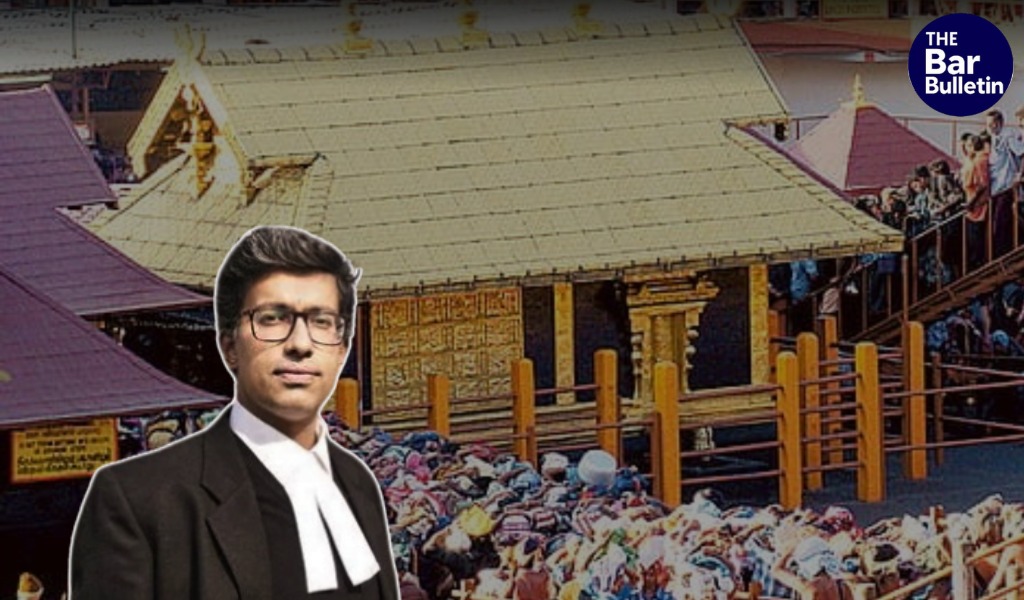

Appearing shortly, Senior advocate Gopal Subramanium urged the Supreme Court to first settle foundational constitutional questions before entering the factual controversies surrounding the Sabarimala Reference. He said the issues raised go beyond a single dispute and require a principled, reflective approach.
“These questions will have to be first answered in an abstract manner, without reference to the facts of any particular case,” he submitted, emphasising that the Court was dealing with “very profound areas of personal faith as well as collective faith across all religions in this country.”
Denominational Autonomy and Constitutional Structure in Focus
Building on this, senior advocate Gopal Sankaranarayanan argued that the Court must examine the broader scheme of Part III of the Constitution, particularly the interaction between Article 25 of the Constitution of India and Article 26 of the Constitution of India. He urged the Bench to step back from the specifics of Sabarimala and instead consider how religious freedom operates across diverse contexts, from temple entry to practices in other faiths.
“We must look at it on a completely broader plane than looking at it from the point of view of Sabarimala,” he said, pointing to recurring issues involving different religions and communities. He also drew a constitutional parallel with minority educational rights, suggesting that religious denominations occupy a distinct space within the constitutional framework. In a notable submission, he argued that denominational autonomy could extend to regulating entry based on adherence to faith, while making clear that practices such as untouchability would remain constitutionally impermissible.
Essential Religious Practices
Addressing the “essential religious practices” doctrine, Mr Sankaranarayanan submitted: “Do we need an essential religious practices test? My answer is no… The Constitution is very clear on its own terms…if a practice is connected to a religion, defer to what the denomination is saying, I do not think a non-ecclesiastical court should be testing that aspect.”
Senior Advocate Gopal Sankaranarayanan used an analogy to explain that fundamental rights cannot be asserted in every setting without limitation:
“If a school student keeps interrupting the class saying I have an Article 19(1)(a) right… Can the student say his right has been violated? My answer is no…There are spaces within which discipline is required.”
Temple Entry and Who Can Enforce Rights
Mr Gopal Sankaranarayanan distinguished between different kinds of fundamental rights under Article 15 of the Constitution of India, noting that clause (1) operates against the State, while clause (2) extends to private actors as well.
He pointed out that Article 15(2), which prohibits denial of access to public spaces on specified grounds, is a horizontal right, enforceable against individuals and entities, not just the State. This distinction, he argued, is important in determining against whom a fundamental right can be asserted.
In this context, Justice B. V. Nagarathna observed that the earlier Sabarimala challenge involved an indirect challenge to customs and usages.
Building on this, Sankaranarayanan framed the central issue as one of enforceability who can assert a right, and against whom and submitted that identifying horizontal rights like Article 15(2) is crucial to understanding how Article 25 of the Constitution of India operates.
Untouchability, Constitutional Limits and Sabarimala Context
On untouchability, Mr Gopal Sankaranarayanan emphasised that the provision (Article 17) creates a strong, enforceable prohibition across society, describing it as a “horizontal right” that applies to all individuals and entities.
Justice B. V. Nagarathna, however, clarified that the term “untouchability” must be understood in its specific historical context, as intended by the framers.
Responding, he argued that Article 17 is confined to caste-based exclusion affecting the Scheduled Castes and cannot be expanded to cover all forms of exclusion. He stressed that any disability arising from untouchability is absolutely prohibited and must be honoured universally.