
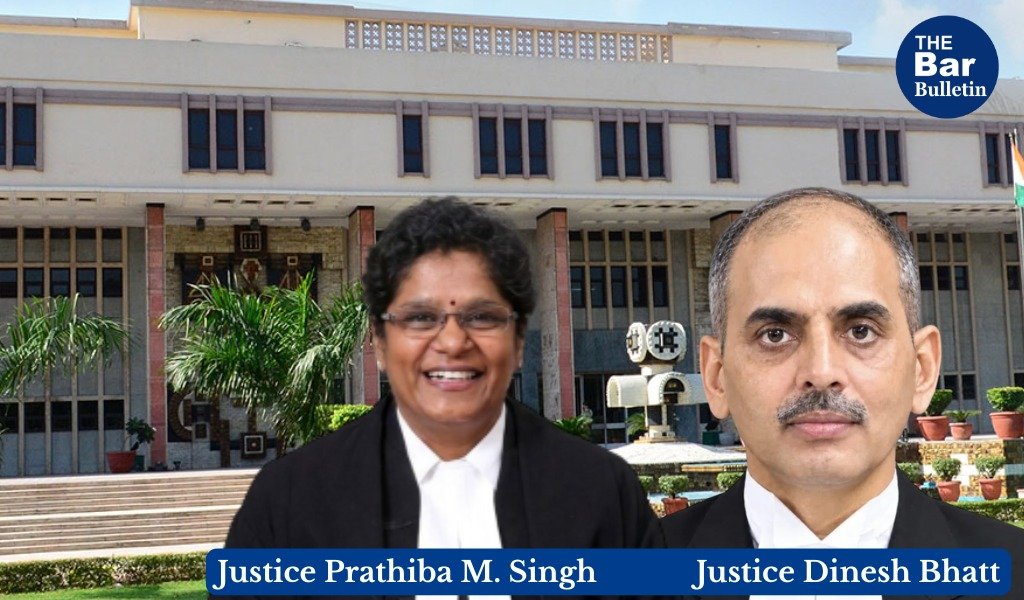

In a couple of petitions filed before the Delhi High Court by various photographers who were rendering services as licensed photographers at the Taj Mahal, assailing Clauses 9 and 9.3 of the ‘Policy for Archaeological Survey of India Photographers to perform within Centrally protected Monuments’ dated 24-05-2017 issued by the Archaeological Survey of India (ASI), Ministry of Culture, a Division Bench of Justice Prathiba M. Singh and Justice Dinesh Bhatt quashed Clause 9.3 of the impugned policy prescribing 65 years as the upper limit for photographers.
By the impugned policy, the petitioners contended that the ASI sought to restrict the age limit for photographers who can render services. Clause 9.1 required a medical fitness test and certificate for renewal after the age of 60 and Clause 9.3 prescribed a retirement age of 65 years, which the Petitioners said would adversely affect their livelihood. It was asserted that their licences were renewed from time to time, including in 2003 after scrutiny by a committee constituted by the ASI. The photographers contended that they had rendered their services uninterruptedly since then.
The Petitioners submitted that the retirement age would deprive them of their sole source of livelihood and adversely affect their dependent families. They argued that they were independent professionals who received no payment from the ASI and competed with other photographers. They also argued that photographers as well as tourist guides were similarly placed under Rule 8(d) of the Ancient Monuments and Archaeological Sites and Remains Rules, 1959.
The respondents submitted that, without a retirement age, younger photographers would not get an opportunity, resulting in overcrowding and a lack of space for tourists. They stated that about 500 photographers were then licensed at the Taj Mahal. The several licensees sent nominees into the monument, and stated that such photographers were not fully conversant with technological advancements.
The Court referred to B.P. Sharma v. Union of India & Ors. (2003) 7 SCC 309, and noted the Supreme Court’s observance that the nature of the license granted by ASI is merely one of access to the monument. It was found that the Supreme Court was clear and categorical in holding that the imposition of an age restriction on tourist guides would be contrary to Article 19(1)(g) of the Constitution.
Further, the Court stated that the Supreme Court had struck down the age restriction on tourist guides whose work involved considerable physical exertion as they are required to move around the monuments, whereas photographers mostly remained stationed at a particular location. Hence, the Court held that the reasoning in B.P. Sharma (supra) applied with great force to the petitioner’s case. The Court also stated that, with increased life expectancy, professionals were physically and mentally equipped to render services even at 65, noting that photography did not require enormous physical labour and that long experience at the monument could benefit tourists.
The Court said that petitioners were self-employed licensees, not ASI employees, and ought to be permitted to work as long as their faculties permitted. However, it was also said that the ASI is fully entitled, under the impugned policy, to ensure that licensed photographers undergo the requisite physical fitness test and furnish medical certificates prescribed under Clause 9.1 of the impugned policy. Subject to the medical fitness test and certificate, the Court found the 65-year limit discriminatory, noting that the petitioners had no other professional skill or vocation and had pursued photography for the last 30 to 40 years.
The Court held that the prescription of 65 years as the upper age limit was discriminatory and contrary to law, and adversely affected the petitioners’ right to livelihood. Furthermore, the Court completely barred the nomination of third parties by license holders. The Court held that if any licensed photographer is found either permitting another person to use his licence or sub-licensing the same in any manner, the licence shall be liable to be withdrawn with immediate effect.
Additionally, the Court directed the petitioners to undertake any refresher course by ASI for upskilling themselves and to ensure that they render high-quality services to the tourists. The petitioners were also directed to appear in and qualify any test conducted by ASI. Nominees that had already been permitted were permitted to continue only in cases involving license holders with disabilities. ASI was also granted liberty to conduct any physical fitness test or medical exam of the photographers after they attain the age of 65 years.
Subject to the said conditions, the Court quashed Clause 9.3 of the impugned policy which affixed the retirement age of the photographers at 65. The Court directed that the petitioners’ licences, stated to be renewed till the date of judgment, be renewed for the rest of the year and annually thereafter. Thus, the petitions were disposed of.
