
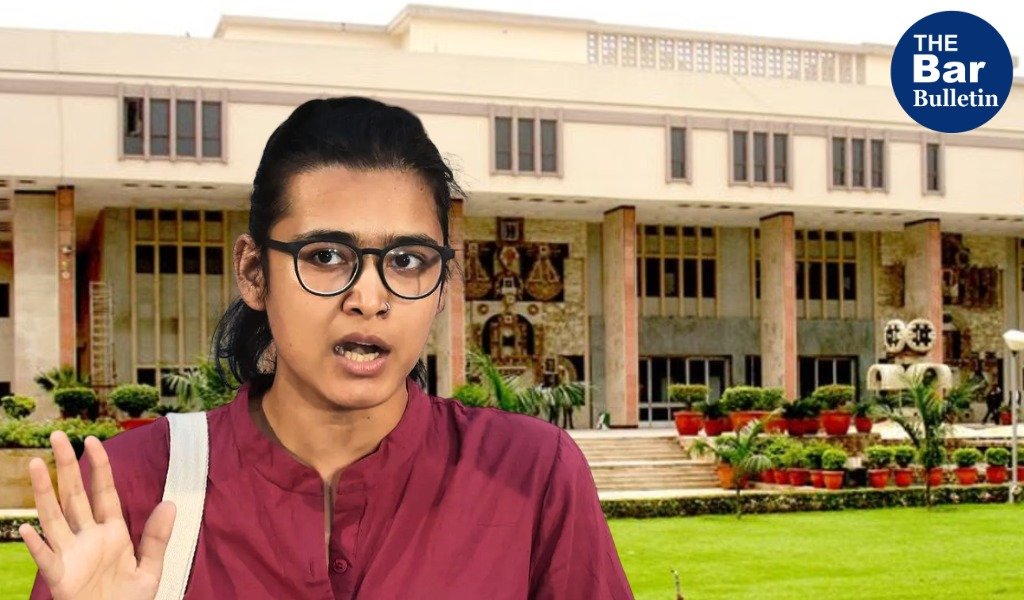

The Delhi High Court has dismissed the writ petition filed by All India Students’ Association (AISA) National President Neha Bora challenging a show-cause notice issued by a Special Executive Magistrate (SEM) under Sections 126 and 130 of the Bharatiya Nagarik Suraksha Sanhita, 2023 (BNSS), seeking an explanation as to why she should not be directed to execute a bond for keeping the peace.
Justice Subramonium Prasad held that the notice met the requirements of Chapter IX of the BNSS, which deals with preventive proceedings for maintaining peace and public tranquillity. The Court observed that, at the stage of a show-cause notice, its scrutiny was limited to examining whether relevant material was available before the Magistrate and whether the Magistrate had applied his mind to that material.
The petition arose from a notice dated October 17, 2026, issued after Neha Bora was detained by Delhi Police at Mandi House on October 16 during protests concerning the functioning of the Election Commission of India (ECI) and the Special Intensive Revision (SIR) of electoral rolls.
The notice alleged that Bora had created a nuisance by shouting slogans at Mandi House, participated in repeated protest-related activities despite prohibitory orders under Section 163 of the BNSS, and instigated people to participate in an unauthorised demonstration at Central Park, Connaught Place. It called upon her to show cause why she should not execute a personal bond of ₹10,000 with one surety for a like amount.
Neha Bora challenged the notice on the ground that it mechanically reproduced the statutory provisions without satisfying the requirements of Section 126 of the BNSS. Her counsel, Senior Advocate Gopal Sankaranarayanan, argued that the SEM had issued the notice without conducting an independent inquiry or forming an independent opinion on whether there was a genuine apprehension of breach of peace.
The petitioner also contended that the notice was based on hearsay material and a police kalandara, and the protest at Mandi House was not covered by the prohibitory orders relied upon by the authorities. She further argued that a peaceful protest could not, by itself, justify preventive proceedings.
Opposing the petition, Additional Solicitor General Chetan Sharma submitted that the SEM had considered the kalandara dated October 17, 2026, accompanying documents and statements of witnesses before forming an opinion that proceedings were warranted. The State also argued that the writ petition was premature, as the petitioner would have an opportunity to contest the allegations during the inquiry before the SEM.
After examining the statutory scheme, the Court emphasised that proceedings under Chapter IX of the BNSS are preventive rather than punitive. Referring to the Supreme Court’s decision in Prakash Chand Sachdeva v. State, (1994) 1 SCC 471, the Court explained that the provisions are intended to prevent a breach of peace before it occurs, rather than punish a person after an incident has taken place.
The Court observed that Sections 126 and 130 require the Magistrate to receive information indicating a likelihood of breach of peace or disturbance of public tranquillity and form an opinion that sufficient grounds exist to initiate proceedings. Explaining the limited scope of judicial review at the show-cause stage, the Court observed:
“
“Therefore, at the stage where only a notice has been issued, enquiry of the Writ Court will be only be limited to examine as to whether there was any material/information before the SEM at all and whether the SEM applied its mind on such material/information received by him, for proceeding under Chapter IX of the BNSS. The Court, at this stage, does not sit on the arm-chair of the SEM to decide as to whether the material/information is sufficient or not and unless it is a case of nil material, which would shock the conscience of the Court, the Writ Court at the stage of issuance of a show cause notice, will not interfere.”
The Court also referred to the Supreme Court’s decisions in Special Director v. Mohd. Ghulam Ghoushe, (2004) 3 SCC 440;Union of India v. Vicco Laboratories, (2007) 13 SCC 270; and J. Sri Nisha v. Special Director, Adjudicating Authority, Directorate of Enforcement, (2026) SCC OnLine SC 517. The Court reiterated that writ courts must exercise greater caution and scrutiny in matters involving an individual’s personal liberty than in cases concerning domestic enquiries.
On the facts of the case, Justice Prasad noted that the SEM had examined three general diary entries, the kalandara dated October 17, 2026, and three witnesses before issuing the notice. The Court held that the proceedings were not based merely on hearsay, as alleged by the petitioner.
The Court also noted that six FIRs had been registered against the petitioner at various police stations, alongside General Diary entries documenting incidents at different locations. It declined to consider additional video evidence whose placement before the Magistrate was unclear. It held that sufficient material was available before the SEM, including kalandara dated October 17, 2026, General Diary entries and three witnesses, to initiate proceedings under Section 126 of the BNSS.
“
“In the opinion of this Court, the SEM in the present case, has duly examined the information received by him, including the three (03) general diary entries along with kalandara dated 17.10.2026 and examined the three (03) witnesses, which would satisfy the requirements under Sections 126 and 130 of the BNSS. It is not necessary that the SEM has to investigate like a fact-finding authority while forming an opinion regarding apprehension of breach of peace under Chapter IX of the BNSS which is preventive and not punitive in nature” the Court observed.
On the petitioner’s reliance on Madhu Limaye v. Sub-Divisional Magistrate, Monghyr, (1970) 3 SCC 746 to contend that the impugned notice failed to comply with the legal safeguards governing preventive proceedings, the Delhi High Court held that the principles laid down by the Supreme Court had not been violated at this stage as the SEM had sufficient material before him to initiate proceedings under Section 126 of the BNSS.
The Court reasoned that the notice disclosed the substance of the information underlying the apprehension of a breach of peace, while the record contained multiple FIRs, General Diary entries and information concerning prohibitory orders. It distinguished the matter from cases where preventive action was based on inadequate material. However, it clarified that the SEM must adhere to the safeguards recognised in Madhu Limaye and Aldanish Reinv. State (NCT of Delhi), 2018 SCC OnLine Del 12207, particularly before directing the petitioner to furnish a bond under Section 135(3) of the BNSS.
Thus, the Court directed the SEM to keep in mind the safeguards governing interim bonds under Section 135(3) of the BNSS. It noted that the provision permits a bond during the pendency of an inquiry only where immediate measures are considered necessary to prevent a breach of peace or disturbance of public tranquillity, and the Magistrate must record reasons for such a direction.
The Court further observed that the SEM must independently assess the material before deciding whether a personal bond or bail bond is necessary. It left open the petitioner’s right to challenge the proceedings at an appropriate stage.
Dismissing the writ petition along with pending applications, the Court clarified that its observations were confined to the scope of interference under Article 226 of the Constitution at the stage of issuance of the show-cause notice and did not determine the merits of the allegations against Neha Bora or prejudge the SEM’s decision on whether she would ultimately be required to furnish a bond.
