
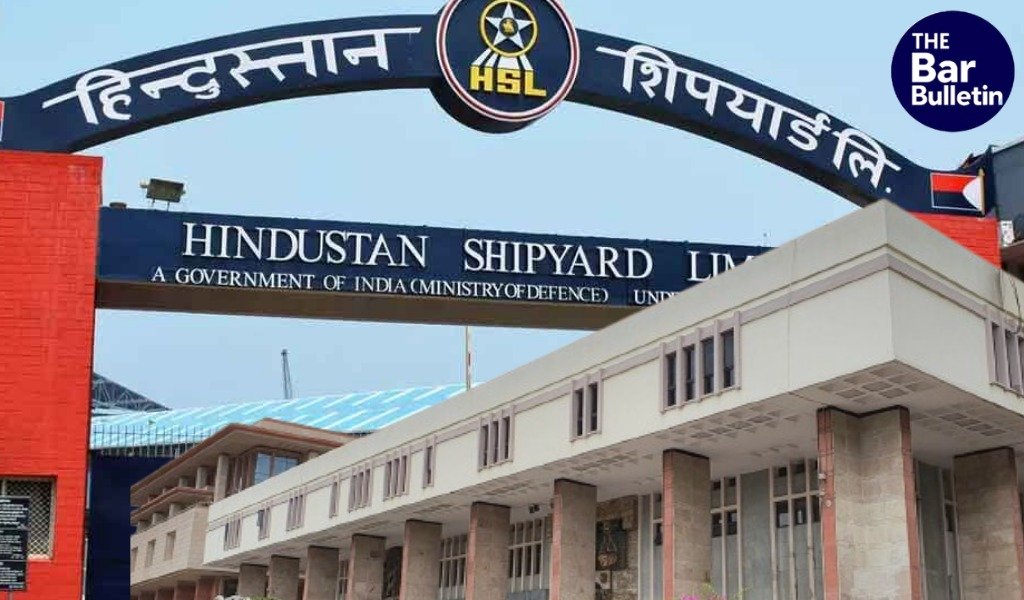

In an application under Order XXXIX Rules 1 and 2 read with Section 151 of the Code of Civil Procedure, 1908 (CPC), before the Delhi High Court, seeking interim reliefs in a suit under Section 37 of the Specific Relief Act, 1963, seeking a declaration and permanent injunction restraining defendant 1 from proceeding with the arbitral proceedings filed before the Indian Council of Arbitration (ICA) (defendant 2), a Single Judge Bench of Justice Tushar Rao Gedela directed ICA’s email directing the plaintiff to file its statement to be kept in abeyance.
Hindustan Shipyard Limited (plaintiff) and defendant 1, a Turkish company, entered into a Collaborator Contract (CC) on 20-03-2020 for collaboration in design, and supply of Key Machinery Equipment, technical assistance, and project implementation towards five Fleet Support Ships for the Indian Navy. The Cabinet Committee on Security approved the FSS Project on 16-08-2023 but decided it would be executed through indigenous industry without the involvement of defendant 1.
The Ministry of Defence, by a letter dated 23-08-2023, directed the plaintiff to initiate contract termination proceedings, and the plaintiff terminated the Collaborator Contract by letter dated 24-08-2023. Settlement meetings at Visakhapatnam failed and after a gap of almost 30 months, defendant 1 invoked arbitration on 08-07-2026. It filed its Statement of Claim before ICA on 07-08-2026. By an email dated 19-08-2026, ICA directed the plaintiff to file its Statement of Defence and nominate its arbitrator, which the plaintiff assailed by filing the present suit.
The learned Solicitor General submitted that the entering into and termination of the Collaborator Contract were sovereign acts of the Government of India, undertaken since the contract pertained to national maritime security and naval readiness rather than being a pure commercial contract. He contended that Article 23.8 was an exception to Article 25, the arbitration clause, and that the word “may” in Article 25.1 rendered arbitration non-mandatory.
Defendant 1 contended that the Court lacked territorial jurisdiction since the Collaborator Contract was signed, executed, and performed at Visakhapatnam, and Article 25.1(d) conferred seat and venue at Visakhapatnam. He submitted that Article 25.1(b) used the mandatory word “shall”, that the plaintiff had already invoked amicable resolution under Article 25.1(a), and that under Section 16 of the Arbitration and Conciliation Act, 1996, the Arbitral Tribunal alone could rule on its own jurisdiction.
The Court deemed it appropriate to first examine as to whether the termination of the CC by Hindustan Shipyard by the communication letter dated 24-08-2023 was not arbitrable, per se, based on the sovereign decision. Hence, articles 23.7 and 23.8 of the Collaborator Contract were examined and it was noted that the expression “any such governmental prohibition” in Article 23.8 was not limited to the event in Article 23.7, and manifested expansive governmental powers relatable to national security and defence procurement. It was also found pertinent to note that the CC was regarding construction of five FSS for the Indian Navy, which are essential and crucial to building national security as well as strategic military development.
Considering the letter dated 23-08-2023 issued by the Government of India, the Court stated that the plaintiff was bound to act in pursuance of any decision taken by the government. The Court stated that Vidya Drolia v. Durga Trading Corpn. (2021) 2 SCC 1 had clearly defined that the decisions taken by the State in certain matters are sovereign functions, which are inalienable and non-delegable, and are thus, non-arbitrable. It was said that if internal security is a sovereign function, then matters related to defence procurement for the armed forces would clearly fall within the expression “sovereign function”, and the decision taken in such context could be expressed as “sovereign decision”, particularly in the context of decisions relating to whether to go ahead with a particular foreign entity or not, having regard to the ever changing and differing geo politics.
It was held that the decision of the government was a “decision of the Sovereign”, and non-arbitrable. The Court said that it cannot be fathomed that a decision taken by a Sovereign in such matters, two contractual parties bound by an agreement would have the right, authority or jurisdiction to call for or question such sovereign decisions.
On territorial jurisdiction, the Court stated that at such a nascent stage of the suit, the Court was only to consider the averments in the plaint and deem that all the facts stated therein are correct. It was said that it would be premature for this Court to reject the suit under provision of Order VII Rule 11 CPC at the threshold by disbelieving certain portions of the plaint.
The Court held that, prima facie, the plaintiff had a strong case and that the balance of convenience was tilted in favour of the plaintiff, who would suffer irreparable loss if ad-interim directions were not passed. It was opined that since the decision dated 23-08-2023 fell within the ambit of a “sovereign decision” and would be “inherently non-arbitrable ab initio”, it would be in the interest of justice to keep the email dated 19-08-2026 by ICA in abeyance till the next date of listing.
Thus, notice was issued, and the matter was directed to be listed before the Joint Registrar on 17-11-2026 and before the Court on 08-12-2026.
ALSO READ: Supreme Court Mandates Time-Bound Compliance With ICU Infrastructure, Safety & Staffing Guidelines
