
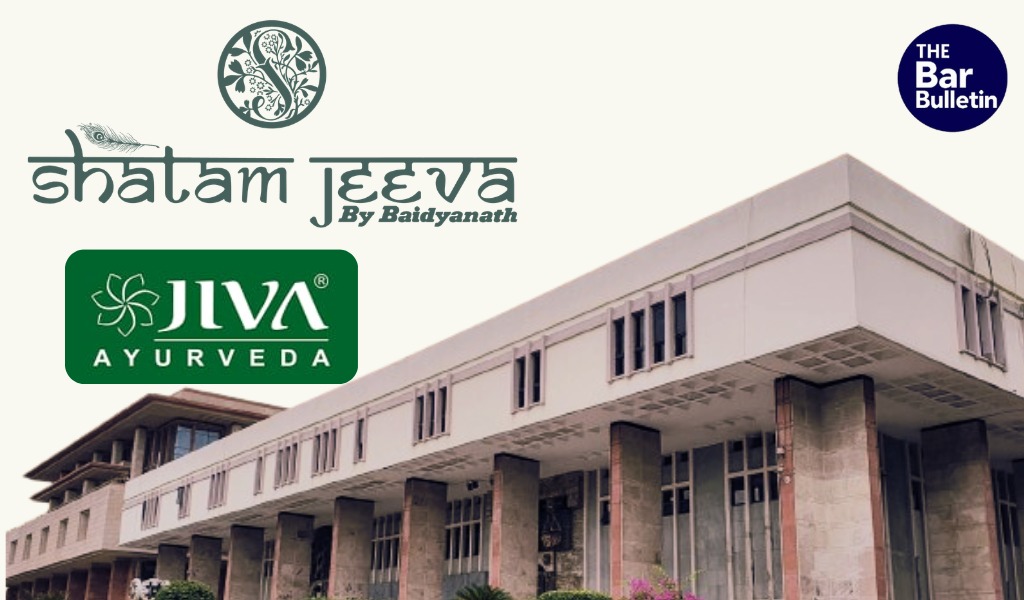

The Delhi High Court has that in trademark disputes involving composite device marks, the test of deceptive similarity must be applied holistically and not by dissecting the marks to isolate a common element. Even if a shared element is alleged to be dominant, the decisive inquiry remains whether the marks, viewed in their entirety, create a likelihood of confusion in the mind of an average consumer of ordinary intelligence and imperfect recollection.
The Court further held that where the rival marks, taken as a whole, are visually, phonetically, conceptually and structurally distinct, and where additional elements such as “Shatam” and “By Baidyanath” clearly distinguish source, no prima facie case of infringement arises.
The Court also held that for passing off, the plaintiff must establish the classical trinity of goodwill, misrepresentation and damage, and the enquiry must be based on the overall representation and trade dress. Where there is no deceptive similarity and no misrepresentation, passing off cannot be sustained, and an interlocutory injunction ought not to be granted.
The Division Bench comprising Justice C. Hari Shankar and Justice Om Prakash Shukla first noted that an appeal against an interlocutory order of the Commercial Court is an appeal on principle, and interference is warranted only where the order is arbitrary, capricious, perverse, ignores settled principles governing injunctions, or where the view taken was not reasonably possible on the material before the Court.
The Bench reiterated that under Section 29(2)(b) of the Trade Marks Act, infringement requires a registered trademark, deceptive similarity, use in relation to identical or similar goods or services, and likelihood of confusion or association in the public mind. It further held that infringement is not assessed solely by comparing the dominant part of the marks; while the dominant feature may assist, the true test is the overall impression created by the competing marks on a person of average intelligence and imperfect recollection.
Referring to Pernod Ricard India Private Limited vs. Karanveer Singh Chhabrra [FAO (COMM) 334/2025], the Bench emphasized the anti-dissection rule and held that marks must be compared as a whole. It observed that the mere presence of a shared or generic word in two composite marks does not by itself justify a finding of deceptive similarity; the Court must undertake a holistic comparison of visual, phonetic, structural and conceptual elements.
On the Commercial Court’s reasoning, the Bench found that the impugned order was unclear as to whether injunction had been granted on the basis of infringement, passing off, or both, and that no specific finding on goodwill had been returned, though goodwill is an essential ingredient of passing off. The Bench also found that the Commercial Court failed to adequately consider the distinguishing effect of the phrase “By Baidyanath”.
On prima facie infringement, the Bench held that after comparing the marks as a whole, there was no phonetic, visual or conceptual similarity between them. It observed that the Plaintiffs’ mark used “Jiva” with a lotus device, whereas the Defendants’ mark used “Shatam Jeeva” with a circular “S” and depictions of herbal plants, and that the use of “Shatam” and “By Baidyanath” clearly distinguished source.
The Bench therefore held that even assuming “Jiva” to be the dominant part of the Plaintiffs’ mark, the overall commercial impression of the two marks was distinct and no likelihood of confusion arose. On passing off, the Bench reiterated the classical trinity of goodwill, misrepresentation and damage. It observed that in passing off, added matter can make a significant difference, and the entire trade dress must be compared.
Upon examining the rival trade dresses, the Bench found no visual or conceptual similarity except for the occurrence of “Jeeva/Jiva”; it held that the herbal plants in the Defendants’ mark, the lotus in the Plaintiffs’ mark, and the phrase “By Baidyanath” sufficiently distinguished the source of the Defendants’ services. The Bench further held that misrepresentation was absent and that no case of passing off could therefore be sustained.
Briefly, the appeal arose from the order dated November 17, 2025 passed by the Commercial Court, whereby the Defendants were injuncted from using the mark “SHATAM JEEVA” or any other mark identical or deceptively similar to the Plaintiffs’ registered trademarks “JIVA”, and were also restrained from infringement, passing off and unfair competition. The Plaintiffs pleaded that they form part of the “JIVA Group”, that the mark “JIVA” has been used since 1992 for Ayurvedic products and services, and that they possess several trademark registrations in different classes, along with substantial sales, advertising expenditure, websites and domain name presence.
The Plaintiffs stated that in April 2022 they learnt that the Defendants were operating a wellness retreat under the name “SHATAM JEEVA” and were using the domain name ‘www.shatamjeeva.com’. They alleged that the Defendants had also registered a device mark in Class 5 in 2018, which according to them was visually, structurally and phonetically similar to their registered marks. A legal notice was issued on April 25, 2022, which was denied by the Defendants on April 28, 2022, following which the suit for permanent injunction and interim relief was instituted.
The Defendants pleaded that Defendant No. 1 was the registered proprietor of its mark registered in 2018 and that they were using the mark “Shatam Jeeva By Baidyanath” along with the domain “https://shatamjeeva.life”. They contended that the mark was adopted in connection with the centenary of the Baidyanath brand, that “Jeeva” is a common Sanskrit word, that the mark had to be seen as a whole, and that the addition of “By Baidyanath” distinguished their mark from that of the Plaintiffs.
The Defendants argued, inter alia, that both marks were registered, that the anti-dissection rule required comparison of the marks as a whole, that the Plaintiffs had no registration for the word mark “Jiva” simpliciter, and that no case of infringement or passing off was made out. The Plaintiffs, on the other hand, argued that “Jiva” was the dominant part of their marks, that they were prior users with goodwill since 1992, and that passing off was maintainable even against a registered trademark.
Appearances:
Senior Advocate Suhail Dutt, along with Advocates Prakhar Sharma and Azhar Alam, for the Appellants
Advocates Mr. Virender Goswami, Soni Singh, Abhinav Bhalla, Swati Goswami, Parkhi Singh and Vedang Upadhayay, for the Respondents
