

In a Section 37 appeal arising from an MSMED Act arbitration, the Delhi High Court confirmed that a buyer cannot adjust admitted dues against liquidated damages suffered under a separate contract with a third party absent any mutually accepted contractual stipulation. The Court held that party cannot unilaterally enlarge the contractual liability of the other party through one-sided correspondence or by reference to obligations arising under an independent contract with a third party, in the absence of a mutually accepted contractual stipulation.
The Court emphasised that the defence of adjustment of admitted dues against alleged losses fails where there is no contractual provision or subsequent mutual agreement incorporating such liability, and reliance on Sections 55, 73 and 74 of the Indian Contract Act, 1872 cannot substitute for the absence of a foundational contractual obligation. Accordingly, findings recorded by the Sole Arbitrator on merits, based on appreciation of contractual documents and evidence, cannot be recast as a violation of the principles of natural justice merely because the aggrieved party disagrees with the conclusion, added the Court.
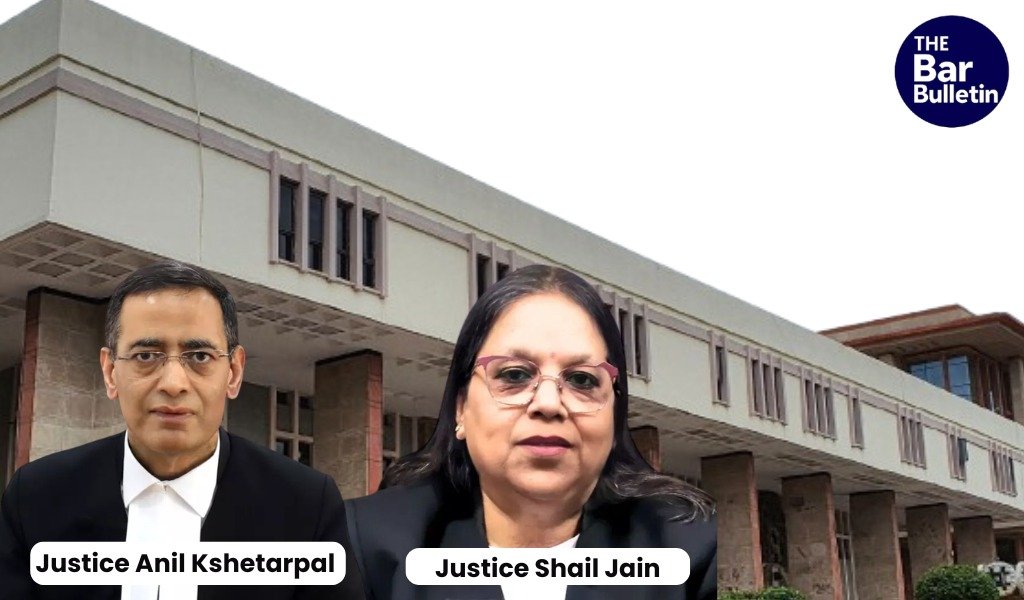
On the question of whether time was the essence of the contract, the Division Bench comprising Justice Anil Kshetarpal and Justice Shail Jain found no infirmity in the Sole Arbitrator’s conclusion that the Purchase Order did not contain any stipulation declaring time to be of the essence. The Court noted that although specific delivery dates were mentioned, there was no contractual provision making delayed delivery a ground for fastening liability upon the Respondent or requiring it to bear liquidated damages.
The Court further observed that merely because the supplies were intended for use in another contract awarded by the RBI would not, by itself, alter or rewrite the contractual relationship between the Appellant and the Respondent, and that the obligations and liabilities of the parties must be gathered from the terms of the contract between them and not from conditions in a separate agreement with a third party. The Appellant was unable to point to any clause in the Purchase Order whereby the Respondent agreed that time would be the essence or that it would be liable for liquidated damages incurred under the Appellant’s independent contract with the RBI.
On the Appellant’s reliance on contemporaneous correspondence, the Court observed that the mere exchange of emails reminding the Respondent to expedite supplies or communicating the possible consequences of delay cannot, in the absence of a contractual stipulation accepted by both parties, create a fresh contractual obligation or enlarge the liabilities originally undertaken by the Respondent under the Purchase Order. The Sole Arbitrator considered the said correspondence and declined to accept the interpretation sought to be placed by the Appellant, which was a plausible view arising from the material on record and could not be characterised as patently illegal or perverse.
On the plea of adjustment of outstanding dues against liquidated damages, the Court noted that the Sole Arbitrator found no contractual stipulation or mutually accepted arrangement entitling the Appellant to recover alleged damages from the Respondent or to unilaterally adjust the admitted amount payable. The communication dated Aug 26, 2015 merely conveyed the Appellant’s apprehension that liquidated damages might be imposed by the RBI and its intention to recover the same from the Respondent, but neither formed part of the Purchase Order nor constituted a contractual stipulation, and there was nothing on record to indicate that the Respondent accepted the said stipulation or that the parties mutually agreed to modify the contractual terms.
The Court held that the reliance on Sections 73 and 74 of the Contract Act did not advance the Appellant’s case because the very foundation for claiming compensation, namely a contractual obligation making the Respondent liable for the alleged losses, was found to be absent by the Sole Arbitrator upon interpretation of the Purchase Order and appreciation of evidence.
On the contention that the Commercial Court mechanically dismissed the objections, the Court found that the Commercial Court adverted to each of the principal objections and rightly concluded that the Appellant was, in substance, seeking a re-appreciation of evidence and a fresh interpretation of contractual terms. On the natural justice plea, the Court observed that the Sole Arbitrator examined at considerable length the Appellant’s contention regarding adjustment of the amount against alleged losses and rejected it on merits after considering the Purchase Order, contemporaneous correspondence, and oral evidence, and that such findings on merits could not be recast as a violation of natural justice or a procedural infirmity.
Also read No Public Order Disturbance Made Out: Bombay HC Quashes MPDA Detention Order
Briefly, the Respondent, Spark Technologies Pvt Ltd, a company dealing in computer peripherals and networking products, supplied networking products and allied material to the Appellant, Vantage Integrated Securities Solution Pvt Ltd, a company engaged in the design, supply, installation, testing and commissioning of electronic security and surveillance systems, pursuant to a Purchase Order dated May 07, 2015. The supplies were effected under various invoices aggregating to Rs. 25.68 lakhs, against which payments of Rs. 15.75 lakhs were received, leaving an outstanding balance of Rs. 9.92 lakhs. Despite repeated requests and a notice, the Appellant failed to clear the outstanding dues, prompting the Respondent to invoke the provisions of the Micro, Small and Medium Enterprises Development Act, 2006 by approaching the Micro and Small Enterprise Facilitation Council. Upon failure of conciliation, the dispute was referred under Section 18(3) of the MSMED Act to the Delhi International Arbitration Centre for adjudication under the Arbitration and Conciliation Act, 1996.
Before the Sole Arbitrator, the Respondent claimed recovery of the outstanding principal of Rs.9.92 lakhs along with interest under the MSMED Act and consequential reliefs. The Appellant resisted the claim on the ground that the supplies were not made within the stipulated time, resulting in delay in execution of a separate project awarded to the Appellant by the Reserve Bank of India for installation of IP CCTV surveillance systems. The Appellant contended that the RBI consequently levied liquidated damages upon it and that the outstanding amount was liable to be adjusted against the losses so suffered. The Appellant further pleaded that the Respondent had been informed through contemporaneous correspondence that any liquidated damages imposed by the RBI would be passed on to it.
The Sole Arbitrator, by award dated Oct 27, 2020, substantially allowed the Respondent’s claim, holding that the Purchase Order did not stipulate time as the essence of the contract, that there was no contractual term entitling the Appellant to recover or adjust any alleged liquidated damages, and that the Appellant had failed to establish that the Respondent had assumed any contractual liability in respect of the liquidated damages imposed under the Appellant’s independent contract with the RBI. The award also recorded that no counterclaim seeking recovery of the alleged losses had been filed. Aggrieved, the Appellant filed a petition under Section 34 of the 1996 Act before the District Judge (Commercial Court)-01, Patiala House Courts, New Delhi, which dismissed the petition by holding that the findings of the Sole Arbitrator were based on appreciation of contractual terms and evidence and did not suffer from patent illegality or perversity.
