
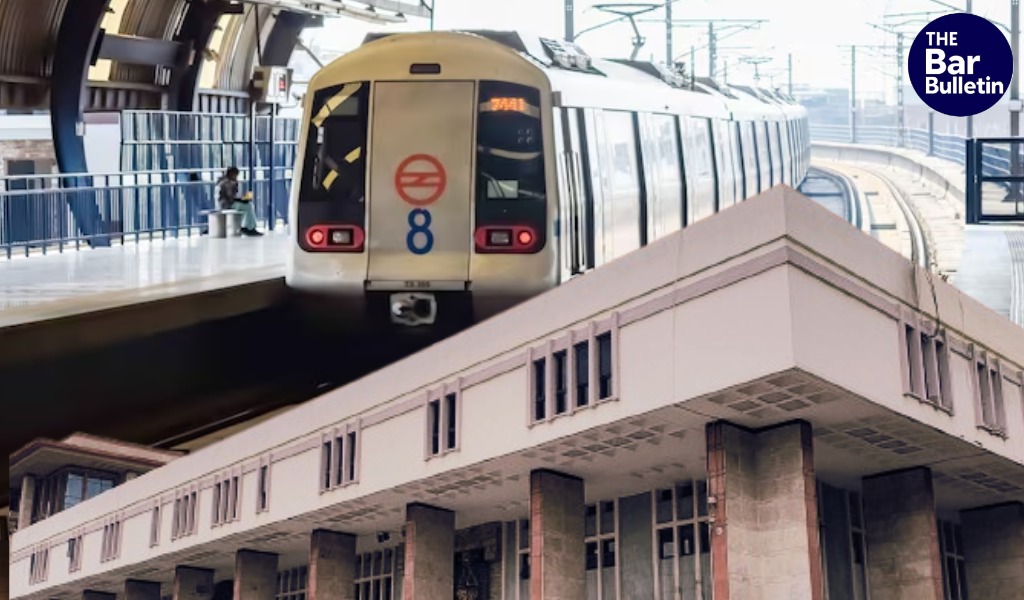

The Delhi High Court has upheld the Election Commission of India’s directions prohibiting the display of political advertisements in Delhi Metro trains and stations during the operation of the Model Code of Conduct (MCC), holding that the restriction is reasonable, limited in duration, and intended to preserve a level playing field and ensure free and fair elections.
A Division Bench of Justice V. Kameswar Rao and Justice Manmeet Pritam Singh Arora dismissed a Letters Patent Appeal filed by advertising agencies challenging the Election Commission’s directions requiring the Delhi Metro Rail Corporation (DMRC) to incorporate a clause in its licence agreements prohibiting political advertisements during the MCC period.
Appearing for the appellants, Senior Advocate Ashish Mohan argued that the Election Commission had acted arbitrarily and discriminatorily by prohibiting political advertisements in metro stations and trains while permitting similar advertisements at bus queue shelters and other commercially authorised sites. He contended that the classification lacked any intelligible differentia and violated Article 14 of the Constitution. He further submitted that the impugned directions infringed the appellants’ rights under Articles 19(1)(a) and 19(1)(g), as they were based on executive instructions without statutory force and resulted in a unilateral alteration of long-term licence agreements under which the agencies had structured their bids by factoring in potential revenue from political advertisements during elections. He also argued that the Election Commission’s earlier communications had expressly permitted political advertisements on commercially authorised sites, making the subsequent prohibition inconsistent and arbitrary.

Also read SAM acts as the Lead Legal Counsel to Jio Platforms on its Proposed IPO
Opposing the appeal, Sanjay Vashishtha, Standing Counsel for the Election Commission of India, submitted that the impugned directions were issued pursuant to the Commission’s constitutional powers under Article 324 to regulate matters connected with elections and ensure a level playing field among political parties. He argued that the restriction operates only for the limited duration during which the Model Code of Conduct remains in force and does not prohibit the appellants from displaying any other commercial advertisements. He further contended that any grievance regarding modification of the licence agreements was contractual in nature and ought to be resolved through arbitration rather than in writ proceedings. On the allegation of discrimination, he submitted that metro stations and trains are distinct from bus queue shelters and roadside advertising structures, which are akin to public billboards, and that any under-inclusiveness in the policy does not amount to a violation of Article 14.

Accepting the Election Commission’s stand, the Division Bench agreed with the Single Judge’s finding that the appellants are merely service providers leasing advertising space to third parties and that their own right to freedom of speech and expression is not directly affected by the prohibition on political advertisements. It further held that the appellants remain free to display non-political advertisements during the operation of the MCC and therefore their right to carry on trade or business is not curtailed.
The Court emphasised that the restriction is temporary and would operate only during the period when the Model Code of Conduct is in force. Observing that only four or five elections are likely to occur during the ten-year licence period, the Bench held that the restriction would effectively apply only for a few months throughout the contractual tenure and cannot be characterised as unreasonable. It further held that the larger public interest in conducting free, fair and transparent elections outweighs the commercial interests of the advertising agencies.
Rejecting the plea of discrimination, the Court held that metro stations and trains are exclusively identified with the Government and that restricting political advertisements on such premises serves the legitimate purpose of preventing any perceived governmental association with political parties during elections. It also held that the appellants could not seek negative equality merely because political advertisements were allegedly permitted at bus queue shelters or other locations.
On the challenge to the legal basis of the impugned directions, the Court accepted the Election Commission’s submission that, in the absence of a statutory framework governing political advertisements during elections, the Commission’s directions issued in exercise of its plenary powers under Article 324 of the Constitution have the force of law and are binding. Holding that the impugned restriction is narrowly tailored and serves the constitutional objective of ensuring free and fair elections, the Division Bench found no ground to interfere with the Single Judge’s judgment and dismissed the appeal.
