
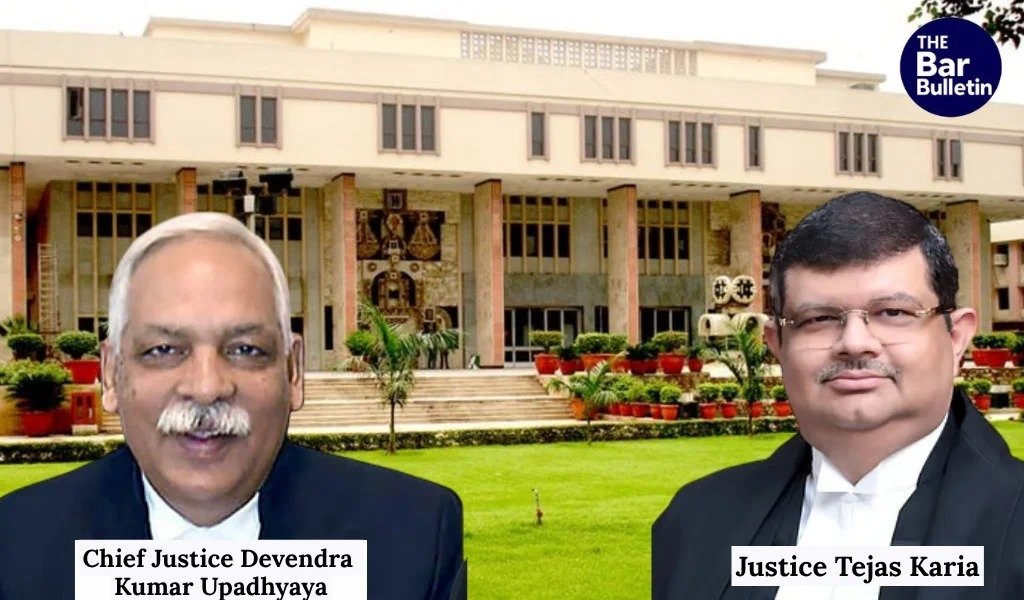

The Delhi High Court has upheld the validity of Rule 22(3)(1)(i) and (iv) of the Delhi Maintenance and Welfare of Parents and Senior Citizens Rules, 2009, holding that the District Magistrate can order eviction of a son, daughter or legal heir from a senior citizen’s property on grounds of non-maintenance and ill-treatment. The Court also held that an eviction application under the Rules can be maintained even where no separate claim for maintenance has been made.
A Division Bench of Chief Justice Devendra Kumar Upadhyaya and Justice Tejas Karia delivered the judgment. The petition was filed by the daughter-in-law challenging a July 7, 2022 order of the Divisional Commissioner directing her to vacate the property and hand over peaceful possession to her mother-in-law.
The petitioner had also challenged Rule 22(3)(1)(i) and (iv), arguing that the Delhi Government had exceeded its rule-making power under the Maintenance and Welfare of Parents and Senior Citizens Act, 2007 by introducing an eviction mechanism not expressly provided for in the parent legislation. She further contended that the Rules violated Articles 14, 15 and 21 and conflicted with a woman’s right to reside in a shared household under Section 17 of the Protection of Women from Domestic Violence Act, 2005.
The Bench, however, rejected the challenge, holding that the impugned provisions were referable not only to Section 32 (rule-making power) of the Senior Citizens Act but also to Section 22, which empowers the State Government to prescribe a comprehensive action plan for protection of the life and property of senior citizens. The Court held that the State had accordingly empowered the District Magistrate to order eviction in cases involving non-maintenance and ill-treatment.
The Court referred to the Supreme Court’s recent decision in Ravi Kant Gupta v. State of Uttar Pradesh, SLP (C) Diary No. 22768/2024, which held that a Tribunal under the Senior Citizens Act has the power to order eviction where necessary to ensure the maintenance or protection of a senior citizen. The High Court also referred to S. Vanitha v. Deputy Commissioner, (2021) 15 SCC 730, and Kamalakant Mishra v. Additional Collector, 2025 SCC OnLine SC 2077.
On the argument that the petitioner had an indefeasible right to reside in the shared household under Section 17 of the Domestic Violence Act, irrespective of whether she had any right, title or beneficial interest in the property, the Court noted that a residence application filed by her under Section 19 of the Act was still pending. The petitioner had contended that until that application was decided, an order of eviction could not have been passed.
The Bench, however, took note of the Divisional Commissioner’s finding that the petitioner already had a separate house in Bahadurgarh and was working as a Post Graduate Teacher with a substantial income. The Court also considered the senior citizen’s stated desire to spend the remainder of her life peacefully and not be drawn into the matrimonial dispute between her son and daughter-in-law.
The Court observed that Section 4(3) of the Senior Citizens Act casts an obligation on children to meet the needs of their parents so that they may lead a normal life. In the circumstances of the case, the Bench held that the senior citizen was entitled to live peacefully without being affected by the matrimonial discord between her son and daughter-in-law, and upheld the eviction order.
The petitioner also argued that Rule 22(3)(1) of the 2009 Rules applied only to a son, daughter or legal heir and did not extend to a daughter-in-law. Rejecting the contention, the Court relied on its earlier decisions in Shadab Khairi v. State, 2018 SCC OnLine Del 7626 and Darshna v. Govt. of NCT of Delhi, LPA No. 537/2018, holding that the provision could not be interpreted restrictively.
On the further argument that harassment, ill-treatment and non-maintenance had to be established and that eviction could not be ordered in the absence of a separate claim for maintenance, the Court held that eviction proceedings under Rule 22(3)(1) are independent of proceedings for maintenance under Sections 4 and 5 of the Senior Citizens Act. Therefore, an application for eviction can be maintained even where no separate maintenance proceedings have been instituted.
The Bench ultimately held that the Divisional Commissioner’s order directing the petitioner to vacate did not warrant interference. It dismissed the writ petition and declined to impose costs.
