
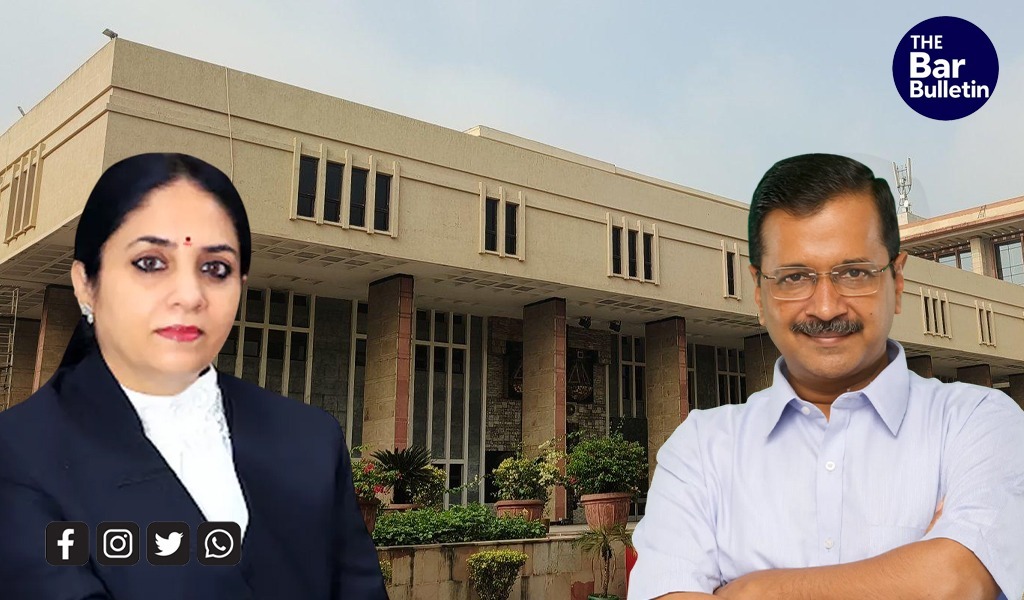
In a detailed order, Delhi High Court judge Justice Swarana Kanta Sharma declined to recuse from hearing the excise policy case, rejecting the apprehension of bias raised by former Chief Minister and Aam Aadmi Party (AAP) leader Arvind Kejriwal.
Reflecting on the moment before deciding the plea, the Court remarked, “What remained was the quiet weight of responsibility of being a judge who had taken oath on the Constitution of India, that is, Bharat, to uphold the purity and dignity of the judicial system with one persistent question, should I recuse? It noted that the issue had moved beyond the case, becoming a question of “the judge and the fairness of the process and the institution itself.”
The Court emphasised that while recusal may have been the easier path, it chose to decide the application in order to uphold institutional integrity. “The natural instinct would have been to recuse… which would have been the easier path…however, for the sake of institution, I decided to adjudicate the recusal application.”
Addressing the basis of the plea, the Court noted that the applicants themselves did not question its integrity but raised only an apprehension of bias.“I am dealing with an apprehension in the mind of the litigant and not actual bias in myself,” the judge clarified.
The Court cautioned against allowing such apprehensions to dictate judicial functioning, stating that “a judge cannot abandon judicial responsibility in the face of unfounded allegations.” It further warned that accepting such pleas could open the door to misuse, observing that it may enable litigants to engage in “forum shopping” and attempt to influence bench composition.
Highlighting the broader consequences, the Court remarked that “personal attacks on a judge are in fact attacks on the institution itself,” and that yielding to such pressure could undermine public confidence in the judiciary.
In a notable observation, the Court also described the situation as a “catch-22”, where any outcome could be spun by the litigant to suit their narrative. “If this court were to recuse on account of accusations, the litigant would be in a position to claim that his allegations had substance and proof and therefore the judge had recused.… if not, he may say he had already predicted the outcome,” it said.
Concluding firmly, the Court held that recusal cannot be based on mere perception or subjective apprehension, reiterating that judicial decisions must rest on law and objective standards, not on “suspicion of a litigant.”
“Allegations and insinuations, though persistent and loud, can never take the place of the proof required in law for seeking recusal.”
She stressed that yielding to such requests would create a dangerous precedent where litigants could influence bench selection through unfounded claims.
“If recusal on such ground is accepted, it would risk the adjudicatory process being shaped by the preference or discomfort of a litigant… it would not be justice administered but justice managed.”
The court also noted that accusations against a judge affect not just the individual but the entire institution. It warned against attempts to undermine it through media-driven narratives and public pressure. “The rule of law is not upheld on the basis of repeated allegations or media headlines, however persistent or widespread they may be.”
She described recusal under such circumstances as an abdication of duty, rather than prudence. She penned that allowing such tactics would signal that courts can be pressured or manipulated, weakening public trust.
“If this court was to recuse, it would not be prudence but abdication of duty… It would be an act of surrender.”
The court categorically rejected allegations of bias arising from the professional engagements of the judge’s family members, holding that such claims were unfounded and unsupported by any material evidence. It emphasized that relatives of a judge have an independent right to pursue their careers, including in the legal profession, and that their work cannot be linked to judicial decision-making in the absence of any direct and proximate connection to the case.
She observed that “a litigant cannot dictate how the children or family members of a judge are to live their lives,” adding that accepting such arguments would effectively deny fundamental rights to judges’ families. The court clarified that a real conflict of interest must be based on tangible material and clear nexus, not on assumptions, perceptions, or social media narratives.
On the issue of participation in events organized by Akhil Bhartiya Adhivakta Parishad, the court dismissed the contention that such appearances indicated bias, stating that these were professional legal functions, not political activities. It noted that judges routinely attend seminars, lectures, and discussions organized by bar bodies and legal institutions as part of their engagement with the legal fraternity. The court observed that merely delivering lectures or interacting with lawyers cannot be construed as political alignment or prejudice, and such participation does not compromise a judge’s ability to decide cases impartially. It further stressed that the relationship between the bench and the bar is integral to the judicial system, and isolating judges from such interactions would be neither practical nor desirable.
In a personal reflection, she acknowledged the personal difficulty of the decision but reaffirmed her commitment to constitutional duty.
“The easier path of recusal would have offered a quiet exit… however, this court knows that the office of a judge demands restraint and silence….Justice lies not in yielding under pressure, but in doing justice objectively, while enduring that pressure.”
The court, thus, unequivocally rejected the recusal applications and confirmed that the case will proceed before the same bench. “The applications seeking recusal are therefore rejected… this court affirms its fidelity to the Constitution.”
The court clarified that the recusal issue would have no bearing on the merits of the main case, ensuring impartial adjudication going forward.
“Justice lies not in yielding under pressure, but in doing justice objectively while enduring that pressure. This is, has been, and will remain the solemn trust, quiet strength, and unwavering resolve of this Court, i.e., to remain faithful to its oath, to not choose the easier path of recusal, but to walk the path shown by the Constitution, unhesitatingly, fearlessly, and by adjudicating without fear or favour, and state in clear terms – that I will not recuse.”
The Court granted a final opportunity to the respondents to file their replies, directing that no further extensions would be entertained. The matter has been scheduled for the hearing beginning on Wednesday, April 29, 2026. The Court also directed that interim orders shall continue to remain in force during the course of the proceedings.
Appearances:
For the Petitioner: Mr. Tushar Mehta, SG, Mr. S.V. Raju, Mr. D.P. Singh and Mr. Chatan Sharma, ASGs, with Mr. Zoheb Hossain, Mr. Manu Mishra, Ms. Garima Saxena, Mr. Venkatesh, Mr. Vivek Gurnani, Ms. Tanvi Jain, Mr. Pranjal Tripathi and Mr. Imaan Khera, Advocates alongwith Mr. J. S. Randhawa – DIG, Mr. Alok Shahi -ASP, Mr. I. B. Pendhari-SP (CBI) and Mr. Naveen, Sub-Inspector for CBI.
For the Respondent: Mr. Tushar Agarwal, Mr. Naveen Kumar, Mr. Arun Kumar, Mr. Abhishek Mahal and Ms. Rashi Chaudhary, Advocates for R-1.
Mr. Pradeep Rana and Mr. Tushar Rohmetra, Advocates for R-2
Mr. Shadan Farasat, Sr. Advocate, Mr. Harshit Anand, Ms. Varisha Sharma and Ms. Suvarna Swain, Advocates for R-3
Mr. Sumer Singh Boparai, Mr. Surya Pratap Singh, Mr. Abhilash Pathak and Mr. Sirhaan Seth, Advocates for R-4
Mr. Nitesh Rana, Ms. Zainab Khan, Mr. Aditya Narayan, Ms. Aditi Singh and Mr. Suyash Pandey, Advocates for R-5
Mr. Shivendra Dwivedi and Ms. Onmichon Ramrar, Advocates for R-6 and R-10
Mr. Dhruv Gupta and Mr. Anubhav Garg, Advocates for R-7
Mr. Sanjay Hegde, Senior Advocate with Mr. Vivek Jain, Mohd. Irshad, Mr. Sadiq Noor, Mr. Ankit Tiwari and Mr. Angad Pathak, Advocates for R-8.
Mr. Adit S. Pujari, Mr. Shashwat Sarin, Mr. Shaurya Mittal and Ms. Dhanya Visweswaran, Advocates for R-9.
Mr Abhishek Singh, Mr Vishvendra Singh, Mr Talib Mustafa, Mr Ketan Kumar Roy and Mr Shubh Mathur, Advocates for R-11.
Mr. Rajat Bhardwaj, Mr. Dushyant Chaudhary and Mr. Tushar Garg, Advocates for R-12
Ms. Baani Khanna, Mr. Robin Singh, Mr. Kapil Balwani and Ms. Komal Thakkar,
Advocates for R-16
Mr. Dama Seshadri Naidu, Sr. Advocate with Mr. Ramesh Allanki, Ms. Aruna Gupta and Mr. Sahil Sood, Advocates for R-17.
R-18 in person (through VC).
Mr. Chanchal K. Singla, Senior Advocate with Mr. Rohit Kaliyar and Mr. Akshay Malhotra, Advocates for R-19
Mr. Prabhav Ralli, Mrs. Stuti Gupta, Mr. Dev Vrat Arya, Mr. Samraat Saxena and Ms. Deeya Mittal, Advocates for R-20
Ms. Tusharika Mattoo, Advocate for R-21
Mr. Harsh Bora and Mr. Sahil Ghai, Advocates for R-22
Mr. Vikas Pahwa, Senior Advocate with Mr. Mayank Jain, Mr. Madhur Jain, Mr. Arpit Goel and Mr. Deepak Jain, Advocates for R- 23
