
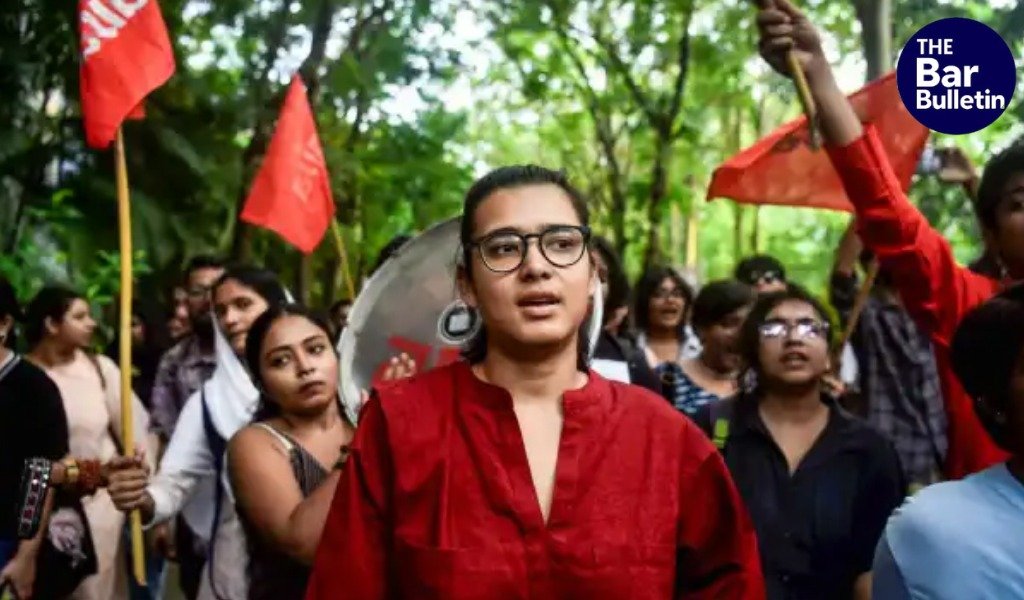

The Delhi High Court on Thursday reserved its judgment on a plea filed by All India Students’ Association (AISA) president Neha Bora challenging a police notice requiring her to furnish a bond to maintain peace following her detention during a protest in New Delhi. The judgment is scheduled to be pronounced on Friday, October 23, at 6 PM.
Justice Subramonium Prasad heard detailed arguments on the legality of preventive proceedings initiated against Neha Bora under Sections 126 and 130 of the Bharatiya Nagarik Suraksha Sanhita (BNSS). The arguments were advanced on the following questions:
● whether the notice disclosed sufficient material to justify apprehending a breach of peace,
● whether the Executive Magistrate had independently applied his mind before issuing it, and
● whether the statutory provisions could be invoked together at the show-cause stage.
Appearing for Neha Bora, Senior Advocate Gopal Sankaranarayanan and Advocate Abhik Chimni argued that the notice failed to meet the statutory requirements and that preventive powers could not be exercised mechanically against a person for participating in a peaceful protest. The State, represented by Additional Solicitor General Chetan Sharma, defended the proceedings, contending that the Magistrate had examined the police report, general diary entries and other material before forming an opinion that preventive action was necessary.
Notice Does Not Disclose Material Justifying Preventive Action: Sr Adv Gopal Sankaranarayanan
Mr Sankaranarayanan submitted that the challenge was confined to the legality of the notice and the requirements of Sections 126 and 130 BNSS, rather than the separate issue concerning the denotification of Jantar Mantar as a protest site.
Describing the matter as a narrow legal question, he argued that the notice did not disclose the substance of the information or the material on which the authority had formed an opinion that Bora was likely to breach the peace. He submitted that:
“
“The first is that this notice does not meet with the essential requirements as mandated by law under Section 126. It does not meet with those requirements.”
He further contended that the notice was a mechanical reproduction of a standard format and that the Magistrate had not demonstrated the independent application of mind required before initiating proceedings. He argued that the person must be informed of the substance of the apprehension to be able to respond meaningfully. He submitted:
“
“As a recipient of a notice like this, as a citizen of India, I read this notice. I am supposed to respond. I ask myself, to what? You apprehend that I will breach the peace. How do I respond to this? What am I expected to say? What is the substance on the basis of which you arrived at this conclusion, considering it is a stand-alone notice? It is that before you issue this notice to me, you need to show what are the parameters on the basis of which you satisfied yourself that such a notice must go. That material is essential and there is not one.”
‘There Has Never Been Any Exhortation To Violence’: Mr Sankaranarayanan On Neha Bora’s Protest Call
On the factual matrix, Mr. Sankaranarayanan submitted that Neha Bora, as AISA president, had participated in peaceful protests and called for a gathering at Mandi House on October 16, following a press conference the previous day. Referring to her social media post describing Jantar Mantar as a symbol of resistance and stating that “today all of Central Delhi has become Jantar Mantar,” he argued that the post contained no incitement to violence, violation of law, or attempt to disturb public tranquillity.
“
“There is no question of incitement to violence. There is no question of breaking any law. There is no question of attempting to breach peace at all. There is no question of upsetting public tranquillity. There is no question of inviting congregations in order to commit any offence, whether cognisable or otherwise. The only thing that happened is that she and some others raised some slogans. That’s all. The entirety of raising slogans is what this arose out of. And she was detained.”
He also sought to distinguish Bora’s gathering from a separate call for a protest at Connaught Place’s Central Park, which he said had been organised by CJP.
He further raised concerns about the circumstances of her detention, alleging that protesters were taken to police stations without being allowed immediate contact with lawyers or family members. He invoked Article 22 of the Constitution in support of his submissions concerning procedural safeguards.
Sections 126 And 130 Must Be Read Together: ASG Chetan Sharma Argues
Opposing the plea, Additional Solicitor General Chetan Sharma submitted that Sections 126 and 130 BNSS operated together within the statutory scheme for preventing breaches of peace. He argued that separating the provisions would undermine the purpose of preventive proceedings. Section 126 empowers the Executive Magistrate to initiate proceedings where there is a likelihood of breach of peace, while Section 130 prescribes the requirements of the written order, including the substance of the information received and the proposed bond conditions. He contended that treating the provisions as disconnected would undermine the legislative purpose of preventive action. He submitted:
“
“And I am firm and humble in my submission that 126 and 130 ride together. They are not disjunctive, they ride together in a scheme of prevention which is echoed by the seven-bench judgment of Madhu Limaye to say there is a likelihood of breach of peace and public tranquillity. So therefore, the aspect of an individual being prejudiced must give way to the larger and the more statutorily ingrained and defined aspect of public tranquilly and peace. And that is why if it is sought to be infracted, if there is a likelihood that somebody may commit within the jurisdiction or outside the jurisdiction, 126 kicks in with 130.
If you disjoint them, then the entire raison d’être of the two sections, of what the legislature intended, vanishes. Because such technical splitting between 126 and 130 will take away the essence of public tranquillity and breach of peace.”
Opposing the challenge to the notice issued to Neha Bora, the ASG submitted that the Magistrate had considered the police report, general diary entries and previous FIRs before initiating proceedings. He argued that the need to prevent a potential breach of peace must be assessed in the context of the statutory framework, rather than by technically separating the two provisions.
He argued that the statutory objective was to prevent a likely disturbance of public peace and that the law required the authorities to consider the apprehended consequences rather than wait for a breach to occur.
He also disputed the contention that the proceedings had been initiated without material or independent consideration by the Executive Magistrate. Referring to the record, he submitted that the Magistrate had considered the police report, general diary entries and details of previous FIRs, and had also examined the investigating officer before issuing the notice.
According to the State’s submission, the record reflected more than a mechanical endorsement of the police report. Sharma argued that the material had been examined and that the Magistrate had independently applied his mind before issuing the notice.
The Court sought clarification on the material that had been placed before the Magistrate and whether the documents relied upon by the State were available to the petitioner. ASG acknowledged that the Kalandra and other documents had not been given to her. The Court directed the State to provide them
ASG further argued that the case was not one in which there was no material whatsoever, describing it as a case involving substantial material supporting the preventive action.
He also relied on the geographical restrictions applicable to parts of central Delhi. Referring to the map and the relevant notification, he disputed the contention that the area in which Bora had been stopped was outside the notified zone. He nevertheless maintained that Section 126 could operate independently of a prohibitory order under Section 163 BNSS.
On the statutory scheme governing preventive proceedings, including Sections 126, 130, 131, 133 and 135 BNSS and the requirement that a written order set out the substance of the information received and the subsequent inquiry into the truth of that information, the Court questioned whether the notice and the material underlying it demonstrated the requisite application of mind.
The Court asked counsel to explain the effect of Section 135(3) on the requirement of a bond in proceedings initiated under Section 126. Section 135(3) BNSS deals with an interim bond during an inquiry, whereas Section 126 deals with initiating proceedings to require a person to show cause why they should not furnish a bond to keep the peace.
Mr Sankaranarayanan argued that the statutory scheme required the Magistrate to disclose the substance of the information at the notice stage and that reasons could not subsequently be supplied to cure a defective notice. The State, on the other hand, relied on the record to contend that the Magistrate had independently considered the material before proceeding.
After hearing the submissions from both sides, the Delhi High Court reserved its verdict on Neha Bora’s plea, scheduling the pronouncement for October 23, 2026, at 6 PM.