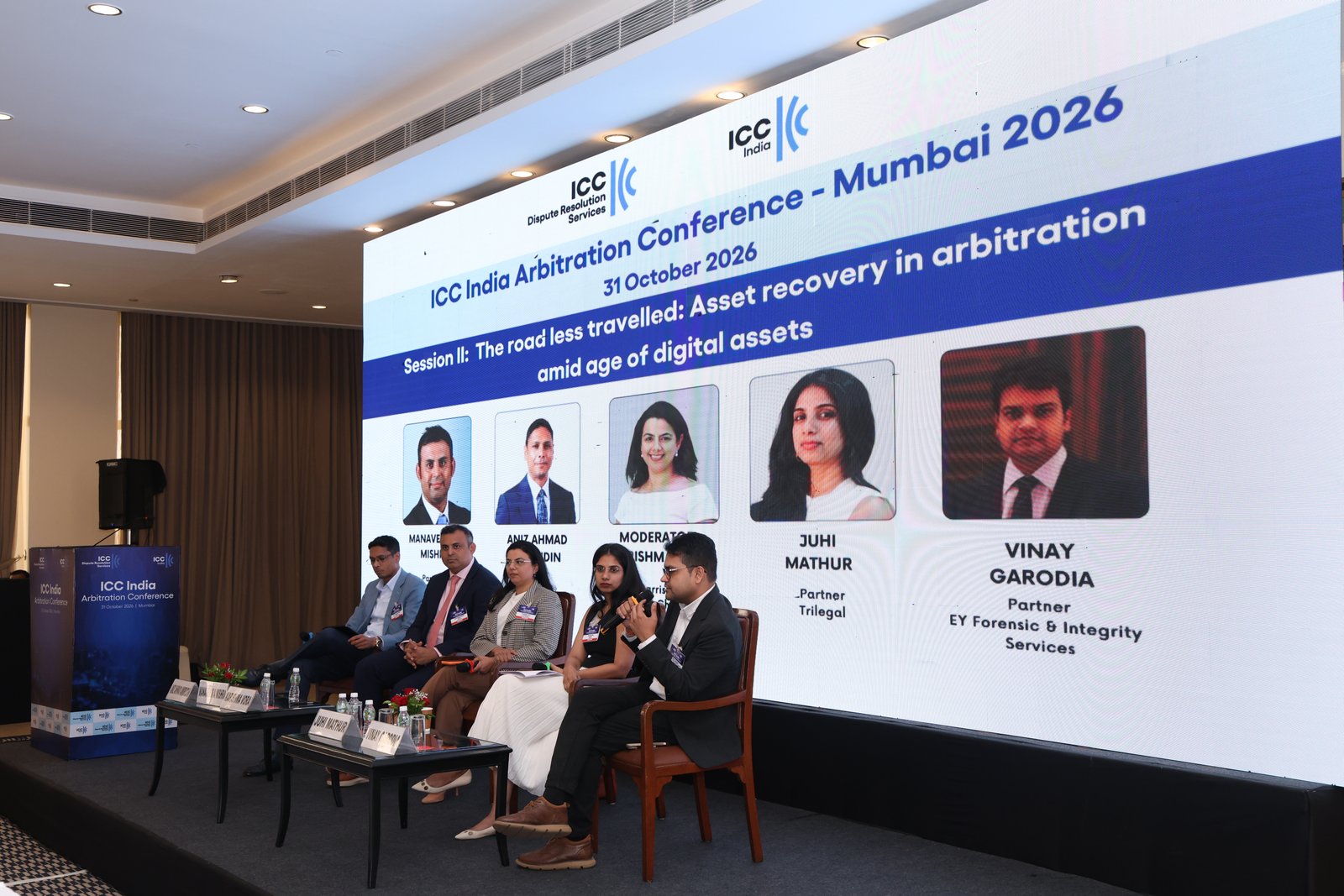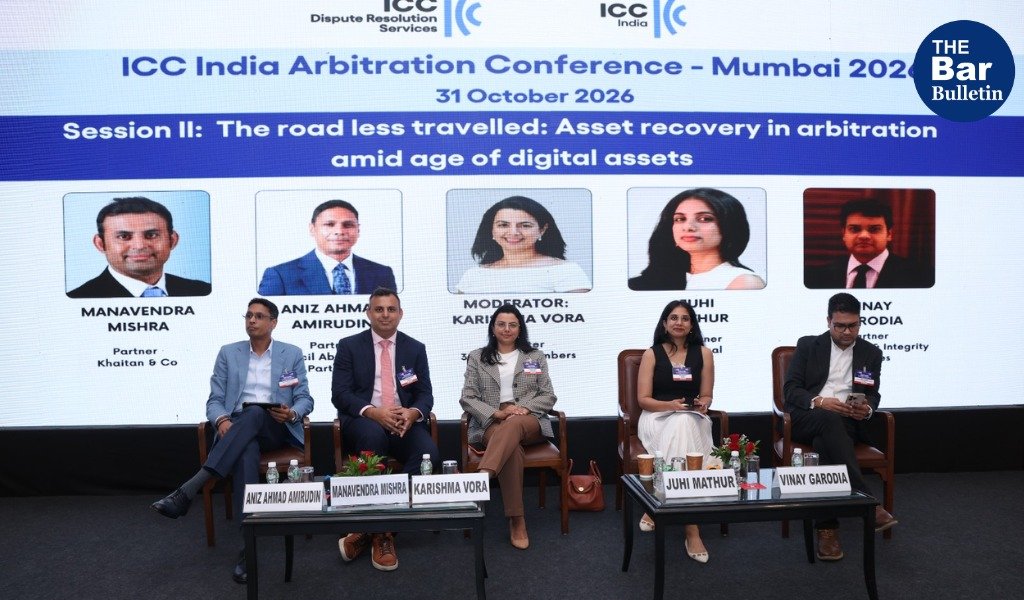

The challenges of tracing, identifying and preserving digital assets in cross-border disputes came under discussion at the ICC India Arbitration Conference, Mumbai 2026, during Session II titled “The Road Less Travelled: Asset Recovery in Arbitration Amid Age of Digital Assets”.
Moderated by Karishma Vora, Barrister, 39 Essex Chambers, the session featured Aniz Ahmad Amiruddin, Partner, Cecil Abraham & Partners; Manavendra Mishra, Partner, Khaitan & Co.; Juhi Mathur, Partner, Trilegal; and Vinay Garodia, Partner, EY Forensic & Integrity Services.
The discussion examined how conventional asset-recovery mechanisms can be adapted to disputes involving cryptocurrencies, digital wallets, exchanges and other intangible assets, particularly where assets can be transferred across borders within minutes.
Juhi Mathur discussed the potential of disclosure orders, including Norwich Pharmacal-type relief, to identify individuals behind digital transactions. Drawing on the use of such orders in cases involving impersonation and infringement of personal rights, she questioned why similar principles could not be extended to digital-asset disputes to obtain information from intermediaries and platforms.
Aniz Ahmad Amiruddin addressed the practical difficulties of identifying and tracing digital assets. He highlighted the importance of establishing the location of assets, identifying the relevant wallets and exchanges, and understanding the movement of funds. The discussion also brought out the challenges arising when a party disputes ownership or denies holding the assets sought to be recovered.
Manavendra Mishra examined the difficulties surrounding asset preservation and interim relief in digital-asset disputes, including the need to secure effective remedies before assets are dissipated or transferred. The discussion considered how legal remedies must respond to the speed and mobility of digital transactions.
Vinay Garodia brought the forensic perspective to the discussion, explaining how experts can assist lawyers in identifying and interpreting digital footprints. He emphasised the importance of gathering information from cryptocurrency exchanges as well as electronic devices, transaction records and other sources. He also highlighted the importance of maintaining confidentiality during investigations so that the opposing party does not become aware of the evidence being gathered.
The discussion further examined the availability of emergency relief and freezing orders in arbitration. The panellists considered the difficulties in preserving digital assets pending the outcome of substantive proceedings, particularly where the assets are held through exchanges or transferred between multiple wallets.
On the question of jurisdiction, Juhi Mathur discussed the difficulties in determining the appropriate jurisdiction for disputes involving assets that exist entirely in a digital environment. Referring to the Indian position under Section 9 of the Arbitration and Conciliation Act, 1996, she discussed the significance of connecting factors such as the user’s location, the platform through which the assets are accessed and the banking arrangements involved in the transactions.
The panellists also explored the challenges of tracing assets through multiple transactions and identifying the individuals who initially received the funds, as distinct from subsequent recipients who may have had limited involvement in the underlying wrongdoing.