
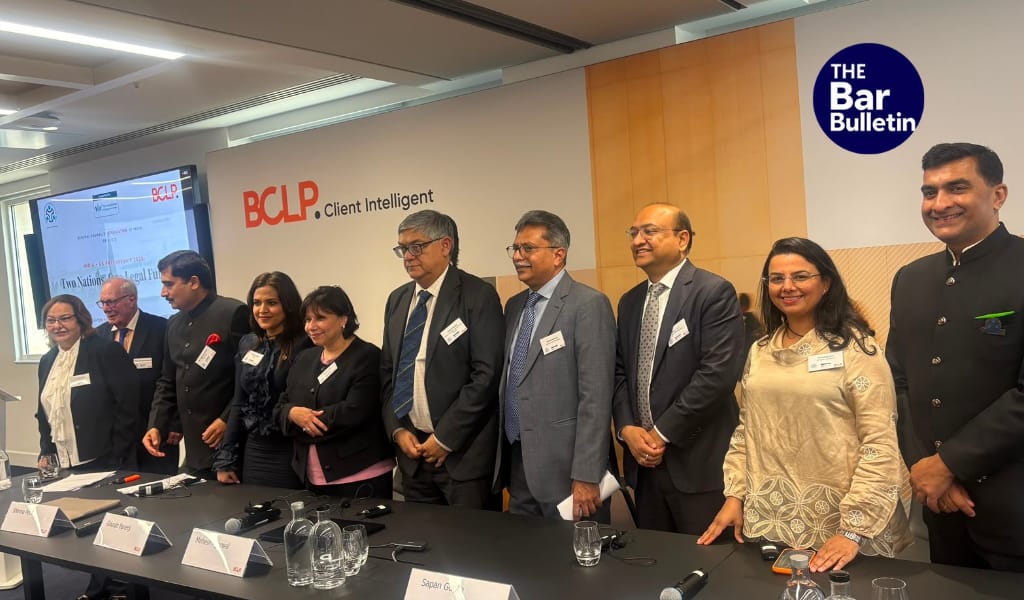

The second session of the conference, titled “Dispute Resolution 2.0: Arbitration, Mediation and Technology in a Digital Economy,” brought together leading practitioners from India and the United Kingdom to examine how dispute resolution frameworks are evolving in response to global commerce, technological disruption, and shifting user expectations.
The session was part of the conference, “Two Nations, One Legal Future – India–UK Partnership 2026,” jointly organised by the General Counsels’ Association of India (GCAI), Bryan Cave Leighton Paisner LLP (BCLP), and the Law Society of England and Wales. Moving beyond conventional comparisons, the discussion focused on cross-learning, enforcement realities, regulatory barriers, and the future trajectory of dispute resolution mechanisms.
The session was co-moderated by Ms Shivani Sanghi, Partner at Bryan Cave Leighton Paisner, and Ms Sherina Petit, Partner and Head of International Arbitration and India Practice at Stewarts Law. The panel comprised:
• Mr Gourab Banerji, Senior Advocate, Supreme Court of India;
• Mr Sapan Gupta, Group General Counsel at ArcelorMittal Group;
• Mr Mahesh Agarwal, Managing Partner at Agarwal Law Associates, and
• Ms Karishma Vora, Barrister and Arbitrator at 39 Essex Chambers
“India must learn discipline, but London must learn adaptability” – Gourab Banerji
Mr Gourab Banerji opened the discussion on cross-jurisdictional learning by highlighting structural and cultural differences between the Indian and English systems. He pointed to London’s procedural discipline, particularly in arbitration, where strict timelines, limited filings, and focused hearings ensure efficiency. In contrast, Indian proceedings often suffer from procedural excess and a lack of time control.
At the same time, he cautioned against viewing the English system as inherently superior. Indian lawyers, he argued, bring a distinct advantage in their ability to think on their feet and adapt dynamically in courtrooms that are often unpredictable and high-volume. He said:
“
“I think India can certainly learn from London’s discipline in managing proceedings, where timelines are respected, and hearings are tightly controlled. But equally, Indian lawyers operate in a far more demanding environment, handling multiple matters a day, which gives them a sharpness and adaptability that is not always seen in more structured systems.”
“Without real costs, there is no deterrence against frivolous litigation” – Mahesh Agarwal
Mr Mahesh Agarwal focused on one of the most pressing structural issues in the Indian legal system: the absence of a robust costs regime. He explained that historically, litigation in India has been inexpensive, which has encouraged parties to pursue weak or strategic claims without meaningful financial risk.
He stated that the lack of cost consequences has led to a culture where litigation is used as a delaying tactic, particularly in enforcement matters. While legislative provisions for awarding costs exist, they are rarely implemented in practice. He said:
“
“In India, even after prolonged litigation, the usual outcome is that each party bears its own costs. This creates a situation where there is no real deterrence against filing weak or frivolous claims, because there is simply no financial consequence to losing.”
He noted that concepts such as security for costs and adverse cost orders, which are well established in England, are only beginning to emerge in India. For meaningful reform, he stressed the need not just for legislative change but for a shift in judicial mindset.
“Costs must be reasonable and proportionate if they are to work as a system” – Karishma Vora
Building on this, Ms Karishma Vora examined the role of costs in reducing pendency and improving efficiency. She emphasised that while India has the framework to award costs, its inconsistent application undermines its effectiveness. She highlighted that in England, the principle of proportionality ensures that legal costs are aligned with the value and complexity of disputes, thereby creating a fair and predictable system. She added:
“
“So long as legal costs are reasonable and proportionate to the dispute, there is no reason why courts should not require the losing party to compensate the successful party. That is how the system becomes self-regulating and discourages unnecessary litigation.”
Beyond costs, she proposed mediation as a critical tool to address case backlog, noting that jurisdictions like Australia have successfully reduced pendency through mandatory and structured mediation frameworks. She also suggested exploring part-time judicial appointments for senior practitioners to address systemic capacity constraints.
“We cannot ignore reality: third-party funding exists, so regulation must follow” – Gourab Banerji
The discussion then turned to the controversial issue of success fees and third-party funding. While Indian law continues to prohibit lawyers from taking a stake in the outcome of disputes, Mr Banerji argued that the market has already evolved beyond this formal restriction. He pointed out that third-party funding arrangements are increasingly common, effectively introducing contingency-based economics into dispute resolution, albeit indirectly. He added:
“
“The architecture for success-based arrangements already exists through third-party funding. We cannot pretend otherwise. The real question is whether we regulate this reality or continue to ignore it while it operates in the background.”
This view was met with some resistance from other panellists, reflecting the broader tension between maintaining the traditional character of the legal profession and adapting to commercial realities.
“Enforcement is where arbitration succeeds or fails” – Sapan Gupta
From a corporate perspective, Mr Sapan Gupta brought the conversation to what he described as the most critical stage of dispute resolution: enforcement. He highlighted that while arbitration frameworks may appear robust on paper, their effectiveness ultimately depends on the ability to enforce outcomes.
He pointed to practical challenges such as asset tracing, jurisdictional arbitrage, and delays, which often undermine the value of arbitral awards. “In reality, enforcement is the biggest challenge in arbitration. By the time you reach that stage, assets may have been moved, structures altered, or jurisdictions chosen specifically to delay recovery, making the entire process far more complex.”
He noted that as a result, companies are increasingly focusing on pre-dispute strategies, such as asset ring-fencing and jurisdictional planning, rather than relying solely on post-award enforcement mechanisms.
“India is becoming more enforcement-friendly, but perception still lags” – Gourab Banerji
Mr Banerji offered a more optimistic view on enforcement in India, particularly with respect to foreign awards. He observed that while older cases contributed to a perception of delay and resistance, recent trends indicate a shift towards a more pro-enforcement approach. He noted:
“
“There are two categories today: legacy cases that have been stuck for years, and recent cases where enforcement is actually moving much faster. Courts are increasingly aligned with the New York Convention framework and are generally supportive of enforcement.”
He emphasised that while the number of enforcement cases remains relatively small, the consistency and speed of recent decisions suggest that India is moving in the right direction.
“The Indian legal market cannot remain closed if India wants to be a global economy” – Sapan Gupta
On the liberalisation of the Indian legal market, Mr Sapan Gupta expressed strong frustration with the current regulatory framework, arguing that it is out of step with India’s broader economic ambitions. He noted that despite reforms introduced by the Bar Council of India, foreign lawyers remain largely restricted from practising Indian law or advising Indian clients. He stated:
“
“We cannot aspire to be a global economic power while keeping our legal market closed. Every other sector has been opened up, but legal services continue to operate in isolation, which does not align with the country’s broader vision.”
He also highlighted the benefits of opening the market, including knowledge transfer, increased competition, and greater exposure for Indian lawyers on the global stage.
“Mediation can succeed, but only if it is structured and credible” – Mahesh Agarwal
Turning to the future of dispute resolution, Mr Agarwal emphasised the potential of mediation in India, particularly in reducing court backlog and providing faster outcomes for commercial disputes. However, he cautioned that for mediation to succeed, it must be supported by strong institutional frameworks and safeguards against misuse. He added:
“
“Mediation can be extremely effective in India, but it must be properly structured, with credible mediators and clear enforcement mechanisms. Without that, there is a risk that it could be misused or fail to inspire confidence among parties.”
He also stressed the importance of enforceability, noting that the success of mediation depends on whether its outcomes are treated with the same seriousness as arbitral awards.
“AI is already here, the real question is how far we allow it to go” – Karishma Vora
The panel concluded with a forward-looking discussion on the role of technology and artificial intelligence in dispute resolution. Ms Vora highlighted that while AI is already being used in areas such as document review and small-value dispute resolution, its integration into core adjudicatory functions remains limited. She pointed to ongoing debates around transparency, disclosure, and the extent to which AI-assisted outputs should be relied upon in legal proceedings. She said:
“
“AI is already being used in dispute resolution in various forms, but the real question is where we draw the line, particularly when it comes to decision-making, independence, and accountability.”
She noted that while AI-driven arbitration for low-value disputes is becoming more common, widespread adoption in complex disputes will depend on how courts respond to enforcement and due process concerns.
The session highlighted that dispute resolution is at a critical inflection point. While arbitration continues to dominate cross-border disputes, its effectiveness is increasingly being questioned in light of enforcement challenges, rising costs, and procedural delays. At the same time, mediation and technology are emerging as viable alternatives, though both require careful structuring and regulatory clarity.
Perhaps the most striking takeaway was the recognition that reform is not merely technical but cultural. Whether it is the adoption of cost regimes, openness to foreign participation, or acceptance of technological tools, the future of dispute resolution will depend as much on mindset as on legal frameworks.