

Introduction
Delhi’s air pollution crisis is no longer seasonal or episodic: it is structural. For several months each year, the city records PM2.5 and PM10 levels far exceeding WHO safety thresholds, triggering respiratory illnesses, cardiovascular complications, and long-term public health consequences. While policy responses have ranged from GRAP restrictions to odd-even schemes, citizens have increasingly turned to air purifiers as a last line of defence; especially households with children, the elderly, and those with respiratory conditions.
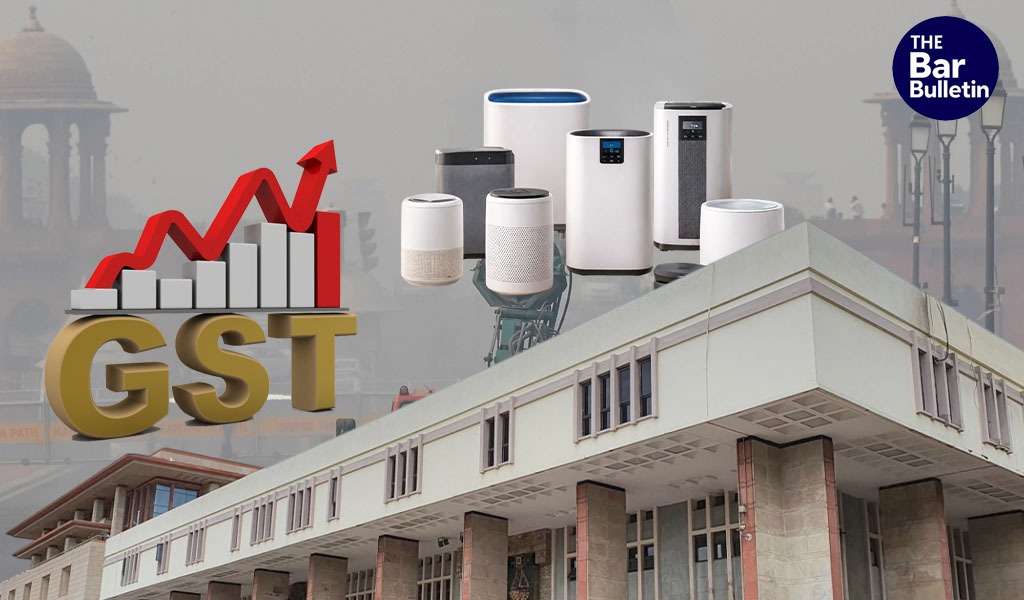
Yet, air purifiers remain taxed at 18% GST, placing them firmly in the “luxury electronics” bracket rather than essential health equipment. This classification has now come under judicial scrutiny, reopening a deeper debate on how India’s indirect tax regime responds to environmental and public health emergencies.
The Petition in Delhi High Court
The present litigation before the Delhi High Court was filed by Advocate Kapil Madan, represented by Senior Advocate Arvind Nayar. It highlights the incongruity between Delhi’s public health emergency and the tax treatment of air purifiers.
Speaking to The Bar Bulletin Team, Senior Advocate Arvind Nayar quoted that “Given the situation in the NCR, this is an issue of critical importance”.
The petition before Delhi High Court argues that air purifiers perform a preventive, physiological-support function equivalent to other devices already taxed at 5%, and that continuing to levy 18% GST is arbitrary, disproportionate and violative of Article 21 (right to life and clean air).
It emphasises that in conditions of “extreme emergency crisis” due to air pollution in Delhi-NCR, treating air purifiers as luxury goods creates financial inaccessibility and denies effective access to a life-protective device, failing the constitutional test of intelligible differentia under tax law.
The petition framed access to clean indoor air not as a lifestyle choice, but as a public health necessity, particularly in a city officially acknowledged as one of the most polluted capitals in the world. It calls for policy re-evaluation of GST classifications in light of environmental realities and right-to-health considerations.
“We are confident on the legal proposition that Air purifier qualifies as a medical device and will be putting forth our arguments in support thereof,” petitioner Advocate Kapil Madan said, adding, “We are also hoping that the government may take a considerate view on this situation looking at the gravity of the issue involved.”
The Court’s Directive to GST Council
On 24 December, a Division Bench comprising Chief Justice Devendra Kumar Upadhyaya and Justice Tushar Rao Gedela, in a strongly worded order, termed air purifiers as “medical devices” in the prevailing environmental context and directed the GST Council to convene a meeting and decide the issue of lowering or abolishing of GST on air purifiers (and HEPA filters), explicitly calling the air quality situation an “emergency”.
The Bench made a strong normative statement: if the State cannot provide clean air, the minimum it can do is reduce or waive GST so that citizens can access purifiers, even if the tax relief is temporary.
While formally deferring to the GST Council’s policy domain, the court has indicated a prima facie view that, considering the February 2020 medical device notification and the function performed by air purifiers, there is no apparent reason why they should not be taxed at the 5% medical device rate.
The order is significant not for what it mandates, but for what it reframes: pollution mitigation devices as part of the health ecosystem.
Speaking to the Bar Bulletin team, Ms Anuja Pethia, Managing Partner, Swarnim Legal said that “The Delhi High Court’s decision clearly reflects the urgent public health emergency unfolding in the NCR region, where we are all inhaling toxic air daily. The Court has shown commendable restraint, placing this critical issue front and centre for the GST Council without crossing the boundary of judicial activism and interfering in the policy domain of the executive. The rational taxation of air purifiers will make them accessible and have positive public health outcomes. The GST council should consider the suggestion in the right spirit.”
Government Response
Sources within the Union government indicate the position that air purifiers currently fall in the 18% GST bracket applicable to most electronic appliances, and that it is not feasible to unilaterally lower tax for one item outside the collective GST Council framework.
Government representatives have signalled that any change must be deliberated and decided in a GST Council meeting chaired by the Union Finance Minister, with all States participating, and that such a proposal can be considered in an upcoming meeting rather than as a suo motu, one-off exception.
This response reflects both a legal-structural constraint (cooperative federalism under GST) and a political concern about opening the floodgates for similar demands from other sectors claiming “essential” status.
While the statement reflects procedural openness, there is no substantive commitment. There is an institutional tension here: GST is built on the idea of cooperative federalism, and any reduction must pass through the ritual of Council deliberation, state negotiation and precedent-setting concern. Yet this legal caution also reveals a deeper friction between a tax system designed for normalcy and a city that has run out of normal days.
Impact of a GST Reduction
Analytically, a move from 18% to 5% GST (or a temporary exemption) would have multi-layered market effects.
A straight cut from 18% to 5% would reduce end-consumer prices by roughly 11–13% in effective terms, depending on pass-through and margins. For mid-range purifiers widely sold in Delhi (often in the ₹10,000–₹25,000 band), this could mean a tangible saving of ₹1,500-₹3,000 per unit, potentially making entry-level models accessible to middle-income households that currently defer purchase.
Lower prices are likely to expand the market beyond affluent early adopters, increasing penetration into Tier-II/Tier-III cities in the Indo-Gangetic belt where winter smog is now structurally recurring.
In the short term, a tax-cut announcement could trigger a spike in purchases (especially during peak pollution months), while in the medium term it may accelerate product innovation at lower price points as volumes rise and competition intensifies. Reduced GST could incentivise domestic manufacturers under “Make in India,” helping shift air purifiers from imported premium products to mass-market health devices.
From a fiscal perspective, the absolute GST revenue from air purifiers is relatively small compared to the health and productivity losses caused by pollution; a well-targeted reduction could be defended as a corrective, health-oriented fiscal measure rather than a mere concession.
Public Response
Public sentiment has moved faster than the law. On social media and in comment sections, there is broad approval of the Court’s blunt directive, because it says aloud what many have felt for years: that the State cannot outsource its failure to citizens and then tax them for self-defence. Some internet users are framing the order as a long-overdue acknowledgment that Delhi’s air crisis is effectively a “slow, invisible lockdown”.
Environmental activists and health experts have welcomed the court for using taxation as a lever to operationalise the right to life and clean air, while cautioning that purifiers cannot substitute structural pollution control measures. Several public figures and civil society voices have argued that if items like masks and sanitisers could be temporarily tax-rationalised during COVID-19, air purifiers merit similar treatment during a persistent air-quality crisis.
Some politicians are using this case to attack the government for not doing enough, while others are warning that making a one-off tax cut like this could open the floodgates for many industries to ask for similar special breaks.
A Closer Look
The broader public sentiment reveals a quiet frustration. For many Delhi residents, air purifiers are seen as forced purchases, not aspirational gadgets. There is growing resentment that citizens must pay extra tax to protect themselves from a failure of environmental governance.
There is a widening perception gap between those who can afford high-quality purifiers and air-tight homes, and those who cannot, leading many citizens and civil society groups to view tax relief on purifiers as a distributive justice issue, not just a pricing debate.
At the same time, to normalise air purifiers as medical devices is, in one sense, an act of honesty: it names the crisis for what it is and tries to make survival equipment less expensive. However, a significant section of the public expresses discomfort with “normalising” purifiers as the solution, arguing that easier access to purifiers risks shifting focus away from controlling emissions at source, similar to treating bottled water as a replacement for safe public drinking water.
Overall, public sentiment appears to favour a two-track approach: treating air purifiers as essential, quasi-medical devices during high-pollution periods (including via lower GST), while insisting that governments remain primarily accountable for structural air-quality improvements rather than outsourcing the right to breathe to private gadgets.
Conclusion
The Delhi High Court’s directive places the government at a crossroads. This is not merely about GST rates; it is about whether India’s tax policy can adapt to lived realities. Treating air purifiers as luxury electronics in a city gasping for breathable air risks normalising environmental harm as a private inconvenience rather than a collective failure.
The Court has scheduled the next hearing on 26 December. If the GST Council meaningfully engages with this issue, it could set an important precedent: that fiscal policy, like constitutional law, is more about the people’s lungs than the treasury’s.