
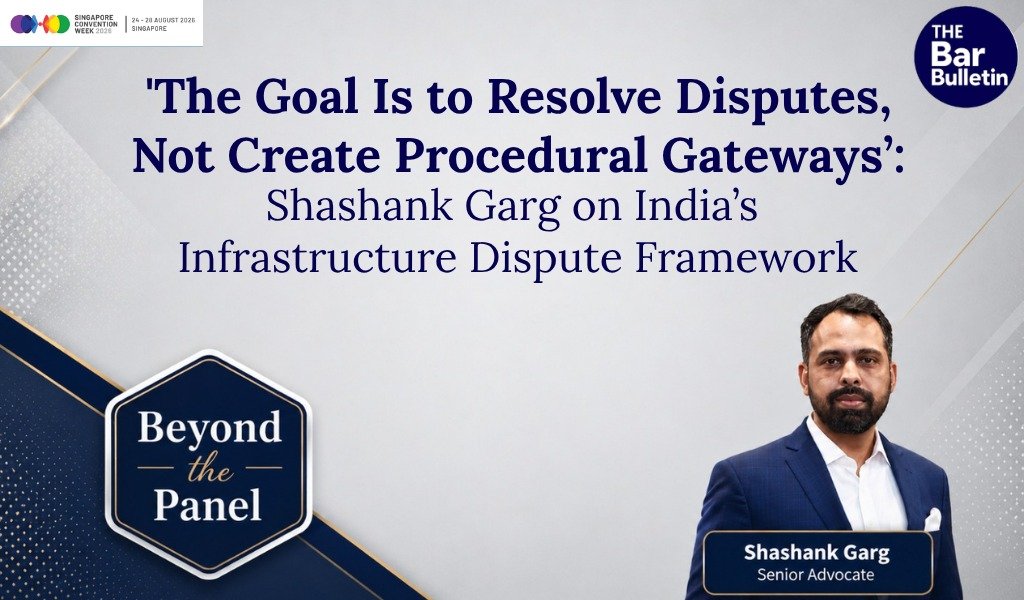

Senior Advocate Shashank Garg recently participated in a panel discussion titled “The Road to $5 Trillion: Is India’s infrastructure dispute resolution keeping pace? Measures warranted and lessons from comparable economies, including Singapore,” held during Singapore Convention Week 2026.
The discussion examined whether India’s dispute-resolution framework is equipped to support the country’s infrastructure ambitions, with the panellists discussing arbitrator appointments, institutional arbitration, delays, government litigation and the economic consequences of prolonged disputes.
In this Beyond the Panel conversation with The Bar Bulletin, Sr Adv Shashank Garg reflects further on what India needs to change if its dispute-resolution system is to keep pace with the scale and complexity of its infrastructure growth.

1. If India is serious about building infrastructure at the scale required to reach a $5 trillion economy, should dispute resolution be treated as part of infrastructure policy itself rather than as something that comes into play after a project goes wrong? What would that shift look like in practice?
India is not only serious but committed to building infrastructure at the scale commensurate with a $5 trillion economy. This commitment is evident from various initiatives undertaken by the Government of India and, most recently, the allocation of ₹12.2 lakh crore for infrastructure development in the 2026 Budget (i.e approximately 22.8% of the total estimated government expenditure). With such a massive infrastructure development roadmap, disputes are a natural by-product, and it is therefore imperative that they are avoided in the first place and managed effectively once they arise.
“
Every large project inherently carries claims and dispute risks from the day it is bid for.
The mistake is to treat dispute resolution as something that begins once the project has gone wrong. It has to be built into the infrastructure project from the outset, in the same way that financing, risk allocation and project governance are built into it. The question is therefore not simply whether a contract contains an arbitration clause. It is whether the contract has been designed to identify, manage and resolve disputes at the earliest appropriate stage.
Infrastructure policy thus requires a systematic overhaul that caters for both dispute avoidance and a dispute-resolution mechanism designed to ensure that disputes do not unnecessarily escalate. This would include having standardised dispute boards constituted at the commencement of the project itself, which would be empowered to issue decisions on disputes arising during the pendency of the contract within a weekly window. Such decisions must be binding unless and until revised. While some of this exists on paper, we have not been able to incorporate it effectively in practice. Strict reliance on the FIDIC principle of “pay now and argue later” can be the single highest-leverage reform, converting a claim from an existential cash-flow crisis into a routine commercial issue.
The same principle should apply to the project-level decision maker. In most cases, it is the project head or the engineer in charge who is well conversant with the nuances of the project at hand and the reality of the dispute that may be brewing. If his decision-making is insulated from excessive vigilance and audits, it is quite likely that many issues will be managed by them before they spiral into a full-fledged dispute. The same set of insulation and/or protection must also be accorded to the officers who get the opportunity to look at the dispute from a legal standpoint and are permitted to settle it at the outset without the fear of consequences.
There should also be greater emphasis on resolving a dispute at the lowest appropriate level. Project-level disputes can be taken to a dispute board. Mediation or conciliation can be used where there is a genuine possibility of a commercially viable settlement. Arbitration should ultimately remain available where a binding adjudicatory determination is required. The important point is that these mechanisms should be designed to resolve disputes, and not merely become successive procedural gateways before the parties can reach the final adjudicatory forum.
Lastly, finality should be treated as a matter of policy. Acceptance of DAB decisions and arbitral awards should be the norm, and challenging an award or a decision of the dispute board should be the exception, based on cogent reasons recorded at the highest level of decision-making.
The recent shift in policy by the Government towards relying on mediation much more than arbitration, particularly in high-stakes disputes, cannot per se be faulted on paper. However, in effect, unless the above-mentioned overhaul is undertaken, the mediation policy may meet the same fate as arbitration, not just for the Government but also for contractors. This would ultimately lead to the clogging of courts and, more importantly, the blocking of the flow of money that is essential to the next cycle of infrastructure development.
2. You have argued that taking arbitrator appointments away from parties and placing them with courts or arbitral institutions could restore confidence in arbitration. If we made that change, what other features of India’s arbitration ecosystem would need to change alongside it for India to genuinely compete with jurisdictions such as Singapore?
“
Arbitration as a concept hinges on party autonomy, and thus any idea of restricting or curtailing such autonomy may, at first blush, appear to be an antithesis to arbitration.
However, there is sufficient reason and logic to the argument being made. One has to understand the scope and ambit of party autonomy in the context of arbitration.
It begins at the stage where parties choose to resolve their disputes through a system that is an alternative to traditional court litigation. Once this choice is made, they get to choose whether any prospective dispute shall be resolved through an institution or not. If through an institution, they get to decide which one is most suited to their needs.
Further, parties get a choice as to the law applicable to the contract as well as the law applicable to the arbitration agreement. They also get to choose the seat and venue of the arbitration. Party autonomy also extends to the procedure that would be followed for the adjudication of the dispute by the arbitral tribunal.
The proposed restriction on party autonomy concerns only one aspect of the freedom that parties enjoy which is the procedure for appointing the arbitral tribunal. In this regard, the restriction that is being discussed does not take away the choice of the number of arbitrators or the suitable qualifications that the arbitrators must possess to be chosen to sit on their dispute. The question is therefore not whether parties should lose the ability to have arbitrators with the qualifications and expertise suited to their dispute, but whether the process through which those arbitrators are appointed should itself be neutral.
The statistics would show that the problem is further restricted to a tribunal consisting of three or more members, where each party gets to nominate an arbitrator, and not to clauses that envisage a sole arbitrator, since parties are almost never able to agree on a name. Therefore, ultimately, the sole arbitrator is either appointed by court or by the institution, if there is an institutional arbitration clause.
The scenario in discussion has a sizeable number of ad hoc arbitrations with clauses enabling parties to choose their arbitrator, and there is a strong argument in support of this practice stemming from the concept of party autonomy. However, this subset of party autonomy has arguably done more damage to the arbitration ecosystem in India than anything else. A party often nominates an arbitrator for various considerations that are unfortunately not limited to the qualifications and expertise of such an arbitrator. Likewise, there are factors such as the expectation of repeat appointments that may cast a cloud over the neutrality of a party-appointed arbitrator.
This also has a direct bearing on the quality and perception of the arbitral process. The objective should be to have arbitrators who are appointed because of their qualifications, expertise and ability to decide the particular dispute, rather than because of their relationship with or expected future appointments from a particular party. The quality of arbitrators and the confidence of parties in their independence are therefore closely connected to the manner in which appointments are made.
If parties agree to give away this limited part of their autonomy, the arbitral tribunals appointed will invariably have no allegiance to either party and will, in future, be appointed purely on the merit of their work and without extraneous considerations. This will enhance the accountability of arbitral tribunals and will also restore the faith of parties, including the State, which is no longer as confident in the integrity of the process.
Our Arbitration Act, under Section 11, already takes care of this to a large extent, as the appointment of an arbitrator can be made either by the court or by any institution delegated with such power by the court.
Lastly, it is not my argument that there should be a statutory restriction on parties wanting to nominate their arbitrators, but rather a voluntary shift in how arbitration clauses are drafted, ensuring that the process of appointment of the tribunal itself is neutral by agreeing for the same to be undertaken in an institutional manner.
3. Infrastructure disputes can lock up enormous amounts of capital while projects, contractors and governments wait for final resolution. If you had the power to introduce just one reform tomorrow to make India’s infrastructure dispute-resolution system more commercially effective, what would it be and why that reform over all others?
The Indian Arbitration and Conciliation Act is a very dynamic legislation and has seen remarkable reforms brought in 2015 and 2019, with the very same objective of ensuring that the dispute-resolution system is commercially viable as well as effective.
One such reform was to do away with the automatic stay on an arbitral award merely because the award is challenged. This was an important reform. The post-award stage can itself become a prolonged second phase of litigation through Sections 34 and 37. For an infrastructure contractor whose working capital remains locked during such proceedings, the commercial value of a favourable award may remain unrealised for years.
It is essential that the capital it recycles is not blocked in the dispute resolution system for the better part of a decade.
“
Money that is blocked is the same money that is prevented from being deployed in the next contractual package.
“
This is not merely a dispute-resolution problem. It is a balance-sheet problem for the contractor, a liability problem for the Government and, ultimately, a project-bankability problem for the infrastructure sector.
The reform that I would pick is therefore to supplement this new normal by introducing statutory timelines for the execution of awards and providing for the release of deposited arbitral amounts to successful parties in a routine manner, on the basis of a corporate guarantee, unless there is a prima facie case of fraud or corruption as envisaged in the second proviso to Section 36. These reforms will ensure greater sanctity for an arbitral award, which would also mean greater accountability throughout the arbitration process. Arbitral awards would then ordinarily mean the final word on the dispute, rather than the commencement of a new stage of litigation after arbitration.