
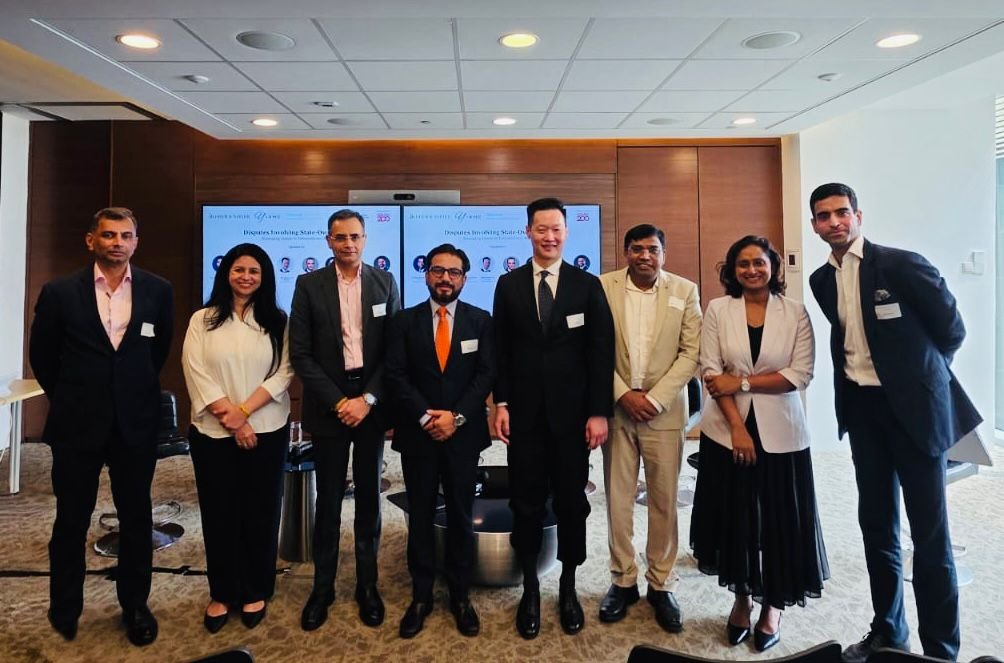
Sidharth Sethi, Partner at JSA, recently participated in a panel discussion during Singapore Convention Week 2026 on “Disputes Involving State-Owned Entities: Emerging Issues in International Arbitration.” The discussion examined the unique challenges that arise when States and State-owned entities are involved in commercial and investment disputes, including questions of attribution, jurisdictional immunity, enforcement against sovereign assets, investment treaty protection and the recovery of losses.
In this Beyond the Panel conversation with The Bar Bulletin, Sidharth Sethi takes a closer look at the evolving relationship between States, State-owned entities and private investors, and considers how dispute resolution may change as governments increasingly focus on preventing disputes rather than merely resolving them.
1. When does a dispute with a State-owned entity stop being a commercial dispute and become a dispute with the State itself?
State ownership alone does not make a State-owned entity, the State. Where a State-owned entity acts as a separate commercial entity, a contractual dispute ordinarily remains a dispute with that entity.
The position changes when the State steps in as a regulator, licensing authority, concession grantor or otherwise in the conduct giving rise to the dispute. The key question then is: whose conduct caused the harm, in what capacity, and can that conduct be attributed to the State?
This requires looking beyond ownership to the entity’s legal status, the function it performed, the authority under which it acted and the nature of the conduct. A State-owned entity does not become a State organ merely because the State owns or controls it. But its conduct may be attributable to the State where it exercises governmental authority, acts as a State organ, or acts on the State’s instructions or under its direction or control, depending on the applicable attribution rules.
This distinction can change the claim entirely: from a contractual claim against the State-owned entity to a potential claim against the State under applicable international law.
Mapping the Conduct
In practice, one of the first steps in the dispute analysis should be to map the relevant conduct:
- Which entity took the decision and in what capacity?
- What decision or conduct caused the harm?
- What legal relationship connects that conduct to the State or contractual counterparty?
- What remedy and forum are available against that respondent?
This mapping determines the respondent, cause of action, evidentiary strategy and forum. It is particularly important because the contractual forum against a State-owned entity may not extend to claims arising from a regulator or another State body. The claimant may therefore need to consider contractual, domestic and, where applicable, treaty-based remedies.
Ultimately, the question is not whether the entity is State-owned, but whether the conduct in question is legally the conduct of the State.
“
Attribution is the bridge between a commercial dispute with a State-owned entity and a claim against the State. Even then, the claimant must separately establish jurisdiction, breach, causation and loss.
2. Is India’s newer BIT policy making investor protection more predictable or simply narrower?
India’s newer BIT policy is doing both: making protection more defined, but also narrower and more conditional. The turning point came in the mid-2010s. Following a series of adverse awards, India terminated around 75 BITs in 2016–17 and adopted the more restrictive 2016 Model BIT.
The India–UAE BIT, 2024 signals a recalibration. It retains investor protection and Investor-State Dispute Settlement (“ISDS”), but defines the protected standards more precisely, while expressly preserving the State’s right to regulate through exceptions and carve-outs for areas such as taxation, procurement, subsidies and compulsory licensing.
ISDS remains, but access is more structured: Investors must first pursue local remedies for three years, making the route to international arbitration more conditional than under traditional BITs.
At the same time, India is recalibrating rather than retreating. In 2026, India is reviewing its Model BIT with a stated move towards a more investor-friendly framework. But its recent treaty practice does not suggest a return to broad, unconditional ISDS and remains cautious on ISDS:
- India’s newer agreements with the European Free Trade Association (EFTA), Oman and the UK largely keep investment protection outside their scope, and the EU–India Free Trade Agreement (signed in 2026 and not yet in force) does not provide for investor-State arbitration.
- The India–Brazil BIT goes further, relying on State-to-State mechanisms rather than giving investors a direct right to sue the State.
- The India–Kyrgyzstan and India–Uzbekistan BITs largely retain the 2016 Model BIT structure, including local-remedy requirements. They do, however, introduce modest improvements, including six-year limitation periods, full protection and security, and clearer New York Convention language to facilitate enforcement.
The direction is therefore not simply “less protection”. It is more selective, more defined and more treaty-specific protection, with greater regulatory space for the State.
For investors, that makes treaty due diligence and structuring critical: the applicable BIT, investor nationality and investment structure can determine both the protection available and the forum for resolving disputes.
3. Does that mean investors now have to plan for treaty protection at the structuring stage rather than rely on it later?
As treaty protection becomes more selective, early structuring becomes more important, not less: treaty protection is now something to be designed for, not assumed.
Protection follows structure: The investor’s nationality, corporate vehicle and ownership chain can determine whether a BIT applies, making structuring a substantive investment decision rather than merely a corporate one.
The applicable treaty determines the available toolbox: Before investing, one should identify whether the relevant treaty offers ISDS, substantive standards of protection and portfolio-investment protection, and what procedural conditions apply. India’s recent treaties show that these protections are no longer uniform.
Structure cannot easily be repaired after the dispute: Moving an investment into a treaty-protected jurisdiction once a dispute is foreseeable may invite jurisdictional or abuse-of-process objections, so the safest time to consider treaty protection is before the investment is made.
And it is not enough to ask “What protection does the BIT provide?” The investor must also ask “Who can bring the claim, against whom, before which forum, and after what procedural steps?” India’s 2016 Model BIT, for example, contains a mandatory domestic-remedies requirement.
The India–UAE BIT illustrates the point: it retains ISDS and expressly protects portfolio investments, while other recent Indian treaties take a more restrictive approach.
Plan treaty protection with everything else: Treaty planning should happen alongside tax, corporate and regulatory structuring.
“
The modern investor should conduct a treaty protection audit at the investment-design stage rather than after a dispute arises.