
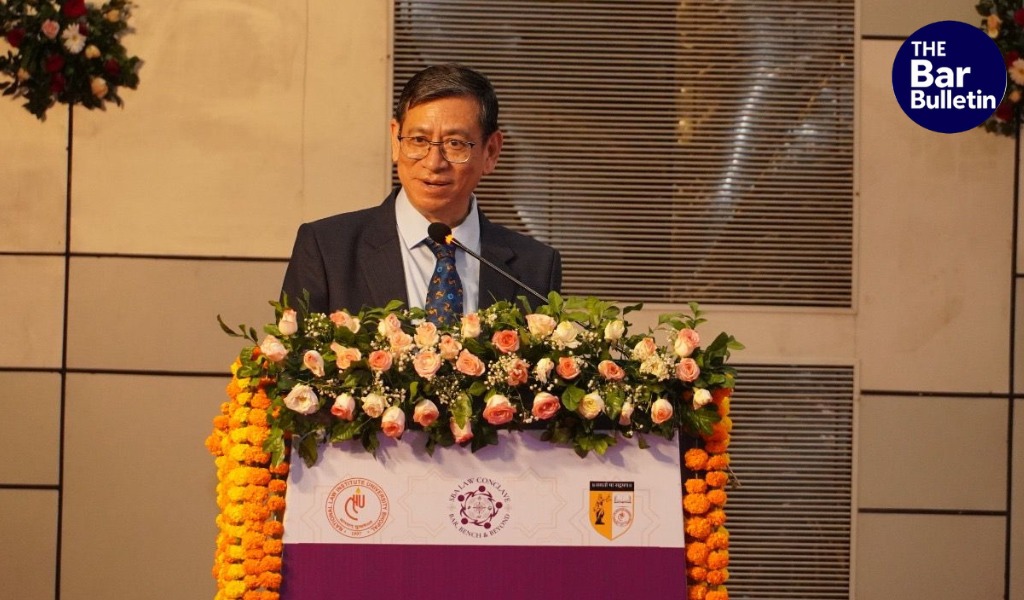

Speaking at the 4th and concluding session of the 2nd NLIU SBA Law Conclave, organised by the Student Bar Association of the National Law Institute University, Bhopal, on the theme “Beyond Colonial Hangovers: Rethinking and Reforming the Western Influence on India’s Legal System,” Justice N. Kotiswar Singh (Judge, Supreme Court of India) delivered a richly layered address that drew as freely from ancient Indian philosophy and jurisprudence as it did from the modern constitutional framework. Justice Singh made a compelling case that India’s civilisational inheritance is not a relic of the past, but a living resource for legal reform.
HMJ Kotiswar Singh opened on a personal note, sharing that over the course of his career, alongside reading law books, he had also immersed himself in various religious and philosophical scriptures. It was through this broader reading, he said, that he encountered a debate between Adi Shankaracharya and Mandana Misra, a classical intellectual duel in which the loser would become the disciple of the winner. He posed a simple but striking question to the audience: “why have we not studied this?” The point was not rhetorical. Justice Singh was gesturing at a tradition of rigorous, structured intellectual discourse that India had long practised, and which the legal profession would do well to recover.
He turned first to the nature of the Constitution itself. “It is not merely a legal document,” he observed. It is historical, social, and constructive one, creative in the deepest sense; it provides the manner in which society can progress. He stated that the real question is not whether we should reform, but whether, in reforming, we can draw on what we already have. India went from being among the richest civilisations in the world to a colonised nation and in that journey, an enormous philosophical inheritance was obscured. “No philosophy is as evolved as Indian philosophy. It is part of our lived experience.”
To illustrate this, Justice Singh spoke about the ancient dialogues convened by King Janaka, who would invite scholars from across the subcontinent for structured debates. One such exchange, between Janaka and the scholar Sulabha, outlined five qualities of a true debater: subtlety, clarity in listing the points of debate, krama (logical order), nirnay (determination), and prayojan (purpose). Verbosity was to be avoided; truth was paramount. And the debater was instructed to guard against four internal corruptions while framing any argument – kaam (desire), krodha (anger), bhaya (fear), and lobh (greed). The principles, Justice Singh suggested, were as applicable to a courtroom as they were to a philosophical assembly.
He then turned to the domain of epistemology, referring to Nyaya – the ancient Indian school of logic which classifies how knowledge is obtained into categories including pratyaksha (direct perception), anumaan (inference) and upmaan (comparison). These were not curiosities, he argued, but sophisticated frameworks for establishing truth. These were frameworks that informed legal reasoning long before the arrival of English common law. He also spoke about the Mimansa school of Indian philosophy, particularly the principle of Gun-Pradhan that where an ancillary provision conflicts with a primary one, the ancillary must be interpreted to preserve the principal, or discarded altogether. He pointed to its direct parallel in the legal maxim that special law prevails over general law, and cited the Sabarbhashya sutra’s formulation that where there is a conflict between purpose and material, purpose must prevail. This is a principle that contemporary courts continue to apply. He noted that Jaimini’s interpretative principles, especially the emphasis on context, purpose, and hierarchy of provisions, continue to resonate with modern statutory interpretation. These ancient tools, he suggested, demonstrate that India’s legal tradition had already evolved nuanced methods of construing law long before colonial influence.
Justice Singh was emphatic about a point that has become increasingly contested: the idea that concepts such as liberty, equality, and fraternity are Western inventions exported to India through colonial education. “Liberty, equality, and fraternity did not originate in the French Revolution. Our tradition already had it. We were not able to see it because of western education.” He noted that India is one of the very few countries in the world that has, across millennia, welcomed people of every faith like Jews, Persians, and others. It has done so not as exceptions but as a natural expression of its civilisational character. The concept of Zero itself, he reminded the audience, originated here. When Europe was in its dark ages, India had already attained remarkable heights of civilisation.
Mr. Atul Sharma(Executive Chairman, Dentons Link Legal), offered a pointed and practical counterpoint. He observed that Britain, the very country whose legal system India inherited, still does not have a written constitution. The complications of Brexit and the difficulties of holding referendums, he noted, are in no small part a consequence of this absence. India’s Constitution, he reminded the audience, came into force three years after independence and has provided the framework within which Indian law has grown. The problem, he suggested, is not with what has been built on that foundation, but with whether new entrants to the profession have the support and grounding to understand and use it well. How, he asked, can a new graduate be expected to navigate a legal system of such complexity without adequate institutional support?
The words of both the dignitaries inspired the large gathering of legal professionals, faculty members and students who had gathered in the event. The session ended with some questions from the side of the audience.
***