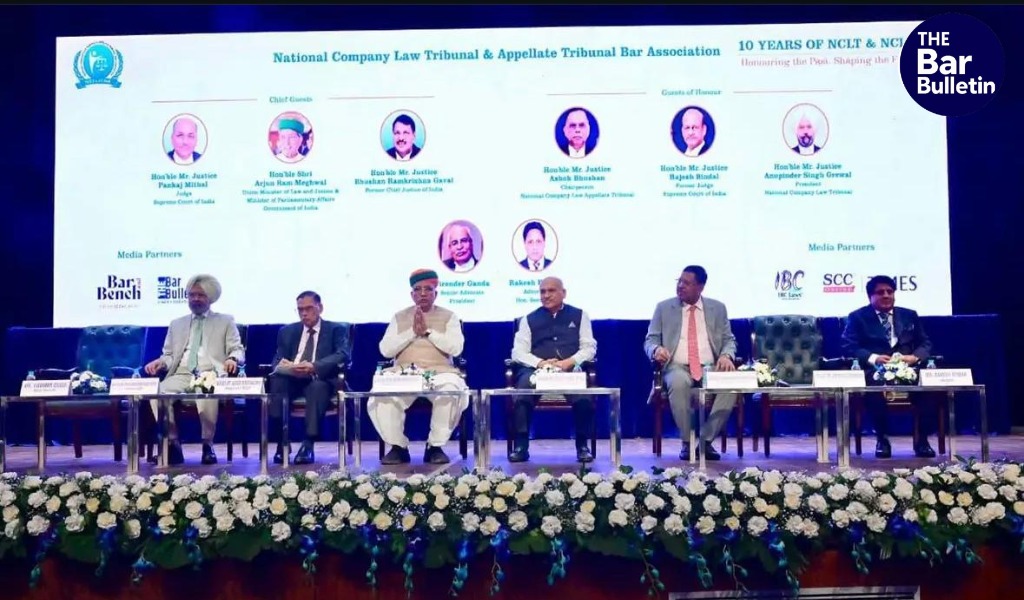

Celebrating the 10th anniversary of the National Company Law Tribunal (NCLT) and National Company Law Appellate Tribunal (NCLAT), the Judiciary and Government leaders convened at the Constitution Club of India, reflecting both on the progress of India’s insolvency regime and the lessons to be drawn from its past successes and failures.
The event was organised by the NCLT & NCLAT Bar Association under the leadership of Senior Advocate Virender Ganda, with programme curation by Rakesh Kumar, Vipul Ganda, and Zorawar Singh.
The evening opened with a challenge from Justice Pankaj Mithal, of the Supreme Court, asking if “institutional changes [have] translated into substantive improvements in justice delivery.” He said the Insolvency and Bankruptcy Code, 2016 (IBC) and the establishment of the tribunals were a “very important institutional shift” but also warned that “the creation of new institutions does not automatically guarantee reform”.
Speakers remembered an “overlapping regime, lengthy delays and uncertainty for stakeholders” before 2016. Justice Ashok Bhushan, Chairperson of the NCLAT, said that the previous regime was “not just inconvenient, but deeply dysfunctional”, as there were multiple jurisdictions and litigation, which had eroded the value of assets and investor confidence. The IBC, he added, had made a “fundamental reordering of priorities” with the time-bound resolution process, which is driven by creditors.
However, there was some disagreement among the presenters regarding the time scale. Justice Bhushan emphasised the principle of ‘time is value’ and that if the process of resolution is delayed, it defeats the very purpose of the insolvency resolution system. While admitting that the delays were a concern, Justice Anupinder Singh Grewal, President of the NCLT, sounded a more measured tone, saying, “Adjudication is not a mechanical process just for time limit.” He stressed that principles of natural justice, procedural fairness, and the right to be heard should be respected and not sacrificed, and appealed for efficiency and fairness.
Justice Rajesh Bindal had a more outcome-oriented view, citing statistics to show that the framework is slowly coming into a state of stability. “Litigation has declined as parties understand that it is not possible to keep the process going forever,” he said, and resolution rates have improved greatly over the years. He pointed out the economic significance of reviving businesses, which includes job retention and market continuity, while highlighting the need to make revival the initial attempt.
Justice B.R. Gavai emphasized the importance of legal certainty for economic growth by setting the context in the Constitution. He noted that “a weak insolvency regime would be marred by a lack of certainty and consistency in legal decisions”, which would also “erode investor confidence”. He emphasized that “the rule of law is the basis for the functioning of businesses”, and stressed the importance of the courts in providing coherence and predictability in the legal system.
Union Law Minister Arjun Ram Meghwal put the insolvency regime in the context of the overall economic policy, highlighting its importance in enabling “revival, employment and preservation of economic activity”. He said that the IBC architecture, along with the role of financial and operational creditors and the committee of creditors, was also interconnected with India’s efforts to create a conducive environment for doing business and adaptation to the changing economic landscape of the world.
While Justice Mithal highlighted the strides made, his speech was notable for the depth of expression he gave to the ongoing structural issues. He warned of the increasing pendency and delays beyond the statutory deadlines, which lead to “systematic erosion of enterprise value” due to “complex litigation and repeated appellate interventions”. He also pointed to the need for better infrastructure on benches, as well as the reliance on contracted employees (more than 80%) and the fact that they are not only administrative matters but “to the heart of the purpose behind these reforms.”
A deeper institutional question, he noted, was whether tribunals were created to speed up the adjudication process, but “many of the same disputes” are still making their way through the courts to the Supreme Court. He said that the emphasis now needs to be on institutional efficiency rather than institutional creation, and procedural uniformity, building capacities, and giving greater focus to smaller stakeholders like MSMEs, workers, and homebuyers.
Towards the end, one common thread was found, namely that the first decade of the NCLT and NCLAT has seen a lot of changes; the next decade has to work on the chasm between promise and performance. For Justice Mithal, it is “the next decade must not be a decade of mere continuity but of credibility,” and the ultimate test is “the confidence that people can put their trust” in the system.
The deliberations were a developing convergence that the Indian insolvency regime is at a crucial juncture, which will hinge on how it can be strengthened to provide timely, fair, and effective commercial justice and not create new structures.

Close