
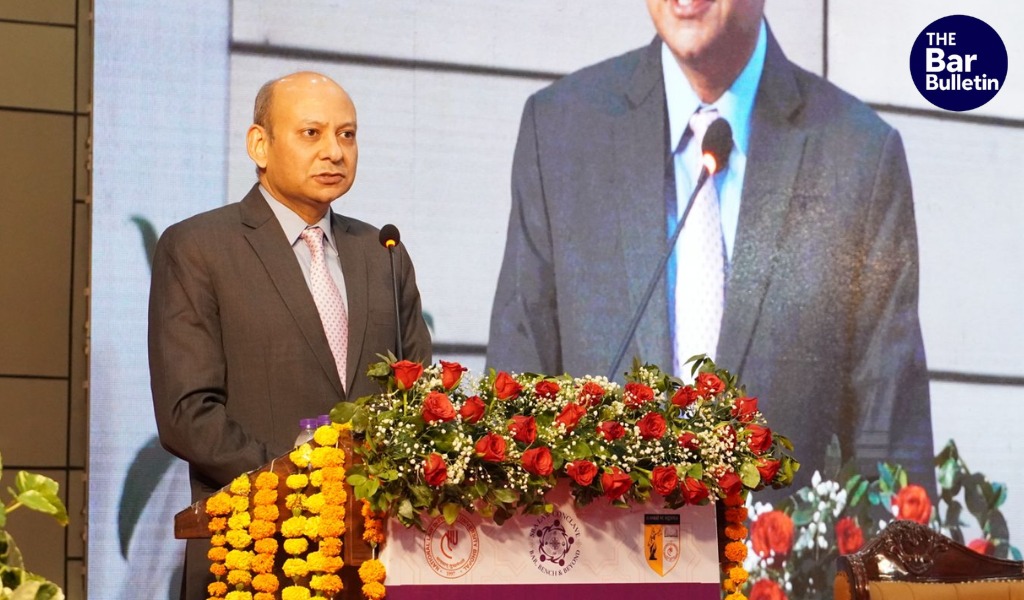

The first session of the 2nd NLIU SBA Law Conclave at the National Law Institute University, Bhopal, on the theme Strengthening India’s Arbitration Framework: Revisiting and Reforming the Arbitration & Conciliation Act, 1996, saw an intellectual discourse by distinguished panellists. Apart from the Chief Guest of the event Mr. Justice Sanjay Karol (Judge, Supreme Court of India), the session was also graced by Sr. Adv. Jayant Mehta (Senior Advocate, Delhi High Court), Adv. Siddharth R. Gupta (Advocate, Supreme Court of India), and Mr. Abhishek Kumar (Partner, Singhania & Partners). They engaged with students and faculty in a wide-ranging discussion that moved from principles to frontier reforms.
Sr. Adv. Jayant Mehta opened with a question, “Why do we have arbitration at all?” Courts, he acknowledged, have their own merit, but one size does not fit all. Litigation is adversarial, precedent-bound, and rigid; arbitration, by contrast, is its “complete antithesis.” It offers what litigation cannot, that is, flexibility, which is itself a component of certainty.
At the heart of arbitration, Mr. Mehta stated lies the concept of party autonomy. Under the 1996 Act, parties have the freedom to choose their arbitrator, their procedural rules, and their dispute resolution mechanism. Section 7, he noted, defines the arbitration agreement along with the principles of independence and impartiality of the arbitrator which flow naturally from the consensual nature of the process. He noted it was often “better to go before a known devil than an unknown one”.
Mr. Mehta also posed thought-provoking questions to the students: Should an arbitral award be open to factual and legal review by courts? To what extent should rigidity be incorporated into arbitral proceedings? And in a moment of pointed wit, referencing the classic metaphor, he described the challenge of reviewing awards as akin to “five blind men trying to describe an elephant,”. Each perceiving a fragment of the truth but none the whole. The journey of Indian arbitration jurisprudence, he said, from the expansive intervention of Saw Pipes (2003) to a more deferential approach, reflected this ongoing tension.
Adv. Siddharth R. Gupta, an alumnus of NLIU, reframed the session’s very theme, he stated that the conversation around India’s arbitration law must shift from a corrective to an evolutionary approach where the focus is on innovation and ingenuity rather than mere patchwork reform.

Mr. Gupta addressed three areas he considered critical. First, the establishment of Arbitration Appellate Tribunals proposed in the draft Arbitration Bill 2024 as Section 34A. It is believed that Section 34A will provide a “safety valve for error correction” that Section 34’s narrow setting-aside mechanism cannot offer. He cautioned, however, that the draft’s silence on a time limit for such tribunals risks making the situation “go from bad to worse,”. Second, he flagged the persistent seat-versus-venue ambiguity under Section 20, arguing that the 2024 draft’s proposed fix, deeming the place of cause of action as the seat, compounds rather than resolves the confusion, and urged India to adopt a clean default rule akin to Section 6A of the English Arbitration Act 2025. Third, on emergency arbitration, he noted that conflicting Delhi High Court decisions have left enforceability of emergency awards in a state of uncertainty, and called for formal legislative recognition of such awards under Indian law, with judicial interference kept to a minimum.
Adv. Abhishek Kumar took the audience through the legislative arc of Indian arbitration law from the 1940 Act to the 1996 Act, and through the critical amendments of 2015 and 2019. The 1996 Act, he explained, was itself three separate pieces of legislation consolidated into one, and it was shaped by India’s growing corporate landscape and the influx of multinational companies whose disputes demanded modern resolution mechanisms.
On Section 9, Kumar highlighted the significance of the provision for interim protection which is available before, during, and even after the conclusion of arbitral proceedings. He also brought into limelight the 2015 amendment that made equivalent protection available at the arbitral tribunal stage itself. He also flagged the issue of unilateral appointments of arbitrators by government departments, addressed by Section 12(5). He went on to discuss the proposed 2024 Amendment Bill’s provision that where arbitration is reinitiated after a partial set-aside, parties remain bound by the findings already recorded, with only the unsettled issues reopened. He stated this as a welcome step towards finality.
The session ended with the dignitaries delivering their closing remarks and addressing the questions of the students.