
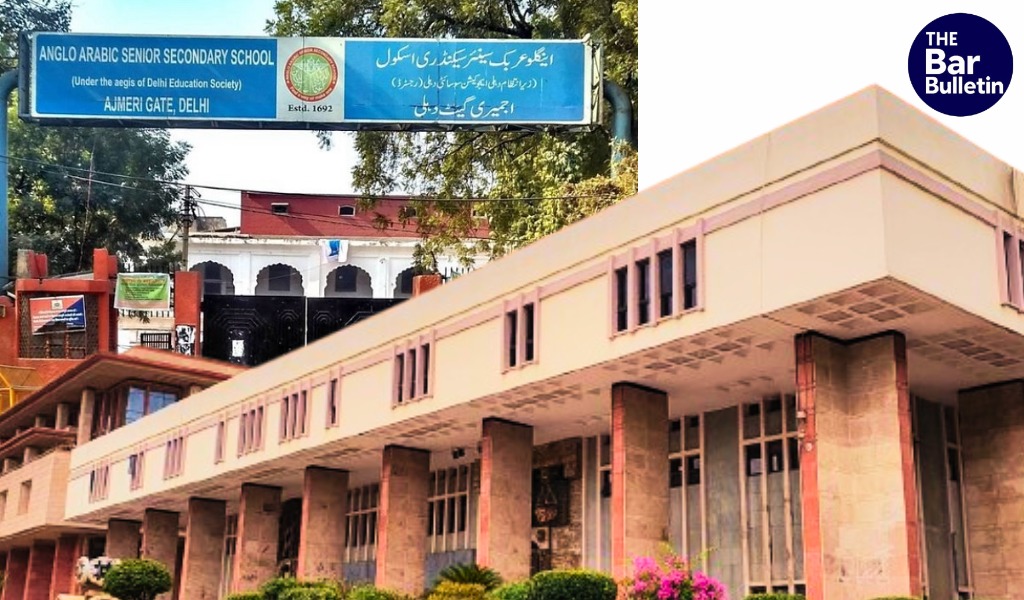

The Delhi High Court has directed the regularisation of a librarian who had been serving at the Anglo Arabic Senior Secondary School since 2009, holding that the school and the Directorate of Education could not defeat his claim by relying on their own failure to complete the statutory recruitment process.
Justice Sanjeev Narula directed that the Librarian be regularised as Librarian with effect from June 27, 2019, the date on which he completed ten years of service. The Court held that his engagement was not a backdoor or illegal appointment but, at the highest, an irregular appointment made through public-facing recruitment processes against a continuing institutional requirement.
The petitioner was appointed pursuant to a public advertisement issued in 2009 and continued to serve as Librarian for years. The Court noted that the school’s own records consistently acknowledged his service as Librarian and reflected that the post had remained vacant for decades. The Directorate of Education also admitted that one sanctioned post of Librarian existed in the school and that the petitioner possessed the requisite qualifications for the post.
Addressing the school’s argument that the petitioner had never been appointed through the complete statutory process prescribed under the Delhi School Education Act and Rules, the Court observed that obtaining Directorate approval, advertising vacancies in the prescribed manner, constituting selection committees and completing recruitment formalities were responsibilities of the school and the authorities not of the employee.
The Court held that a public or aided institution cannot continue to take work from an employee for years and later deny regularisation on the ground that it never completed the legal process required for a regular appointment. It remarked that such an approach would invert the principle laid down in Secretary, State of Karnataka v. Uma Devi, (2006) 4 SCC 1, which was intended to prevent backdoor appointments and not to legitimise long-term exploitation of qualified employees working against recurring institutional needs.
Justice Narula observed that the petitioner satisfied the substantive requirements emerging from State of Karnataka v. Uma Devi, (2006) 4 SCC 1 and subsequent decisions, including the existence of a sanctioned vacancy, possession of prescribed qualifications, completion of more than ten years of service, and engagement through a public recruitment process. The Court rejected the suggestion that he should merely be permitted to participate in a future recruitment process with age relaxation, holding that such a course would perpetuate rather than remedy the injustice suffered by him.
Accordingly, the Court directed the school authorities to forward all papers necessary for his regularisation to the Directorate of Education within four weeks and directed the Directorate to process and grant approval within eight weeks thereafter. The Court clarified that the matter should not be treated as a case of fresh recruitment but as one of regularisation pursuant to the judgment.
On monetary benefits, the Court directed that the petitioner be notionally placed in the regular pay scale of Librarian from June 27, 2019. He was held entitled to the difference between the regular pay and the honorarium actually paid for the period from June 27, 2019 to May 31, 2020. For the subsequent period, the Court directed continuity of service, seniority, pay fixation and retiral benefits, while declining to grant full back wages.
The Court, however, declined to hold the respondents guilty of contempt. It found that the earlier order relied upon by the petitioner merely recorded a statement that the respondents were not contemplating adverse action “at present” and did not contain any clear or continuing direction whose breach could attract contempt jurisdiction. Accordingly, the contempt proceedings were disposed of.
While granting relief in service matters, the Court held that the petitioner had no independent right to continue occupying accommodation provided to him in connection with his duties as Assistant Warden. He was granted four months’ time to vacate the premises and hand over peaceful possession to the school authorities.
