
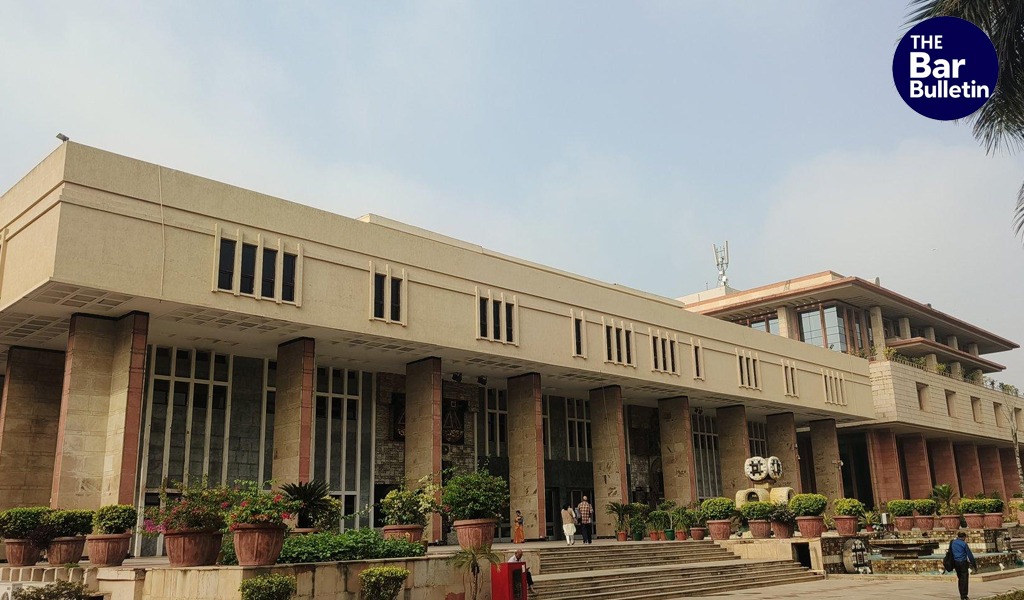

The Delhi High Court has held that the Registrar of Cooperative Societies (RCS), GNCTD could not introduce a maximum age limit of 70 years for empanelment of arbitrators after inviting applications, observing that changing the eligibility criteria mid-process is contrary to settled principles of law. The Court directed that candidates for the current 2025–2028 panel be considered without applying the 70-year age limit, as no such condition was stipulated in the advertisement.
A Division Bench of Justice Prathiba M. Singh and Justice Vikas Mahajan was hearing a petition filed by a retired Group-A Gazetted Officer whose candidature for the 2022–2025 panel of arbitrators was rejected after the Selection Committee subsequently prescribed an upper age limit of 70 years. The petitioner contended that neither the Delhi Cooperative Societies Act, 2003, the Delhi Cooperative Societies Rules, 2007, nor the advertisement inviting applications contained any such age restriction.
During the proceedings, the Court had appointed Senior Advocate Akshay Makhija as Amicus Curiae, who argued that introducing an age criterion after applications had been received amounted to changing the rules of the selection process midway. Reliance was placed on the Constitution Bench decision of the Supreme Court in Tej Prakash Pathak v. Rajasthan High Court, (2025) 2 SCC 1, which reaffirmed that the ‘rules of the game’ cannot ordinarily be altered after the recruitment process has commenced.
The RCS defended the Selection Committee’s decision, contending that Rule 87 of the Delhi Cooperative Societies Rules confers broad discretion in selecting arbitrators and that the age limit had been adopted only to shortlist candidates after receiving over 300 applications.
Rejecting the contention, the High Court observed that while the Selection Committee enjoys considerable discretion in empanelling arbitrators, any eligibility or disqualification criteria must be disclosed in the advertisement itself. Prescribing an additional age criterion after applications have been submitted, the Court held, renders the selection process vulnerable to allegations of arbitrariness, bias and favouritism.
Also Read Supreme Court Upholds Retrospective Karnataka Sugar Tax Law, Grants Relief on Penalty and Interest
The Court noted that the original panel for 2022–2025 had already expired and the dispute now concerned the fresh empanelment for 2025–2028. Since the latest advertisement also did not prescribe any upper age limit, the Bench directed that the petitioner’s candidature, as well as that of other applicants, be considered without applying the 70-year cut-off. It further clarified that the age limit would not be applicable to any candidate who had applied for the 2025–2028 panel.
At the same time, the Court clarified that the remaining selection process would remain within the domain of the Selection Committee. However, it directed that if the Committee intends to prescribe any eligibility conditions such as age limits, disqualifications arising from criminal proceedings, or any other criteria they must be expressly incorporated in future advertisements rather than introduced after the selection process has commenced.
The Bench also suggested that the RCS consider widening the pool of eligible arbitrators by permitting persons possessing legal expertise to apply for empanelment, observing that any such expansion of eligibility should likewise be clearly reflected in future advertisements.
Appearances
For the Petitioner: Mr. Akshay Makhija, Sr. Adv. (Amicus Curiae) with Ms. Shweta Kumar, Adv. along with Petitioner in person.
For the Respondent: Mr. Dhruv Rohatgi, Panel Counsel (Civil), GNCTD, Mr. Dhruv Kumar and Mrs. Chandrika Sachdev, Advs