
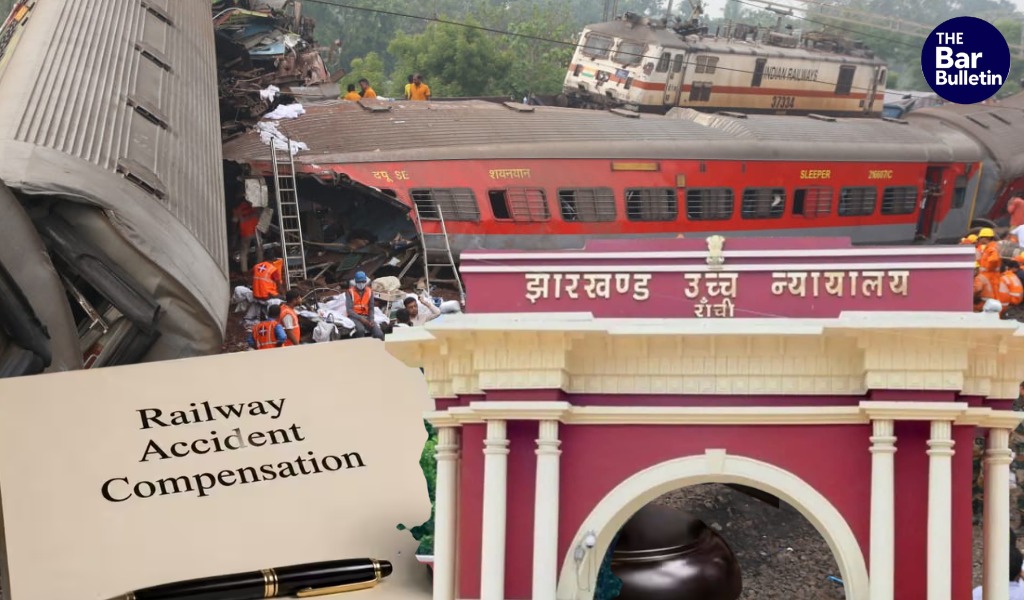

The Jharkhand High Court has set aside an order of the Railway Claims Tribunal rejecting compensation to the family of a train accident victim, holding that the mere fact that the deceased’s body was found 10 metres away from the railway track cannot lead to the conclusion that he did not fall from a running train. The Court directed the Railways to pay ₹8 lakh compensation along with 7% interest per annum from the date of the accident.
Justice Sanjay Kumar Dwivedi allowed an appeal filed by the widow and daughters of Ashok Mehto, who died after allegedly falling from the Danapur–Tatanagar Express in August 2017. The Railway Claims Tribunal, Ranchi, had rejected their claim, holding that the deceased was not proved to be a bona fide passenger and that the incident did not qualify as an “untoward incident” under the Railways Act.
Also Read Delhi High Court to Examine Taxability of Judges’ Allowances Under New Income Tax Regime
Before the High Court, the appellants contended that the deceased had purchased a valid second-class railway ticket from Jamui to Madhupur, which was recovered from his person during the inquest. They also relied on the railway police investigation, inquest report and final report, all of which concluded that the deceased had died after falling from the running train.
Examining the record, the Court found that the travel ticket recovered from the deceased had been duly proved and was also reflected in the inquest and inquiry reports. It further noted that these official records consistently recorded that the deceased had fallen from the train, thereby establishing both his status as a bona fide passenger and the occurrence of an untoward incident.
Rejecting the Tribunal’s reasoning, the Court observed that the location where the body was found could not, by itself, disprove the case of accidental fall. The Court held that a body may land some distance away from the tracks due to the impact of the fall and other surrounding circumstances. Relying on the Delhi High Court’s decision in Anita Devi v. Union of India, it held that recovery of the body away from the railway line does not create a conclusive presumption against an accidental fall from a train.
The Court also rejected the Railways’ argument that there was no eyewitness to the purchase of the train ticket, observing that passengers ordinarily purchase railway tickets without witnesses and that, in the present case, the ticket had already been proved through official railway records.
Referring to the Supreme Court’s decisions, the Court reiterated that the compensation provisions under the Railways Act constitute beneficial legislation and must receive a liberal interpretation. It further observed that Section 124-A of the Railways Act embodies the principle of strict or no-fault liability, and unless the case falls within one of the statutory exceptions, the Railways cannot avoid its liability. The Court also noted that standing near the open door of a moving train may amount to negligence but does not constitute a “criminal act” within the meaning of the proviso to Section 124-A.
Holding that the deceased was a bona fide passenger who died in an untoward incident, the High Court set aside the Tribunal’s order and directed the Eastern Railway to pay the claimants ₹8 lakh as compensation, together with interest at 7% per annum from August 1, 2017, until actual payment, within two months.
