
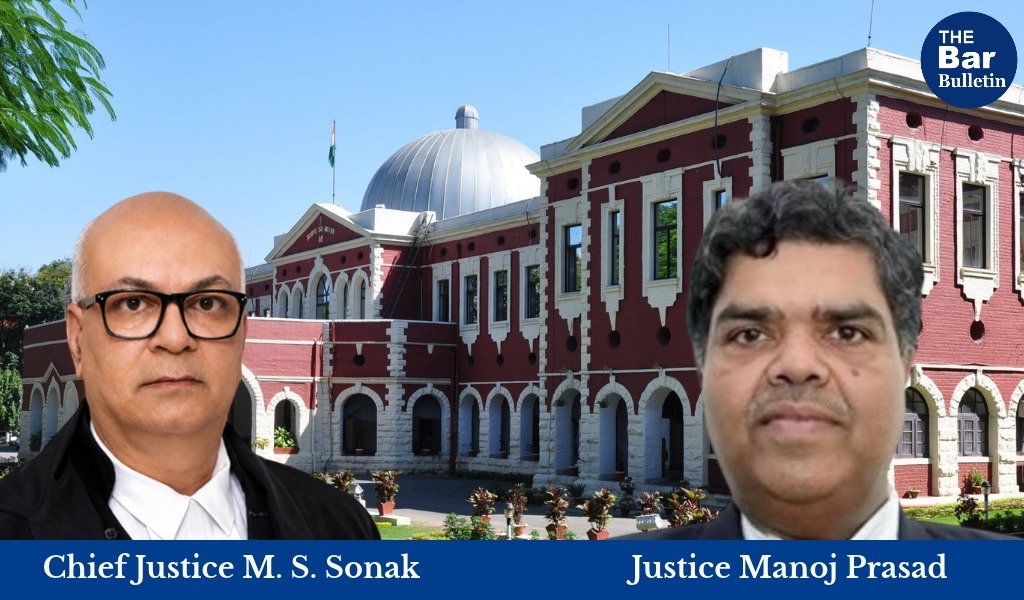

In an appeal filed before the Jharkhand High Court under Section 19(1) of the Family Court Act against a judgment dated 11-06-2024 in a case registered on the basis of an application filed under Sections 19 and 20 of the Hindu Adoption and Maintenance Act, 1956, a Division Bench of the Chief Justice M. S. Sonak and Justice Manoj Prasad held that the appellant was under a legal obligation and pious duty to maintain his widowed daughter-in-law and grandchildren, who were dependents, and that the quantum awarded was not unreasonable while dismissing the appeal.
The appellant was the father-in-law of respondent 1 and the grandfather of respondents 2 and 3, who were minors. Respondent 2 stated that she was the widow of the appellant’s only son, who died on 27-10-2020 at Hyderabad. She alleged that after her husband’s death the appellant did not maintain her or her children, that Panchayat attempts at reconciliation failed, that she had no independent source of livelihood, and that she received no share in the deceased’s estate. She filed an application under Sections 19 and 20 of the Hindu Adoption and Maintenance Act, 1956, claiming that the appellant received a pension of more than Rs.32,000 per month, held more than Rs.80,00,000 in fixed deposit, and had a cumulative monthly income of about Rs.1,00,000.
The daughter-in-law prayed for monthly maintenance of Rs.75,000. The appellant admitted the relationships and the death but alleged that the daughter-in-law behaved badly and that the case was instituted on the instigation of others. He admitted the pension of about Rs.32,000 but denied the fixed deposit. He stated that his wife was also dependent on him and that both of them were over 80 years old. He further stated that his retirement benefits were spent on constructing a house and that he had no agricultural income.
The Family Court, Dhanbad, framed issues on maintainability, cause of action, and entitlement to maintenance under Sections 19 and 20. After evidence was led, the Family Court found that the appellant admittedly received a government pension of Rs.32,000 and paid his grandsons’ school tuition, and that he also received Rs.18,000 per month as shop rent. It directed him, by judgment dated 11-06-2024 to pay Rs.7,000 per month to the daughter-in-law and Rs.5,000 per month to each son until majority. Hence, the present appeal.
The appellant argued that the Trial Court failed to appreciate the scope of Sections 19, 20, 21 and 22 of the Act, that no documentary evidence of his earnings was brought on record, and that the children’s educational expenses, which he bore, were not considered. He further argued that his pension was his only livelihood, that he and his wife were above 80 and suffering from old-age diseases, that ancestral agricultural land, in which respondent 1 was also a coparcener, could not be the basis for maintenance, and that maintenance could not be ordered from a pension.
The Court noted that Section 19 provides for maintenance of a Hindu wife by her father-in-law after her husband’s death, Section 20 provides for maintenance of children and aged parents, and Section 21 defines dependents to include a minor son of a predeceased son and any widow of his son so long as she does not remarry. It was stated that a composite reading of these provisions, together with Section 22, creates a duty on a Hindu to maintain a widowed daughter-in-law without independent livelihood, and the minor grandsons.
The Court noted that the only defence taken by the appellant was that the agricultural land or the other ancestral lands, where his son was also a co-parcener, could not be used for any gainful purpose because the appellant himself was about 84 years old and suffering from age-related illness. However, it was stated that the pious responsibility of maintaining the widowed daughter-in-law and grandchildren does not get exonerated on account of the appellant’s age.
The Court found that nothing rebutted the claim that rent of more than Rs.18,000 was paid to the appellant or his wife, and that the admitted cumulative income of more than Rs.50,000 justified the total award of Rs.17,000 per month. The Court also noted that the arrears of maintenance had not been paid to date despite the fact that no stay had been granted and directed for payment of the same within 2 months.
Thus, the appeal was dismissed.
