
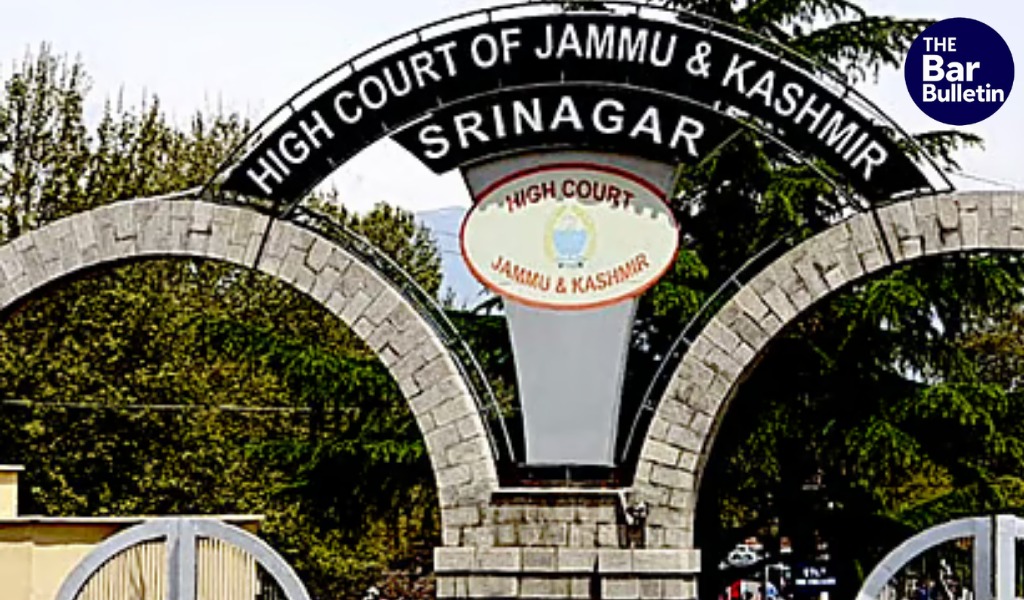

The Srinagar Bench of the Jammu & Kashmir & Ladakh High Court has asserted that where an order passed under Section 73 of the J&K GST Act/CGST Act is appealable under Section 107, the High Court will ordinarily decline to entertain a writ petition under Article 226 unless the case falls within the recognised exceptions to the rule of alternative remedy, namely violation of fundamental rights, violation of principles of natural justice, lack of jurisdiction, or challenge to vires. Mere assertion of breach of natural justice or lack of jurisdiction is not sufficient; the petitioner must demonstrate material facts bringing the case within those exceptions.
Essentially, the Court ruled that Section 65(7) of the CGST Act expressly permits the proper officer to initiate proceedings under Section 73 or Section 74 where audit results in detection of tax not paid, short paid, erroneously refunded, or input tax credit wrongly availed or utilised. Therefore, the conduct of audit under Section 65 does not oust the jurisdiction of the proper officer to proceed under Section 73.
The Division Bench comprising Justice Sanjeev Kumar and Justice Wasim Sadiq Nargal first observed that the show cause notice had granted 30 days for reply and had fixed personal hearing, and that thereafter, by reminder, further time was granted along with a fresh date of hearing. The Bench noted that it was not the petitioner’s case that she approached the State Taxes Officer (STO) or sought another opportunity, and further observed that nothing prevented the petitioner from submitting at least a written reply. On that basis, the Bench concluded that sufficient opportunity had been afforded and that the ground of denial of hearing was without substance or lawful basis.
On the plea of lack of jurisdiction, the Bench rejected the petitioner’s submission by relying on Section 65(7) of the CGST Act. After setting out Section 65, the Bench emphasized that where an audit results in detection of tax not paid, short paid, erroneously refunded, or input tax credit wrongly availed or utilised, the proper officer may initiate action under Section 73 or Section 74. The Bench therefore held that the STO’s initiation of proceedings under Section 73 following audit was in line with the statutory scheme and that the argument that audit precluded recourse to Section 73 was contrary to Section 65(7).
Accordingly, the Bench held that the petitioner had not brought the case within any recognised exception to the rule of alternative remedy and dismissed the writ petition as not maintainable, while granting liberty to the petitioner to challenge the impugned order and notices by availing the statutory appeal under Section 107 of the CGST Act/J&K GST Act. The Bench also clarified that its observations were confined to the writ proceedings and would not be construed as a final decision on the contentious issues in appeal.
Briefly, the petitioner, a proprietorship concern registered under GST, challenged a show cause notice, a reminder, and a demand order issued by the State Taxes Officer (STO), in relation to financial year 2022-23. The petitioner stated that an earlier GST audit had already been conducted for FYs 2017-18, 2018-19, 2019-20, 2020-21 and 2022-23, and that the discrepancies pointed out in the audit report under Section 65(6) of the CGST Act had been duly met by discharge of the requisite tax liability. The impugned demand order however raised a total demand of Rs. 3.41 crores towards tax, interest and penalty.
The petitioner’s case was that the order under Section 73 of the J&K GST Act/CGST Act was liable to be interfered with in writ jurisdiction because it was passed in violation of the principles of natural justice and without jurisdiction. The petitioner asserted that she could not attend the first hearing because she was out of station, had sought extension by representation, and could not attend the adjourned hearing because that date was a public holiday on account of Eid-ul-Fitr. It was also argued that once audit proceedings had been conducted under Section 65 of the CGST Act, the STO was not competent to initiate fresh proceedings under Section 73.
Appearances:
Azhar ul Amin Sr. Advocate with Noman Shafi Advocate, for Petitioner/ Taxpayer
Bisma Ali Advocate and T.M. Shamsi DSGI, for Respondent/ Revenue
