
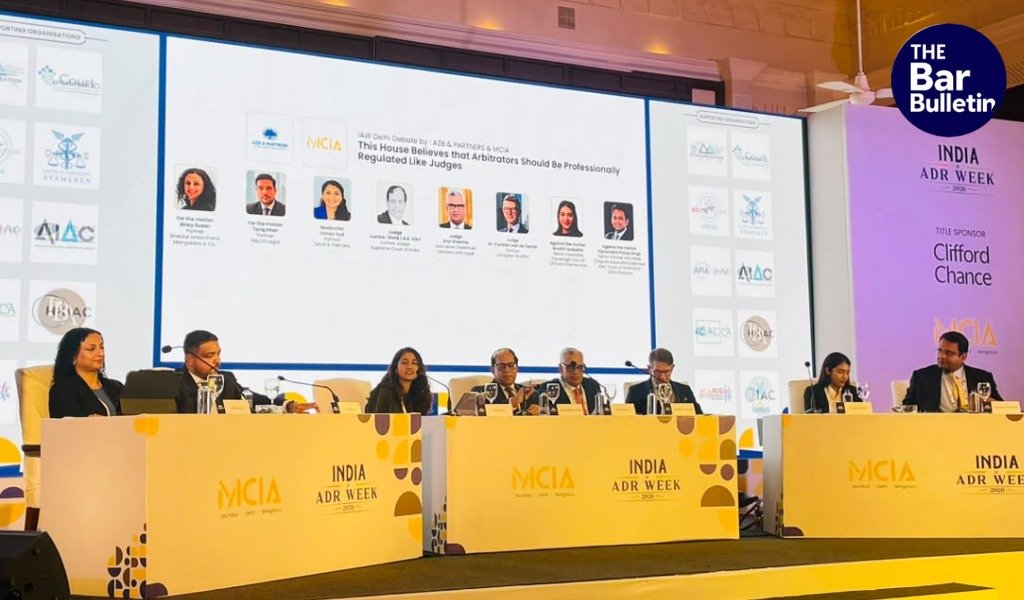

Whether arbitrators should be professionally regulated like judges came under sharp debate at an Oxford-style discussion held during India ADR Week 2026, with leading arbitration practitioners examining the competing demands of professional accountability, independence, efficiency and party autonomy.
The debate, hosted by AZB & Partners and the Mumbai Centre for International Arbitration (MCIA), was moderated by Sanya Sud, Partner, Saraf & Partners. The motion before the house was: “This House Believes that Arbitrators Should Be Professionally Regulated Like Judges.”
The debate was judged by Justice (Retd.) A.K. Sikri, former Judge of the Supreme Court of India; Atul Sharma, Executive Chairman, Dentons Link Legal; and Dr. Carsten van de Sande, Partner, Hengeler Mueller.
Speaking for the motion were Binsy Susan, Partner, Shardul Amarchand Mangaldas & Co., and Tariq Khan, Partner, M&CO Legal, while Srruthi Ilankathir, Senior Associate, Cavenagh Law LLP, Clifford Chance Asia, and Vijayendra Pratap Singh, Senior Partner and Head of Dispute Resolution at AZB & Partners and Member of the SIAC Court of Arbitration, argued against it.
Introducing the motion, Sanya Sud framed the debate around the tension between party autonomy and accountability in arbitration. She noted that arbitrators perform a judicial function by determining facts, applying law, assessing evidence and delivering binding awards, but do not operate within an institutional and constitutional framework equivalent to that applicable to judges.
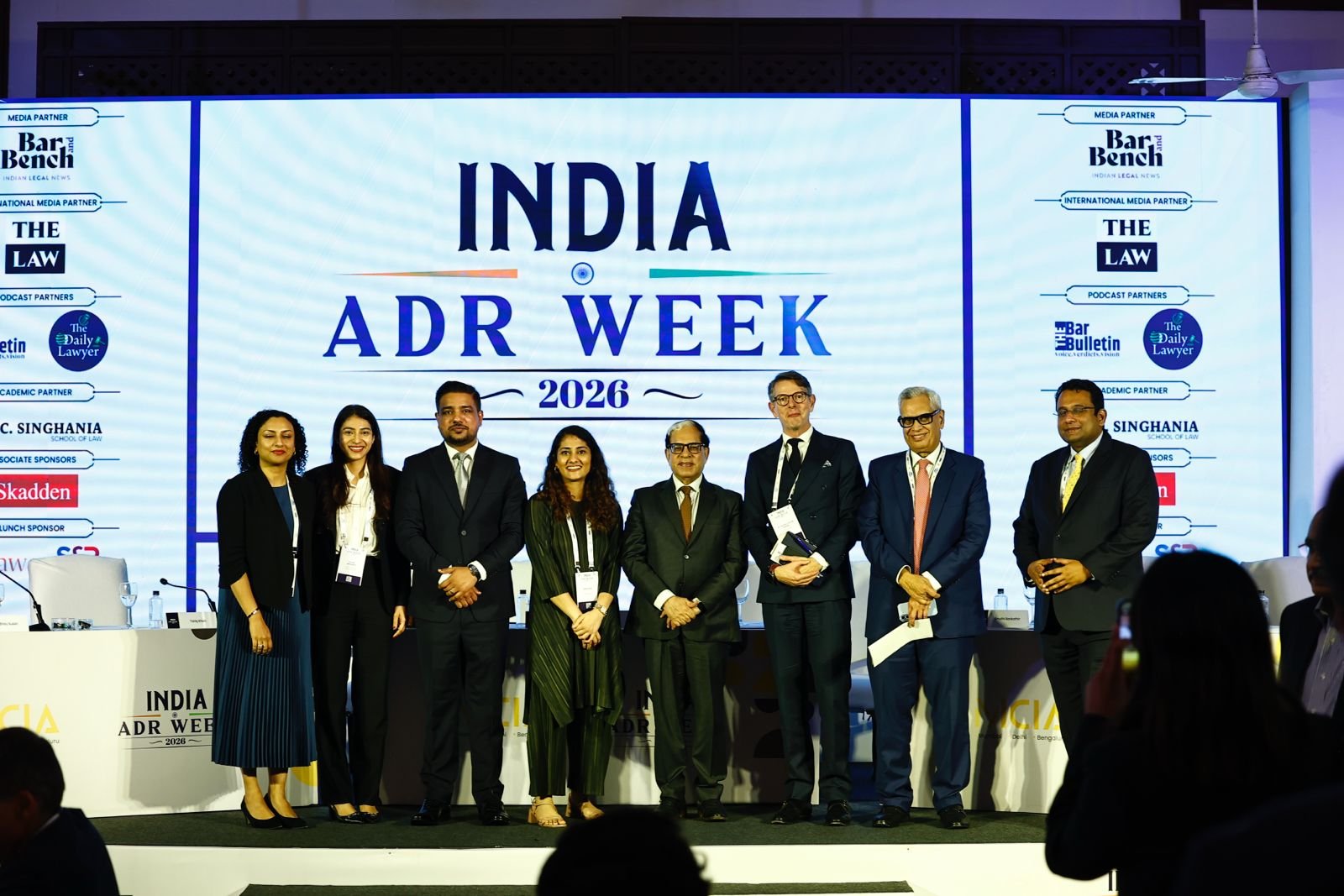
She identified appointment, qualifications, removal and accountability as the four principal areas of discussion. She also highlighted the absence of comprehensive statutory qualifications for arbitrators in India and the significance of the safeguards under Section 12 and the limited scope of judicial intervention under Section 34 of the Arbitration and Conciliation Act, 1996.
For the Motion
Binsy Susan argued that arbitrators exercise significant adjudicatory power and therefore require greater professional accountability. Clarifying that professional regulation would not mean converting arbitrators into judicial officers or subjecting them to identical tenure, salary or impeachment mechanisms, she stated: “More power, in my view, should mean more rules.”
She proposed a regulatory framework built around “Three S’s – Standards, Supervision and Sanctions.” This would involve enforceable professional standards, a professional body empowered to receive complaints and proportionate sanctions for misconduct.
Susan pointed to concerns such as unreasonable delays in issuing procedural orders, arbitrators accepting excessive appointments and undisclosed relationships with counsel. She argued that such conduct may not always meet the statutory threshold for challenge or removal under Section 12, leaving gaps in professional accountability.
She also highlighted the confidential nature of arbitration, arguing that parties may have limited ability to assess an arbitrator’s past conduct. In her view, existing remedies can often operate only after the damage has occurred. She therefore suggested that a professional regulatory mechanism, potentially through the proposed Arbitration Council of India, could provide greater preventive oversight.
Tariq Khan strongly supported the proposition, arguing that anyone who exercises decision-making power affecting individual rights should be subject to regulation. He pointed to concerns surrounding delays, costs, disclosures and allegations of bias in arbitration.
Referring to the Supreme Court’s decisions in TRF Ltd., Central Trade, Central Railway Electrification and Perkins Eastman, Khan emphasised the judiciary’s continuing focus on arbitrator independence and impartiality.
He argued that the narrow scope of judicial review under Section 34 makes preventive professional regulation particularly important. He also suggested that technical and non-legal arbitrators should receive appropriate training to ensure familiarity with due process and reasoned decision-making.
According to Khan, stronger professional standards would enhance confidence in Indian arbitration and prevent individual instances of misconduct from affecting the credibility of the wider arbitral system.
Against the Motion
Srruthi Ilankathir opposed the motion by drawing a distinction between regulating arbitrators and regulating arbitrators like judges.
She argued that arbitrators are already subject to substantial safeguards under Section 12 and the Fifth and Seventh Schedules of the Arbitration and Conciliation Act, 1996, apart from institutional rules and mechanisms for challenge and removal.
Her central argument was that judges and arbitrators derive authority from fundamentally different sources. A judge derives authority from the Constitution and exercises public power, whereas an arbitrator derives authority from party consent and contract.
According to Ilankathir, arbitrators decide disputes because the parties have chosen arbitration, while judges exercise public authority even over persons who have not chosen them. Consequently, importing the complete regulatory framework applicable to judges could undermine the contractual and private character of arbitration.
She argued that the proposition had to establish three things: a genuine regulatory gap, that judicial-style regulation would cure that gap, and that the benefits would justify its costs.
Vijayendra Pratap Singh similarly opposed the proposition and structured his argument around “RIP – Removal, Immunity and Procedure.”
On removal, he pointed to the fundamental difference between judges, who are governed by constitutionally prescribed mechanisms, and arbitrators, who are subject to statutory and institutional procedures for challenge and removal.
On immunity, he argued that judges enjoy constitutional and statutory protections because they exercise public authority, whereas arbitrators operate within a private contractual framework and have qualified immunity. Granting arbitrators the same immunity as judges, he contended, could conflict with existing accountability mechanisms.
On procedure, Singh cautioned that importing court-like procedures into arbitration could make the process slower, more expensive and more formal, undermining arbitration’s purpose as an alternative to litigation.
At the same time, he clarified that the opposition was not against greater regulation. He supported measures such as enhanced disclosures, publication of redacted decisions concerning challenges and mechanisms to address repeat misconduct. He proposed “Three E’s – Efficiency, Economy and Effectiveness” as the appropriate focus of regulation.
Judges’ Observations
Justice (Retd.) A.K. Sikri observed that much of the debate depended upon the interpretation of the phrase “regulated like judges.”
He identified two possible meanings: whether arbitrators should simply be subject to some form of regulation, or whether they should be regulated in exactly the same manner as judges.
If the latter interpretation were adopted, Justice Sikri observed that imposing the same regulatory mechanism on arbitrators would be “an impossibility,” particularly given the constitutional framework governing judges of the Supreme Court and High Courts and the impeachment-based mechanism applicable to their removal.
At the same time, he noted that there was little disagreement with the proposition that arbitrators should be appropriately regulated, pointing to the safeguards already contained in the Arbitration and Conciliation Act, including Schedules V and VII.
He therefore suggested that the central issue may not be the complete absence of regulation but the effective implementation of existing safeguards. He also cautioned against the misuse of bias and disclosure allegations as a means of delaying arbitral proceedings, while stressing that genuine allegations must be addressed.
Atul Sharma observed that the proposition required separating the question of whether arbitrators need regulation from the much broader question of whether they should be regulated like judges.
He emphasised that party autonomy remains the bedrock of arbitration, while also noting that modern arbitration has become increasingly complex and technically sophisticated. Arbitrators dealing with geopolitical conflicts, force majeure issues and complex construction disputes may require specialised legal and technical expertise and appropriate training.
Sharma suggested that the appropriate regulatory model may lie somewhere between complete judicial-style regulation and the existing framework. Referring to developments including the introduction and subsequent deletion of Schedule 8, he highlighted the continuing challenge of balancing professional qualifications with expertise and flexibility.
Dr. Carsten van de Sande concluded that there was no simple black-and-white answer to the question.
He stressed that any regulatory framework must respect party autonomy, while recognising that arbitration is international but remains connected to the law of the seat and the relevant jurisdiction. Regulation, he said, should strengthen the effectiveness and efficiency of existing mechanisms without creating unnecessary restrictions.
He also called for an international level playing field that encourages a “race for the top” rather than a race to the bottom. Excessive regulation, he cautioned, could restrict competition and limit the flexibility and dynamism that are integral to arbitration.
The debate concluded with the broader recognition that the future of arbitral regulation may require a calibrated approach, one that strengthens professional standards and accountability without importing the constitutional and institutional framework applicable to judges into a fundamentally private dispute-resolution mechanism.
The session concluded with a vote of thanks before the programme proceeded to the subsequent events of India ADR Week 2026.