

“
“Every file, F-I-L-E, with the same alphabets contains a life, L-I-F-E. AI does not understand file as life. AI understands file as statistics, as data. But it is a judge who converts a file into life.”
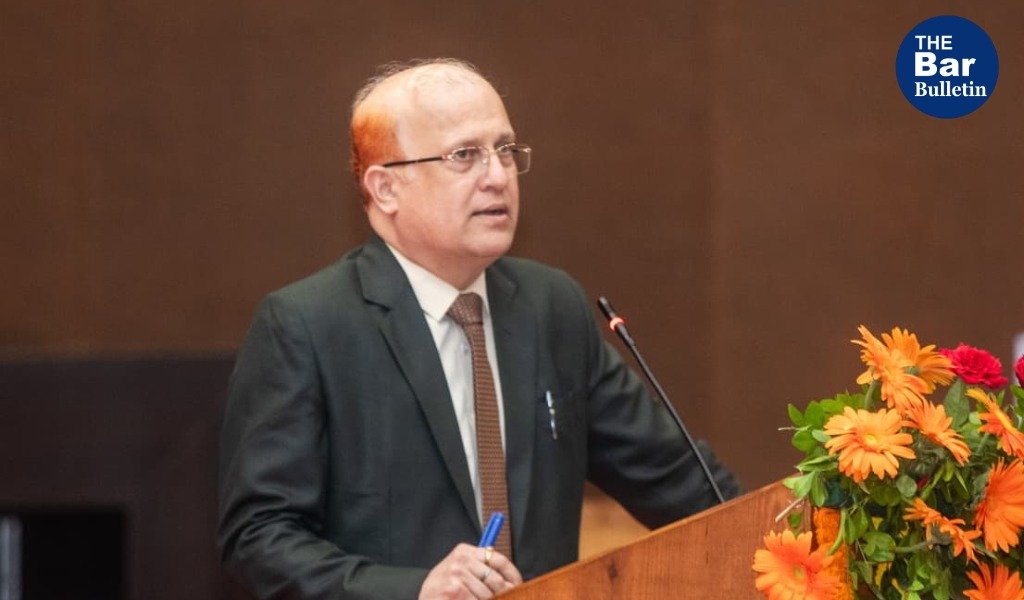
Justice Anand Pathak at the 1st DNLU ‘JUSTECH’ National Conclave.
Delivering his address on ‘Algorithmic Justice on the Driver’s Seat: Reincarnating the Judiciary through AI & Technology’ at the 1st DNLU ‘JUSTECH’ National Conclave, Justice Anand Pathak provided a comprehensive overview of the practical applications of artificial intelligence in the Madhya Pradesh judiciary. While illustrating how technology can bridge systemic gaps, he firmly cautioned that AI must remain an assisted tool, incapable of replacing the human sensitivity and discretion that define the judicial function.
Technological Interventions in Investigation and Trial
Justice Pathak detailed several systemic interventions designed to streamline the justice delivery process. Central to this is the SANDES app, a classified national version of WhatsApp. Under this system, upon the registration of an FIR for a heinous offence, the Station House Officer (SHO) creates a group including the complainant, investigating officers, forensic experts, and medical legal doctors. A unique identification number allows court orders such as the rejection of a bail application to be communicated directly to the group.
“
“Now the complainant knows that the accused person’s bail application is rejected. Now the SHO knows that this person’s bail is rejected,” he explained.
This ecosystem also addresses witness intimidation through an OTP-based web link, allowing victims or witnesses to share anxieties or incidents directly with the investigating officer, reconciling with the emergency response app 112 and e-Lakshya policy. He emphasized that such measures ensure the witness feels supported, aligning with Supreme Court judgments on witness protection.
Furthermore, following a judgment, the case files are sent to the Investigating Officer (IO) and superior officers to evaluate performance and identify investigative follies that led to acquittals.
“
“An AI-based module can evaluate the performance of the IO so that postings can be done accordingly,”
he said, noting the chronic issue of SHOs being posted without adequate investigative experience.
To address the recurring issue of defective vakalatnamas, Justice Pathak proposed a unique prisoner ID for jail inmates, containing comprehensive data that can be seamlessly reflected in legal documents.
Tracing the Apex Perpetrators in Drug Trafficking
Addressing the government’s mission to eradicate drug abuse by 2029, Justice Pathak highlighted a critical flaw in current policing: the focus remains on arresting minor carriers rather than the apex perpetrators who mastermind the trade.
“
“These carriers are minor people. They work for one lakh, two lakhs or limited money and then they are languishing in jail. Apex perpetrators are moving their trade uninterruptedly,” he observed.
To combat this, the High Court has initiated a collaboration with the National Forensic Sciences University (NFSU), Gandhinagar, to create an AI-based database of the specific characteristics of contraband crops including soil, pollen grains, and DNA, a study known as carcinology.
“
“Moment any contraband article is seized, it can be verified… Immediately officer would come to know that this contraband is from Odisha… Then chances of going to apex perpetrator rises,”
he explained, adding that satellite monitoring, DNA sampling, and carbon dating could further aid in tracing origins.
Drishyam Vidhi and Environmental Restoration
Justice Pathak introduced Drishyam Vidhi, an innovative audio-visual learning project that seeks to bridge the distance between the classroom and the courtroom. Utilizing film clips such as the train robbery sequence from Sholay the initiative treats fictional offences as real incidents. Students are divided into teams representing police investigation, prosecution, defence, and adjudication, and are tasked with navigating the case from FIR registration through investigation, charge-sheeting, and a mock trial. The project, approved as a research project by the Academic Council of DNLU, has been demonstrated before the Gwalior Police Department, DNLU, and Bar Associations.
He also highlighted the NISAR app, born from a voluntary initiative where litigants were encouraged to plant saplings in lieu of onerous bail conditions. Utilizing geofencing and geotagging, the app monitors the progress of over 30,000 saplings planted in the Gwalior region.
“
“Every third month, AI-generated automated message comes… if he gives photograph from some different region, more than 100 meters, then it does not accept because it is geofenced, geotagged,”
he said, noting the transformation of a barren hillock into a green space with over 10,000 trees.
The Scene of Crime and Giving Voice to the Voiceless
Under the Bharatiya Nagarik Suraksha Sanhita (BNSS), videography of crime scenes for offences punishable with seven years or more is mandatory. Justice Pathak revealed that the Gwalior Bench, in Vijendra Singh Sikarwar v. State of Madhya Pradesh and Others (M.Cr.C. No. 24900 of 2023), has proposed the creation of an AI-enabled app to analyze this videography. This would assist investigating officers by highlighting critical clues such as sweat, blood, or distinct shoe prints thereby improving the standard of investigation and preventing the acquittal of the guilty due to shoddy police work.
A significant portion of his address was dedicated to an AI-enabled sign-language interpretation app, developed through judicial orders passed by the Gwalior Bench. The initiative began on 8 August 2024, when the Court raised the need for an AI app to interpret the sign language of Persons with Disabilities (PWD) at police stations, ensuring their grievances are accurately recorded. By November 2024, the National Informatics Centre (NIC) and the Department of Social Justice were directed to collaborate, resulting in a system where sign language is captured via mobile or screen and read by an AI app.
By July 2025, the Court directed the Deputy Solicitor General to ensure synergy between the NIC and the Ministry of Women and Child Development, aiming to install the app at all public places to “give voice to the voiceless people.” As reported in the press in November 2024 and February 2026, this directive has led to the implementation of QR-code sign-language helplines, with Sidhi becoming the first district in the country to adopt the system.
The Limits of AI: Dissent, Demeanour and Data Violence
Despite advocating for technological integration, Justice Pathak drew a firm line on the limitations of AI. Referring to the ADM Jabalpur case, he questioned whether AI could have conceived the historic dissenting judgment of Justice H.R. Khanna.
“
“AI cannot conceive at that point of time, that dissenting judgment… So this aspect of human intervention, this aspect of human reason… is missing in AI,” he stated.
He warned against the encroachment of neurotechnology and algorithmic surveillance, describing the tracking of key strokes and scanned emails as data violence. He emphasized that judges must evaluate the demeanour of witnesses, the ambience of the courtroom, and the facial expressions of lawyers aspects that AI cannot navigate or contemplate.
Quoting a French writer, he said,
“Emotions have taught mankind to reason.” Concluding his address, Justice Pathak reiterated that AI must never occupy the driver’s seat.
“
“AI understands file as statistics, as data. But it is a judge who converts a file into life,”
he affirmed, underscoring that technology must ultimately remain a tool in the hands of human empathy and judicial wisdom.
***