
The Commercial Mediation Conclave India 2026, held as part of MCI 2026 – Mediation Weekend, brought together judges, senior advocates, lawyers, mediators, institutional representatives and other stakeholders to examine the role of mediation in resolving commercial disputes.
Held at the India International Centre, New Delhi, the conclave was centred on the theme “Making Mediation Mainstream” and featured discussions on commercial disputes, construction disputes, enforcement, Med-Arb mechanisms, the role of law firms and in-house counsel, and the development of mediation as a professional practice.
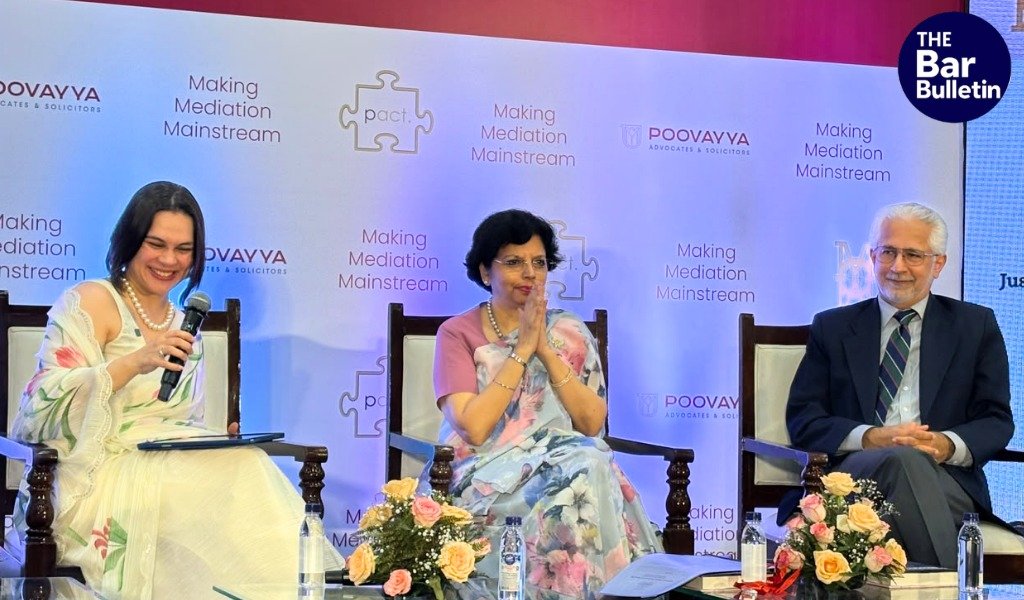
One of the sessions featured a fireside conversation on construction mediation, with Justice Anup Jairam Bhambhani, Judge, Delhi High Court, and Justice (Retd.) Hima Kohli, Former Judge, Supreme Court of India, in conversation with Mehak Oberoi, Author of Construction Mediation.
‘Mediators Should Not Be Treated as a Side Hustle’: Justice Hima Kohli
Justice Hima Kohli emphasised the need for greater recognition of mediation as a specialised professional skill and called for mediators to receive appropriate professional recognition and remuneration.
“
“Mediation need to be acknowledged, recognised and better paid. It should not be treated as a side hustle,” Justice Kohli said.
She said mediation would develop organically through greater awareness, dedicated programmes and platforms, respect for the mediation process and training of stakeholders.
Drawing from her own experience, Justice Kohli noted that judging and mediating require different mindsets. She recalled undertaking mediation training while serving as a Supreme Court judge and highlighted the importance of giving mediation a more prominent place within the dispute resolution ecosystem
Justice Kohli also stressed that the conclusion of a mediation is only as effective as the settlement that records it.
She said mediated settlements must be properly drafted and “water tight”, with all the practical aspects of implementation clearly addressed. This includes payment timelines, consequences of default and arrangements involving vendors, subcontractors and other connected parties.
“Loose ends can be dangerous,” Justice Kohli observed.
She also pointed to the importance of bringing connected parties and disputes into a settlement where necessary, particularly in complex construction disputes involving multiple contractual relationships.
Justice Kohli further emphasised that willingness of the parties is imperative for mediation. While courts can encourage or nudge parties towards mediation, a mediator cannot force parties to settle.
She noted that even where a mediation does not immediately result in settlement, the process can sometimes plant the seeds for parties to return to negotiations and resolve the dispute subsequently.
Justice Kohli also shared an example involving builder-apartment owner disputes and the Indian Arbitration and Mediation Centre (IAMC), Hyderabad.
She referred to mediation being offered in such disputes, with some matters being successfully resolved through mediation and thereafter returning to the RERA framework.
The example was cited in the context of discussing how mediation could provide a more effective mechanism for dealing with large and complex disputes involving multiple stakeholders.
Justice Bhambhani agreed with the concern regarding the lack of trust and said institutional support from senior officials could help give officers greater confidence while taking settlement decisions.
‘There Is No Such Thing as Too Early or Too Late’ for Mediation: Justice Bhambhani
Justice Bhambhani addressed the question of when mediation should be attempted and said there is no universally applicable stage at which parties must enter mediation.
“
“There is no such thing as too early or too late” for mediation, Justice Bhambhani said.
He explained that when parties are open to giving their dispute an opportunity to be resolved, the mediator should be able to step in and explore whether mediation or another appropriate dispute resolution mechanism could assist.
The discussion also examined whether a mediator dealing with a construction dispute needs to be a construction expert.
Justice Bhambhani said mediation is a standalone skill and is domain agnostic. According to him, while a mediator should understand the underlying “pathology” of a dispute, it is not necessary for the mediator to be a construction specialist.
For highly technical issues, he suggested that a mediator could call upon a domain expert, much as an arbitrator may rely on an expert. He also cautioned that excessive domain specialisation could, in certain circumstances, result in a mediator bringing entrenched views from the subject matter into the mediation process.
The conversation also considered the question of pre-litigation mediation and urgent interim relief.
Justice Bhambhani pointed to the practical reality that many parties approaching courts also seek interim orders, sometimes on an urgent or ex parte basis. In such circumstances, he indicated that requiring mediation as an absolute first step may not always be appropriate.
The appropriate timing of mediation, he suggested, must therefore depend upon the nature and circumstances of the particular dispute.
Justice Bhambhani separately raised the challenge posed by large development projects involving thousands of homebuyers.
He suggested that such disputes could benefit from a dedicated or specialised mediation mechanism capable of dealing with disputes more holistically, rather than leaving parties to pursue fragmented proceedings across multiple forums and regulatory mechanisms.
His observation came in the context of considering how mediation could address disputes involving a large number of stakeholders and interconnected claims.
Mediation as a Distinct Professional Skill
Justice Kohli further stressed that mediators should be properly trained and recognised for the specialised skills required in mediation.
She referred to the growing exposure of judicial officers to mediation and noted that Delhi district judges are trained mediators. She also recalled undertaking mediation training through SIMC while serving as a Supreme Court judge, underscoring the distinction between the mindset required for judging and that required for mediation.
She said mediation would require greater stakeholder awareness, institutional support and respect for the process to become a mainstream mechanism.
Book Launch of Construction Counsel Series
The conclave also witnessed the launch of the Construction Counsel Series by Mehak Oberoi, who moderated the fireside chat.
Oberoi, who is also the author of Construction Mediation, brought the discussion on construction disputes and mediation into the broader theme of the conclave making mediation mainstream.
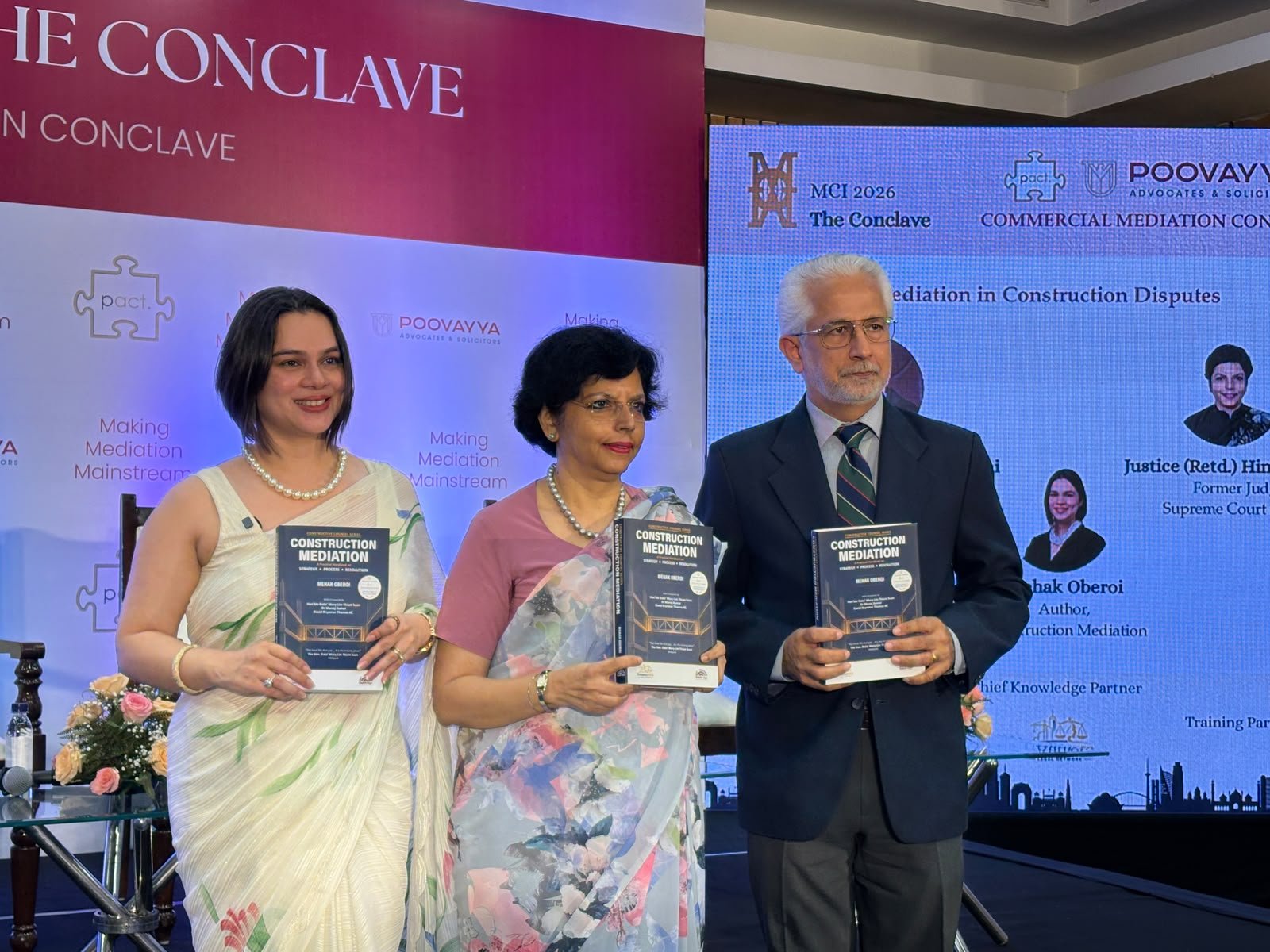 The book launch complemented the session’s focus on construction disputes, an area where disputes can involve complex contracts, multiple stakeholders, technical issues and significant financial consequences.