
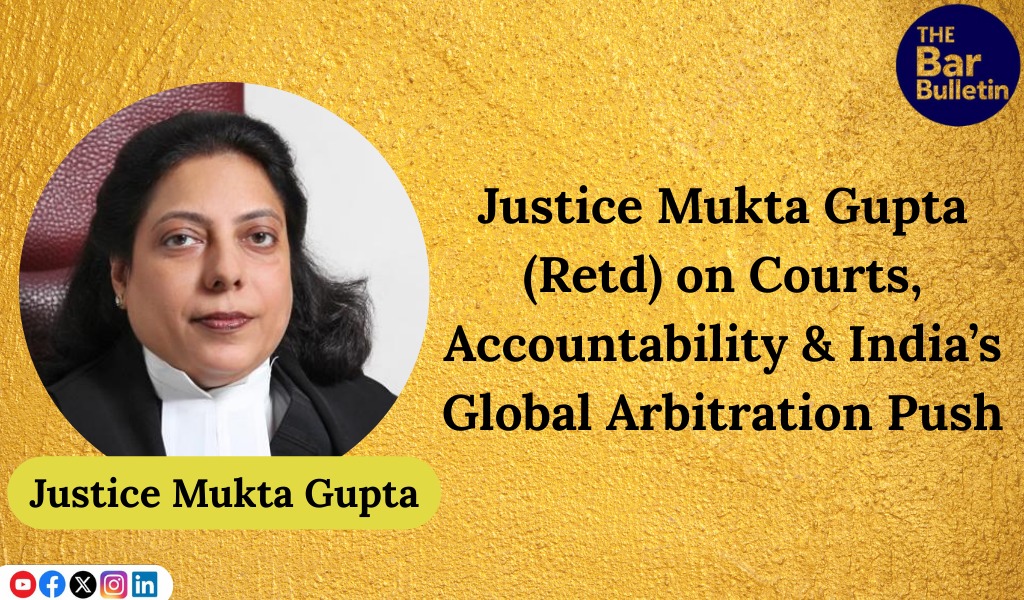

At the Quadrant Chambers breakfast session during Delhi Arbitration Weekend 2025, Justice Mukta Gupta reflects on how courts can help arbitral institutions safeguard against fraud, the evolving balance between arbitral autonomy and accountability in India, and the event’s role in strengthening the country’s position as an international arbitration hub.
1. How do you think Delhi Arbitration Weekend (DAW) or events like Delhi Arbitration Week can strengthen India’s position as an arbitration hub?
Very frankly, any cross-border discussions with other stakeholders, the way they are practising arbitration, the anomalies they feel, the problems they face, is an experience in itself.
We have many of the speakers who have come from outside. They share their views, and we share our views. So with this exchange of views, of course, you try to pick up the best, which helps you in the long run. And I’m sure you’ve seen the way DAW itself over the years has progressed. More and more lawyers, litigants, and general counsels are attracted towards it because everybody wants to have the knowledge of what is going on in other countries, if there are some good practices that can be adopted over here, and our good practices can be adopted there.
2. How can courts support arbitral institutions in safeguarding procedures against fraud?
One method which is now being awarded is that once a draft award is prepared, it will be circulated, and then the institution will look into if there is some element of fraud or deception or something. In my experience as a judge or a lawyer, is that detecting fraud is not an easy thing. It’s generally not so apparent. So one has to go deep into it, and the person who is conducting the proceedings is the best person to find out if there has been some fraud.
Now, the problem is if an arbitrator finds out and spells out in the award, it is good. But to be able to find out an element of fraud by the arbitrator itself, it has to be too apparent. Unless you have gone through each and every part of those proceedings and pleadings, which even by a mere reference to or going through the draft award, you will not be able to direct. I think there should be an expert committees that have time to go deeper, and that will be a second level of scrutiny into the system
3. Is there any policy reform you think which might come, and we can have a second level of scrutiny?
Slowly, everywhere and in all institutions, these draft rules are being prepared—that scrutiny of the draft award should be there. And slowly, when on scrutiny, some errors amounting to fraud are found, we’ll progress and have rules on that also.
4. How do you see that balance between arbitrator’s autonomy and accountability is evolving in India’s arbitration landscape?
As I emphasised, if party autonomy is a grand norm, accountability, impartiality, and independence of the arbitrator is also very important facet to arbitration. Parties cannot have it that, they will have the arbitrator of their choice and the award of their choice. So that should not be the element. Despite the best of party autonomy principles being applicable to arbitration, it is primarily an adjudicatory process. And any adjudicatory process should be free from any fraud or bias.
As far as the challenge to the appointment of arbitrators is concerned, sometimes it is a genuine challenge, sometimes it is a deliberate challenge. They see that probably one of the arbitrators is not going according to their wishes, so they go and challenge in the courts, which is very unfortunate. But certainly, the courts are there to look into all these acts, and I am sure the courts have never encouraged all these.
5. If you have to define Delhi Arbitration Week in one word, what would that be?
I would say it is the sangam of arbitration.