
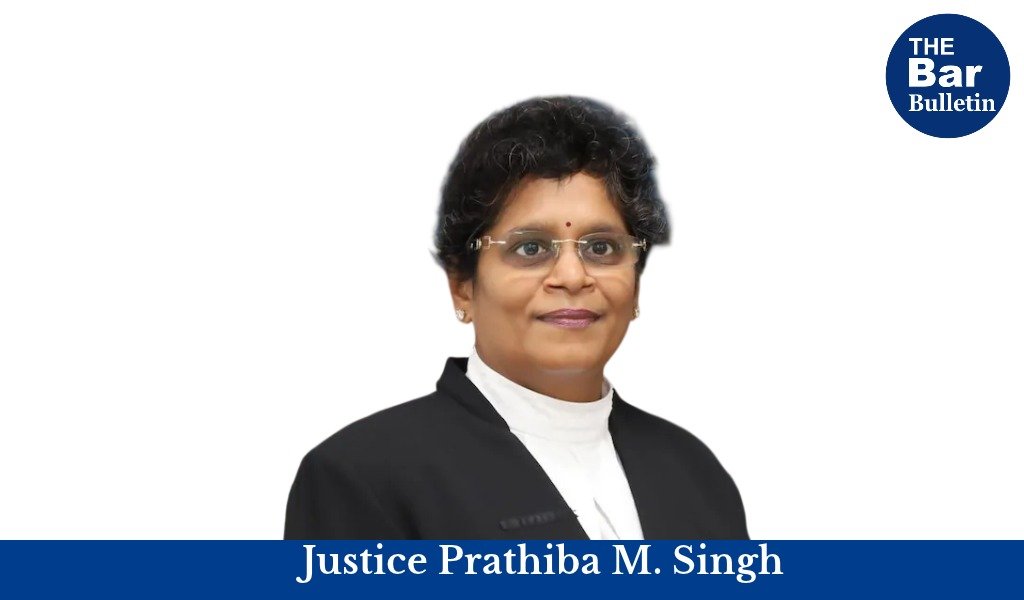

Justice Prathiba M. Singh of the Delhi High Court has emphasised the need for comprehensive judicial reforms, greater use of technology and a reduction in government litigation to ensure that India’s judicial resources are devoted to resolving civil and commercial disputes.
Speaking at a panel discussion titled “Shaping the Legal Architecture of Viksit Bharat: The Supreme Court and India @ 2047” on November 5, 2026, Justice Singh highlighted how India’s experience with commercial courts and specialised Intellectual Property (IP) divisions demonstrates the potential of institutional and procedural reforms in improving the efficiency of the justice delivery system.
Addressing the persistent problem of pendency, Justice Singh referred to an interaction with a Brazilian judge during an international conference, who had informed her that approximately 40% of cases in Brazil were being decided through an AI-based system. According to the account shared by the Brazilian judge, these were largely cases that did not require substantial human intervention, including certain accidental and negotiable instrument matters.
She observed that such developments demonstrate the potential of technology in reducing judicial workload and addressing the challenge of pendency, while allowing judges to concentrate on matters requiring greater judicial application.
Commercial Courts: A Model for Procedural Reform
Explaining the success of the Commercial Courts Act, Justice Singh said that one of its principal strengths was the considerable discretion it gives judges in managing proceedings.
Referring to provisions such as Order XXXVIII and Order XV of the Code of Civil Procedure, she highlighted how judicial discretion in case management enables courts to narrow down issues, reduce the number of witnesses and hearings, and undertake summary adjudication wherever appropriate.
She questioned why similar procedural flexibility should not be extended to the broader civil justice system, particularly when India already has nearly a decade of experience with commercial courts.
Drawing an interesting comparison with the English civil procedure framework, Justice Singh referred to the importance of judicial discretion in allocating judicial resources to individual cases, depending on their nature, complexity and costs involved.
She emphasised that procedural reforms should seek to eliminate unnecessary obstacles and enable courts to allocate time and resources proportionately to the demands of each dispute.
Justice Singh also identified the establishment of specialised Intellectual Property divisions as another significant reform.
Referring to the creation of the IP Division in the Delhi High Court, followed by similar initiatives in the Madras and Calcutta High Courts, she observed that specialised adjudication has substantially strengthened India’s intellectual property enforcement framework.
She highlighted the courts’ approach towards trademark and copyright infringement, including the grant of injunctions, dynamic injunctions and measures addressing infringement through e-commerce platforms, particularly in relation to food and medicines.
She noted that specialised IP adjudication has enabled disputes to be resolved within significantly shorter timelines, with a substantial proportion of cases being disposed of within a year.
India’s Position in Pharmaceutical Patents and Standard Essential Patents
Discussing India’s pharmaceutical patent regime, Justice Singh referred to the introduction of Section 3(d) of the Patents Act, 1970, through the 2005 amendment, and the international criticism that India faced over its approach to pharmaceutical patents.
She observed that subsequent developments, particularly during the COVID-19 pandemic, demonstrated the importance of India’s approach towards preventing evergreening and ensuring that patents are granted for genuine innovations rather than merely modified versions of existing molecules.
She also highlighted India’s growing significance in disputes concerning Standard Essential Patents (SEPs). Referring to a recent international seminar in Geneva involving members of the industry and judiciary, she observed that India has emerged as one of the leading jurisdictions in this area.
She attributed this development, in part, to India’s economic significance and the importance of its market for global technology and telecommunications companies. Unlike certain jurisdictions where companies may choose to withdraw from a market rather than face an injunction, the commercial importance of India makes its judicial decisions particularly consequential in SEP disputes.
Reducing Government Litigation to Free Judicial Resources
Towards the conclusion of her address, Justice Singh underlined the need to reconsider the manner in which judicial resources are utilised.
She pointed out that a significant distinction between the ordinary jurisdiction of courts and their extraordinary writ jurisdiction arises from the involvement of governmental authorities.
Emphasising the need to reduce government litigation, she observed that doing so would enable courts to dedicate greater judicial resources to resolving civil disputes between private parties, which constitute an essential part of their adjudicatory function.
She also called for greater technological integration in the legal system, improved legal education for lawyers and judges, and the expansion of law schools to strengthen the country’s legal ecosystem.
The panel discussion was part of the event organised under the theme “Shaping the Legal Architecture of Viksit Bharat: The Supreme Court and India @ 2047”, held at the University of Chicago Center in Delhi on November 5, 2026. The panel also featured Justice V. Mohana of the Supreme Court of India, Solicitor General Tushar Mehta, Senior Advocate Arvind Datar and NITI Aayog Mission Director Deepak Bagla. Dr. Sanjeev Gemawat moderated the discussion.