
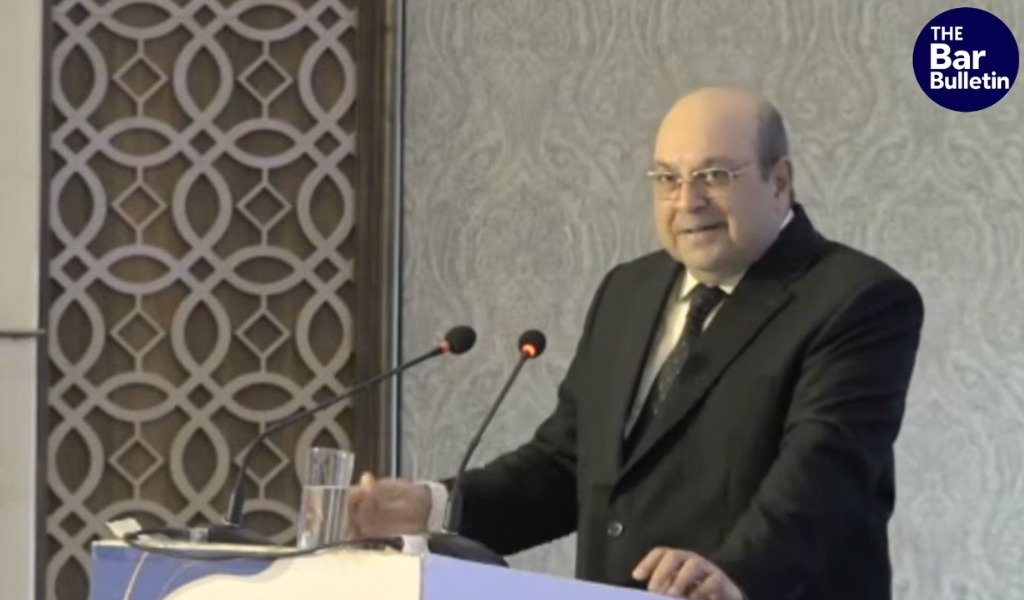

Former Supreme Court Judge Justice Rohinton Fali Nariman, addressing the inaugural ceremony of GHAC Arbitration Week 2026, called for a fundamental rethink of the appellate framework governing arbitral awards, arguing that after nearly three decades of the Arbitration and Conciliation Act, 1996, the time has come to introduce a full-fledged appeal on both facts and law before a Division Bench of the High Court.
Justice Nariman observed that while the 1996 Act was intended to make arbitration cost-effective, efficient and speedy, its working over the last 30 years has exposed significant deficiencies. He particularly criticised the absence of certainty in recent Supreme Court jurisprudence, noting that important questions have repeatedly been reopened, sometimes within a short span of time. According to him, “the judgements don’t conduce to certainty” and repeated reopening of settled questions has led to grave uncertainty in arbitration law.
Tracing the evolution of Indian arbitration law, Justice Nariman said the 1996 Act was a significant improvement over its predecessors but retained certain structural problems. While timelines were introduced for several stages of arbitration and challenges to awards, he pointed out that appeals from decisions on challenges to awards do not carry equivalent timelines, allowing disputes to continue through the appellate hierarchy and, ultimately, to the Supreme Court.
He also examined a series of recent Supreme Court decisions, including Cox and Kings, the seven-Judge decision concerning the interplay between the Stamp Act and the Arbitration Act, the Delhi Metro Rail curative proceedings, and the decision concerning unilateral appointment of arbitrators. Justice Nariman said these judgments raised concerns about consistency and certainty in arbitration jurisprudence. He particularly criticised the broadening of grounds of interference at the curative stage in the Delhi Metro Rail matter, warning that it could expose arbitral awards to factual review at a stage when they ought to have attained finality.
On the cost and speed of arbitration, Justice Nariman proposed that arbitrators could agree with parties at the outset on a lump-sum fee that would not vary with the number of hearings, with the fee deposited in escrow and released only upon delivery of the award. He suggested that such a mechanism could reduce incentives for prolonged hearings.
He further suggested eliminating the single-judge stage in challenges to arbitral awards and moving directly to a Division Bench, coupled with a defined one-year timeline. According to him, this could substantially reduce the time consumed in court proceedings.
Justice Nariman’s principal reform proposal, however, was a full appellate review on facts and law at the Division Bench stage. He argued that because arbitrators are required to give reasoned awards and those awards are governed by the substantive law of India, the reasons should be capable of meaningful appellate scrutiny. He said the objective should be to ensure that an award is “as accurate as a trial court judgment.”
He emphasised that arbitration must simultaneously deliver speed, cost-effectiveness and accuracy, particularly given the complexity of contemporary commercial contracts and the scale of disputes involving large corporations. A system where an award that is wrong on facts or law nevertheless passes without meaningful appellate scrutiny, he suggested, risks undermining confidence in arbitration.
Justice Nariman concluded that such reforms could restore arbitration to its original objectives: cost effectiveness, decongestion of courts, speed and reliable adjudication. He said that if the proposed approach is adopted, the Arbitration Act could return to its original footing and help India move forward as an arbitration-friendly jurisdiction.