
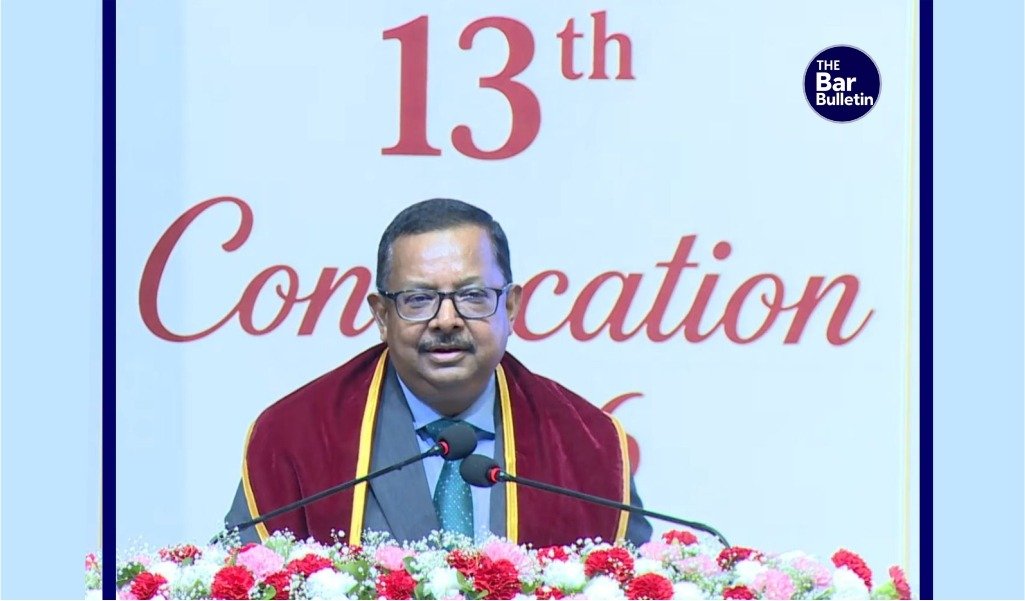

Justice Ujjal Bhuyan addressing the 13th Convocation of the LLM programmes of National Law University, Delhi (NLUD), urged graduating students to carry forward not merely their legal knowledge but also the values of integrity, courage, independent thought and constitutional responsibility.
Addressing students who are entering the legal profession as well as those pursuing further academic research, Justice Bhuyan said the legal profession rests on a foundation of ethics, much of which is not codified, and that maintaining professional integrity requires “a lot of courage and conviction.”
“
“The path of integrity and upholding your character is difficult, particularly when no one is watching. But in that very demand lies the possibility of living greatly,”
Justice Bhuyan said, while extending his best wishes to students joining the Bar.
Referring to Justice Oliver Wendell Holmes’ idea that the practice of law should not merely be a way to earn a living but “a way to make out a life”, Justice Bhuyan said that living greatly meant striving for something larger than oneself, particularly the pursuit of justice.
He also highlighted the importance of legal academia and called for greater recognition of the role that legal scholars can play in the development of Indian law. Pointing to Article 124(3) of the Constitution, he noted that while it permits a “distinguished jurist” to be appointed as a judge of the Supreme Court, no legal academic has so far been appointed to the Supreme Court under this category.
Justice Bhuyan argued that the absence of such appointments deserved greater consideration, observing that distinguished legal academics could bring intellectual depth and a different perspective to the Supreme Court. He said the constitutional provision was intended to widen the field of choice beyond judges and practising advocates and referred to the Constituent Assembly debates surrounding the inclusion of the distinguished jurist category.
He further pointed to examples from jurisdictions including the United States, United Kingdom, Canada and Kenya where distinguished academics have been appointed to constitutional or apex courts, and urged Indian legal academia to debate the issue and bring it back into the public domain.
Turning to the role of legal education, Justice Bhuyan said its greatest value was not simply teaching students to know the law, but giving them “the courage to question” established assumptions and examine whether the application of law in a particular situation has served the cause of justice.
He emphasised that questioning must be accompanied by a willingness to engage with answers that may differ from one’s own perspective. A healthy academic environment, he said, does not require everyone to reach the same conclusion but must allow different views to be expressed, examined and debated.
Justice Bhuyan stressed that tolerance of disagreement and dissent is fundamental to constitutional democracy. Quoting Joseph Joubert, he said, “It is better to debate a question without settling it, than to settle it without a debate.”
He further said that a democratic society cannot be built on the assumption that everyone will think alike, and that differences must be accommodated within the constitutional framework.
“
“In a democracy, a right to question is not an act of defiance. It is an essential expression of citizenship, liberty and constitutional responsibility,” Justice Bhuyan said.
He cautioned that students expressing a different point of view or asking questions cannot be threatened with punitive action, describing such conduct as unconstitutional and a misuse of power and office.
Referring to Justice O. Chinnappa Reddy’s observations in Bijoe Emmanuel v. State of Kerala, Justice Bhuyan reiterated that tolerance is a constitutional value and said that a democracy is meaningful not when everyone speaks the same language of thought, but when different voices can coexist, be heard and treated with dignity.
“
“An intolerant mind, by its very nature, is at odds with the spirit of the Constitution,” he said, adding that disagreement or dissent must not be treated as something that needs to be silenced, rejected or punished.
Justice Bhuyan also highlighted the role of universities in sustaining constitutional democracy. According to him, universities must be spaces where individuals encounter ideas different from their own, established positions can be questioned and disagreements can be addressed through reason rather than hostility.
Concluding his address, Justice Bhuyan urged the graduating students to leave NLUD with the confidence to think independently and with a democratic culture of listening to other perspectives.
“Continue to ask, continue to listen and continue to engage,” he told the graduates.