
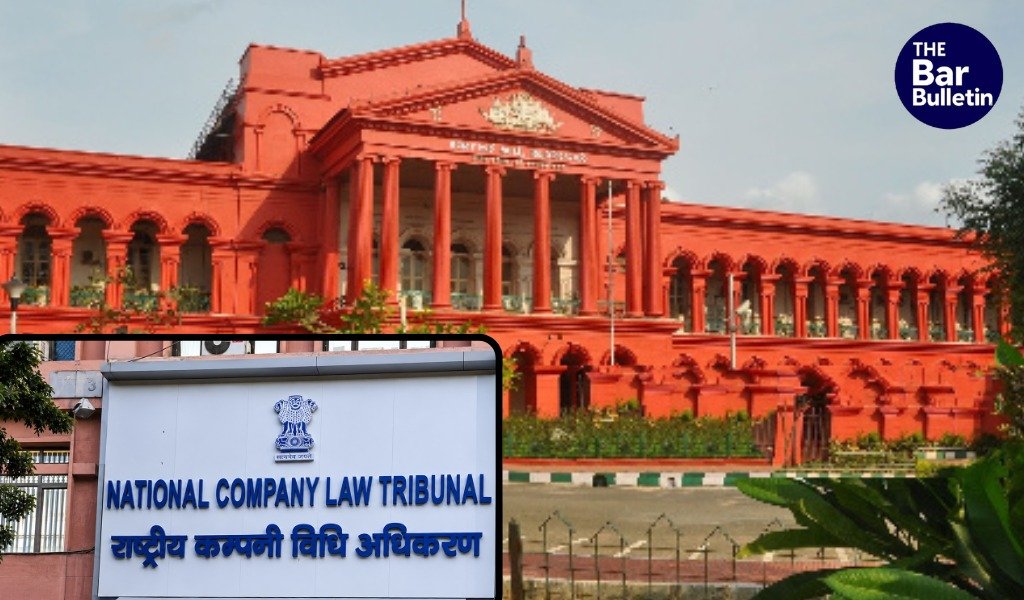

In a significant ruling on the interplay between RERA recovery proceedings and the Corporate Insolvency Resolution Process, the High Court of Karnataka at Bengaluru Bench dismissed a petition filed by landowners seeking to quash a public auction notice issued under Section 41 of the RERA Act against a developer undergoing CIRP, holding that all questions relating to the assets of the corporate debtor fall within the exclusive domain of the NCLT.
The Court held that once the Corporate Insolvency Resolution Process has commenced and proceedings are pending before the NCLT, the High Court under Article 226 of the Constitution cannot bypass the NCLT’s exclusive jurisdiction to determine questions relating to the assets of the corporate debtor, including the execution of a Recovery Certificate issued under Section 41 of the RERA Act. The Court further held that a landowner who enters into a Joint Development Agreement is, by virtue of the Explanation to Section 2(zk) of the RERA Act, deemed to be a promoter and is jointly and severally liable under the Act, and cannot disown that statutory status while claiming the benefits of the agreement.
The Court also laid down that a Public Auction Notice issued in execution of a Recovery Certificate is merely a consequential step, and unless the underlying Recovery Certificate is stayed or set aside, the execution proceedings cannot be interdicted at the instance of a person incidentally affected by such execution.
A Single Judge Bench of Justice Suraj Govindaraj observed that the petitioners, having entered into a Joint Development Agreement with the developer, cannot escape the statutory consequences flowing from Section 2(zk) of the RERA Act, which deems both the developer and the landowner to be promoters who are jointly and severally liable for obligations under the Act. The Court explained that Explanation appended to Section 2(zk) specifically provides that where the person who develops the project and the person who sells the apartments or plots are different persons, both shall be deemed to be promoters and shall be jointly responsible for the obligations and liabilities arising under the Act.
The Court noted that the petitioners cannot simultaneously claim the benefits of the Joint Development Agreement and yet contend that the RERA proceedings concern only Respondent No. 5. The Court further observed that the petitioners had not challenged either the order passed by the RERA Authority or the Recovery Certificate issued pursuant thereto, and that the appropriate remedy, if aggrieved, was to challenge the adjudicatory order or the Recovery Certificate before the forum known to law.
The Court held that the auction notice is merely an execution proceeding, and so long as the Recovery Certificate remains valid and enforceable, the executing authority is under a legal obligation to execute the same, and execution proceedings cannot ordinarily be interdicted merely because a person incidentally affected raises objections. The Court also observed that while Section 238 of the IBC does give overriding effect to the provisions of the Code over inconsistent provisions of other enactments, questions relating to whether a particular proceeding can continue, whether any asset forms part of the insolvency estate, whether the moratorium under Section 14 is attracted, and whether any protective orders are required, all fall squarely within the jurisdiction of the NCLT supervising the CIRP.
The Court emphasised that it cannot, while exercising jurisdiction under Article 226 of the Constitution, assume the role assigned by Parliament to the NCLT under the IBC, and that any order staying the execution proceedings solely on the basis of the pendency of the CIRP would necessarily require the Court to enter into questions relating to the scope of the moratorium, the extent of the insolvency estate, the rights of the Resolution Professional, and the effect of the Recovery Certificate on the insolvency proceedings, all of which properly fall within the domain of the NCLT.
Briefly, the petitioners, M. Govind Reddy and M. Yashodamma, are the absolute owners of a piece of land situated in Bengaluru, who had entered into a Joint Development Agreement (JDA) with Respondent No. 5, Venkat Estates Private Limited, for the development of their property. Respondent No. 5 was subsequently admitted into the Corporate Insolvency Resolution Process (CIRP) under the Insolvency and Bankruptcy Code, 2016 (IBC), and the CIRP is presently pending before the National Company Law Tribunal (NCLT).
Separately, a Recovery Certificate was issued against Respondent No. 5 under Section 41 of the Real Estate (Regulation and Development) Act, 2016 (RERA), pursuant to which Respondent No. 3, the Special Tahsildar, issued a Public Auction Notice dated June 06, 2026, seeking to bring the property to auction. The petitioners, who were admittedly not parties to the proceedings before the RERA Authority, approached the Karnataka High Court seeking to quash the auction notice and to restrain the State authorities from enforcing the Recovery Certificate against Respondent No. 5.
