
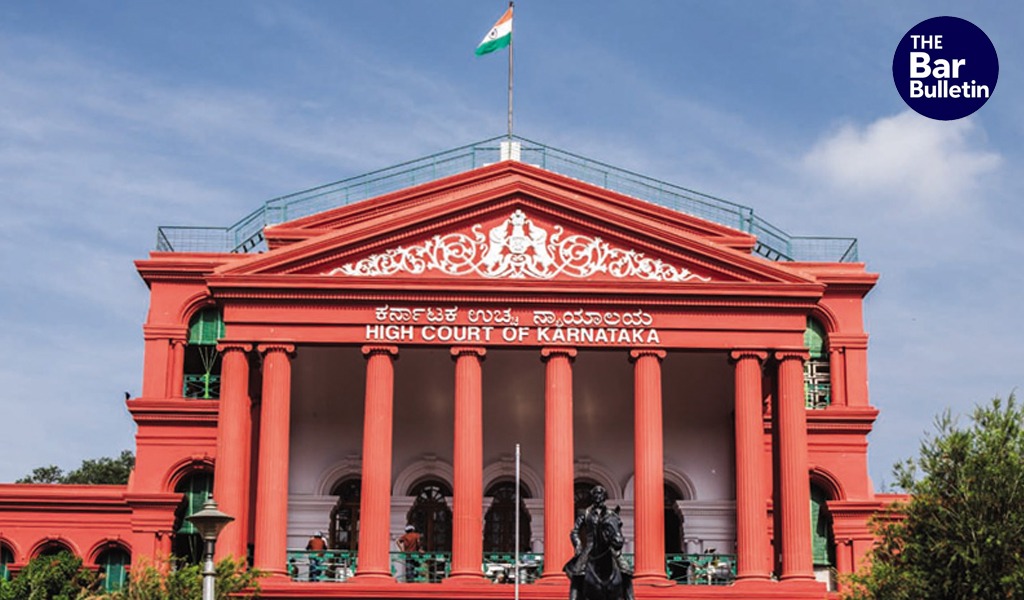

In a writ petition filed before the Karnataka High Court by an anti-corruption and social activist seeking quashing of a letter dated 25-04-2022 by the Speaker of the Karnataka Legislative Assembly, a Single Judge Bench of Justice S. Sunil Dutt Yadav set aside the impugned communication and directed the Speaker of the Legislative Assembly to pass appropriate orders.
Regarding the said letter, the Deputy Secretary of the Karnataka Legislative Secretariat took the stand that the Speaker was not the authority to appoint the Elected Representatives and accordingly, the question of granting sanction for carrying out investigation of prosecution did not arise. Aggrieved, the petitioner filed the present petition seeking setting aside of the letter and a direction to the Speaker to decide the request for sanction of prosecution under Section 19 of the Prevention of Corruption Act, 1988 (Act).
The petitioner had filed a private complaint arraying Members of the Legislative Assembly as accused for offences punishable under Sections 7, 8, 12, 13(1)(b), 13(2), and 15 of the Prevention of Corruption Act, 1988 and Sections 120A, 120B, 171B, 201, 202, and 511 of the Indian Penal Code, 1860. The complaint averred that accused 1 had stated that accused 3 had lured him to cross over from the JD(S) Party to the BJP Party by offering Rs. 30 Crores and an advance of Rs. 5 Crores was paid and received.
The trial court initially took cognizance and summoned the accused, but this direction was set aside by the Court in previous writ petitions. The Court relegated the matter back to the Special Judge to follow the procedure under Section 19(1)(c)(ii) of the Prevention of Corruption Act, which required calling upon the complainant to obtain sanction for prosecution. Consequently, the petitioner made a representation dated 03-03-2022, to the Speaker seeking sanction.
However, the Deputy Secretary of the Karnataka Legislative Secretariat issued a communication dated 25-04-2022, conveying the Speaker’s stand that since the Speaker was not the appointing authority of the elected representatives, the question of granting sanction did not arise. Thereafter, the petitioner made another effort before the trial court seeking issuance of directions to the Speaker, which was turned down by an order dated 12-07-2022.
The Court referred to the Supreme Court’s decision in P.V. Narasimha Rao and Ors. v. State (CBI/SPE) (1998) 4 SCC 626, and stated that the absence of an authority competent to remove a Member of Parliament and to grant sanction for his prosecution under Section 19(1) of the Act, the court can take cognizance of the offences mentioned in the said provision in the absence of sanction. It was also observed that till such provision is made by the Parliament, the prosecuting agency is required to obtain permission of the Rajya Sabha Chairman/Lok Sabha Speaker before filing a charge sheet in respect of the offences referred to in Section 19.
Further, the Court said that even though sanction cannot be taken, the Speaker’s permission is required till such time that the Parliament makes provision even before the charge sheet is filed. It was stated that this legal position ipso facto extended to the Legislators of the Assembly.
The Court noted that while rejecting the memo by the complainant, the trial court had ordered “await sanction by 12-07-2022”. Considering the Speaker’s stand, the Court found it appropriate to set aside the impugned letter and remit the matter for deciding afresh. It was stated that the legal requirement of the statute for obtaining the prosecution’s sanction could not be insisted upon and that it would suffice if the Speaker’s permission is obtained before filing of the charge-sheet.
It was said that although such permission was required to be obtained by the prosecution agency where the proceedings was in the nature of a private complaint, the complainant himself could be called to obtain such permission at the same stage where sanction is to be obtained as per Section 19, where the court not having dismissed the complaint under Section 203, intends to proceed further. The Court held that when the trial court called upon the complainant to obtain sanction, the response made by the impugned letter did not satisfy compliance of the court’s order.
Thus, the Court set aside the impugned communication and directed the Speaker to reconsider and pass appropriate orders upon request of the complainant.
