
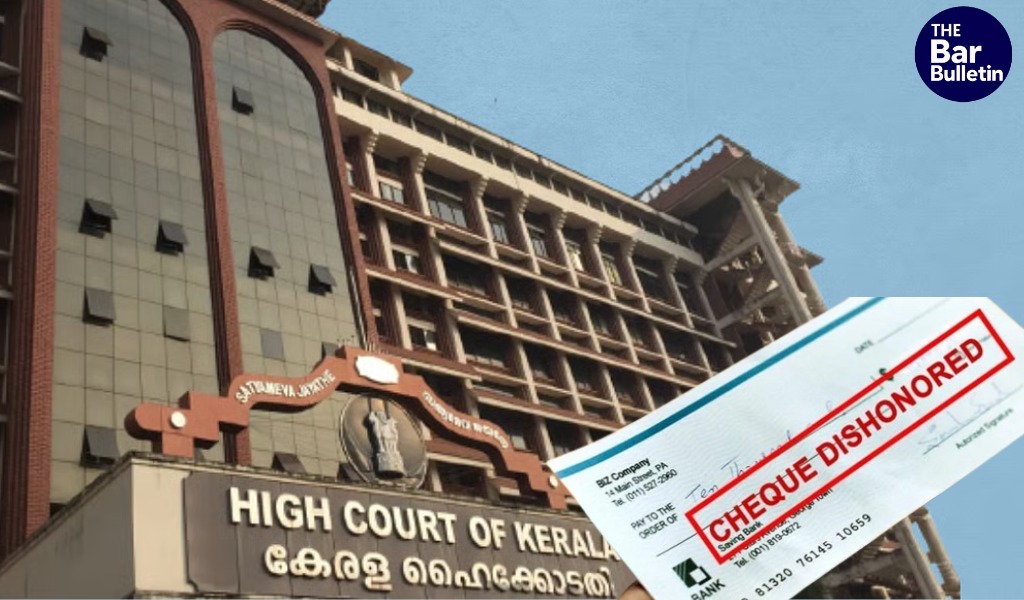

The Kerala High Court (Ernakulam Bench) has held that where the complainant fails to prove, through a witness with direct knowledge, the transaction that led to execution of the cheque and the passing of consideration, the initial burden necessary to invoke the presumptions under Sections 118 and 139 of the NI Act remains undischarged. In such a situation, the complainant is disentitled to the benefit of those presumptions, and a finding that the offence under Section 138 has not been proved beyond reasonable doubt cannot be faulted. Accordingly, the High Court confirmed the acquittal recorded by the Magistrate.
The Court underscored that the statutory presumptions under Sections 118 and 139 of the NI Act do not operate in the abstract. The complainant must first lay a credible factual foundation regarding the underlying transaction and the execution of the cheque. Where the person who actually advanced the money and maintained contemporaneous records is not examined, and the complainant lacks direct knowledge of the transaction, the prosecution may fail at the threshold itself.
A Single Judge Bench of Justice A. Badharudeen observed that in a prosecution under Section 138 of the NI Act, the complainant may avail the twin presumptions under Sections 118 and 139, but only after proving the transaction and execution of the cheque in a convincing manner. The Bench specifically noted that this would necessarily include proof of the passing of consideration covered by the cheque.
The Bench further held that such proof must come from a person having direct knowledge of the transaction and execution of the cheque, and that the evidence of a person without such direct knowledge would be insufficient for that purpose. On the complainant’s own showing, the money was paid by his father to the accused in five instalments, and the details were recorded by the father in a notebook which was not produced before the court.
On that basis, the Bench found that the transaction and the passing of consideration were in fact between the complainant’s father and the accused, and that the complainant himself did not know the transaction or execution of the cheque, including the passing of consideration. The Bench therefore held that the competent person to depose on these aspects was the complainant’s father, who was not examined.
Briefly, the complainant had instituted prosecution under Section 138 of the Negotiable Instruments Act, 1881, alleging dishonour of a cheque for Rs. 4.50 lakhs, said to have been issued by the accused towards discharge of a debt allegedly borrowed from the complainant. The trial court acquitted the accused, and the complainant challenged that acquittal before the Kerala High Court in the present criminal appeal.
The evidentiary record consisted of PW1’s testimony, including the cheque, dishonour memo, intimation memo, statutory notice, postal receipt, and acknowledgment. However, during cross-examination, PW1 admitted that the amount had actually been paid to the accused by his father in five instalments, that the father had maintained a notebook recording those instalments, and that the notebook was available at home but was not produced in evidence.
PW1 further stated that he did not know whether the accused had agreed to repay within any specific period, that he was unaware when the first instalment was paid, and that although a stamp paper and cheque had been obtained, he had not read what was written in the agreement. The complainant’s father, who had direct involvement in the alleged transaction, was not examined.
