
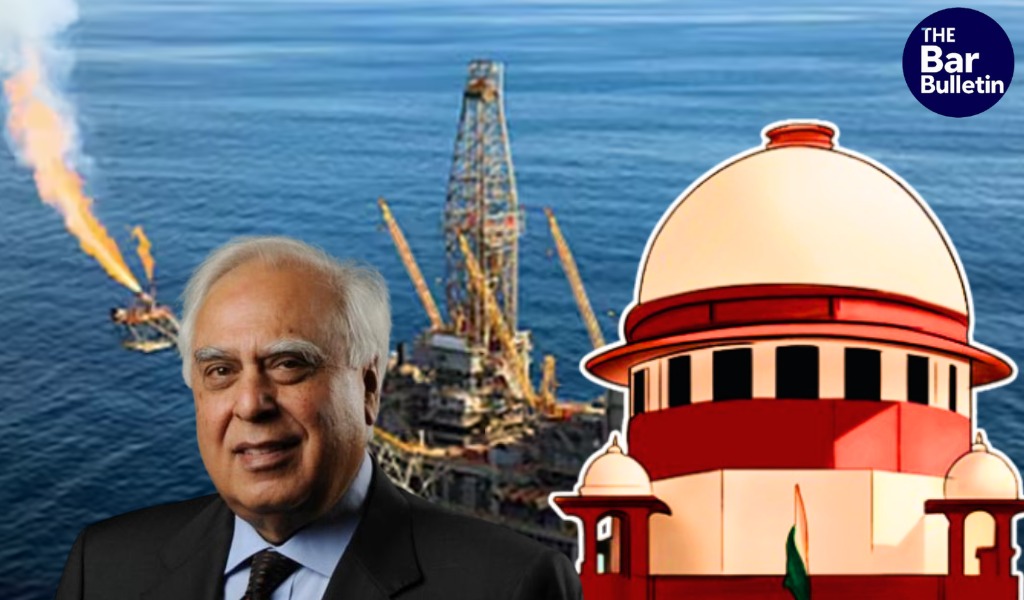

Senior Advocate Kapil Sibal on Thursday defended the arbitral award in favour of Reliance Industries Limited and Niko Resources in the KG-D6 gas migration dispute, cautioning that excessive judicial interference with arbitral awards could adversely impact foreign investment and technology inflow into India’s energy sector.
Mr Sibal further challenged the Delhi High Court judgment for setting aside the arbitral award on “public policy” grounds and submitted that such intervention would undermine investor confidence in India’s arbitration framework.
“If arbitral awards are interfered with in this fashion, and I say this with some sense of responsibility, the flow of finance and technology into this country, particularly in a sector that forms the substratum of economic development, will slow down, as indeed it already has and continues to. That is why legislation must be interpreted in alignment with the contractual framework, and contracts must be interpreted consistently with the legislative policy, so as to inspire confidence among foreign investors, subject, of course, to cases involving fraud. As Your Lordships observed, investors must have confidence that arbitral awards of this nature will not be interfered with lightly. That, My Lords, is the essence, and that is how the judicial approach ought to be.”
Mr Sibal also defended the international commercial arbitration structure under the PSC framework, arguing that mandatory nomination of an Indian operator could not convert the dispute into a purely domestic arbitration. According to him, the entire contractual and statutory framework under NELP was intended to encourage foreign participation and technological collaboration in India’s energy sector.
Referring to emerging technologies and artificial intelligence infrastructure, Senior Advocate Kapil Sibal stressed that India’s future economic growth would require enormous energy resources, making foreign investment and technology crucial for the country’s development. He argued that India’s energy policies, including the New Exploration Licensing Policy (NELP), were framed precisely to attract foreign capital and technological expertise into the oil and gas sector.
Explaining the broader policy framework behind the KG-D6 production sharing contracts, Mr Sibal told the Court that India lacked both sufficient capital and cutting-edge extraction technology, making foreign investment indispensable.
“I say that because energy is the source of all development. In the absence of access to energy resources, development is a very difficult process. It may be gas, it may be petroleum, it may be coal, it may be new forms of energy….We need investment into this country because we need both capital and technology. That’s our requirement. And that’s how FDI flows into this country,” he argued.
He further argued that the NELP regime was consciously designed to place public sector companies like Oil and Natural Gas Corporation and private players on equal footing without any preferential treatment. “ONGC has no preferential treatment. ONGC and private entities were meant to compete on the same terms,” he submitted, adding that the Government itself had framed the policy to attract private participation into deep-sea exploration.
On the core allegation that Reliance had extracted migrated gas from adjoining ONGC blocks, Mr Sibal contended that underground gas migration was scientifically uncertain and impossible to precisely measure.“Nobody knows how gas moves underground. We don’t know how it escaped, where it went, or what part migrated,” he argued, while explaining that geological estimates regarding gas reserves often turn out inaccurate because of subterranean movements and pressure variations.
Defending the consortium’s conduct, Mr Sibal submitted that Reliance had drilled and extracted gas only from wells located within its own contract area and had not carried out any extraction in ONGC’s allocated block. He also argued that the Government had at all times retained ownership over the gas under the Production Sharing Contract (PSC), and that royalty and profit petroleum obligations had been fully discharged.
Background of the case
The KG-D6 dispute concerns allegations that Reliance Industries Limited extracted natural gas that had allegedly migrated from adjoining blocks allocated to Oil and Natural Gas Corporation in the Krishna-Godavari Basin off the Andhra Pradesh coast.
Under India’s New Exploration Licensing Policy (NELP), the Government allotted different offshore exploration blocks to various companies. Reliance received the KG-D6 block, while ONGC was allotted adjacent blocks. Reliance, along with its consortium partners BP plc and Niko Resources, developed and began producing gas from the D1 and D3 fields within KG-D6.
The Government and ONGC later alleged that gas from ONGC’s adjoining reservoirs had naturally migrated into Reliance’s block due to pressure differences underground and that Reliance knowingly extracted and commercially benefited from this “migrated gas” without proper disclosure or approval. Based on this allegation, the Government raised a demand of about USD 2.8 billion against the consortium.
Reliance and its partners denied wrongdoing, arguing that:
- they extracted gas only from wells drilled within their own contract area;
- there was no drilling or extraction inside ONGC’s block;
- underground gas migration is a natural geological phenomenon; and
- all gas produced, including any allegedly migrated gas, still belonged to the Government under the Production Sharing Contract (PSC), with royalty and profit petroleum duly paid.
The dispute went to arbitration, where a tribunal ruled in favour of Reliance and its partners in 2018, holding that the PSC did not prohibit extraction of gas flowing into Reliance’s block so long as the wells were located within the contract area. However, the Delhi High Court later set aside the award, holding that it violated India’s “public policy” and public trust doctrine. The matter is now before the Supreme Court.
Niko’s involvement arises because it was one of the original foreign consortium partners in the KG-D6 project. Under the PSC structure, Reliance was the operator of the block, while Niko and later BP held participating interests, contributing investment and technical support. Since the arbitration award and damages claim affected all consortium members, Niko has separately challenged the Delhi High Court judgment before the Supreme Court.
Senior advocate Kapil Sibal is arguing for NIKO in this matter.