
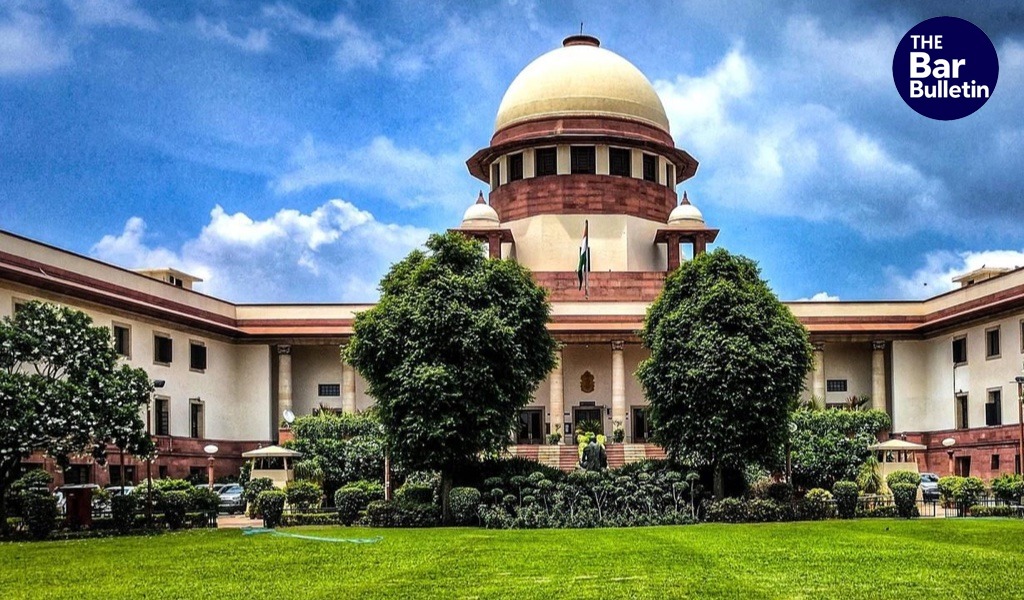

The Supreme Court has held that Special Courts under the Prevention of Money Laundering Act cannot take cognizance of a prosecution complaint without first giving the accused an opportunity of hearing, as mandated under the first proviso to Section 223(1) of the Bharatiya Nagarik Suraksha Sanhita, 2023 (BNSS).
A Bench of Justices M. M. Sundresh and Nongmeikapam Kotiswar Singh allowed the appeal and set aside the Uttarakhand High Court judgment as well as the Special Court’s cognizance order passed in a PMLA case.
The Enforcement Directorate had registered an ECIR against the appellant in July 2023 and filed a prosecution complaint on June 24, 2024, shortly before the BNSS came into force on July 1, 2024. Cognizance, however, was taken by the Special Court on July 2, 2024 without hearing the accused.
The core issue before the Court was whether the first proviso to Section 223(1) of the BNSS which states that “no cognizance of an offence shall be taken by the Magistrate without giving the accused an opportunity of being heard”, would apply to PMLA complaints filed before the BNSS came into force but where cognizance was taken afterwards.
Read more at- SC to examine applicability of BNSS to Pre-July 2024 Complaints with Post-July Cognizance https://thebarbulletin.com/sc-to-examine-applicability-of-bnss-to-pre-july-2024-complaints-with-post-july-cognizance/
The Supreme undertook an extensive legal and factual analysis of the interplay between the Prevention of Money Laundering Act (PMLA) and the Bharatiya Nagarik Suraksha Sanhita, 2023 (BNSS), ultimately holding that the accused has a substantive right to be heard before cognizance is taken in a PMLA complaint filed after the BNSS came into force.
The Court first examined the statutory framework of the PMLA, particularly Sections 43, 44, 46, 65 and 71, and noted that while the PMLA is a special statute, it expressly incorporates criminal procedure provisions unless inconsistent with the Act. The Bench observed that Section 44(1)(d) of the PMLA mandates that trials before Special Courts shall proceed in accordance with the CrPC/BNSS as applicable to Sessions trials, while Sections 46 and 65 further extend the procedural framework of the CrPC/BNSS to PMLA proceedings.
The Court then analysed Section 223(1) BNSS, which states that “no cognizance of an offence shall be taken by the Magistrate without giving the accused an opportunity of being heard.” The Bench held that this proviso is not merely procedural but substantive in nature, as it confers a valuable right upon the accused flowing from the guarantee of fair trial under Article 21 of the Constitution.
“We do find that the allegations against the appellant are quite serious. However, non-compliance with the first proviso to Section 223(1) of the BNSS vitiates the very order taking cognizance, and the same cannot be sustained in the eyes of the law. In fact, the appellant has, at the earliest point in time, filed the application for recall of the order taking cognizance by placing reliance upon the said proviso. Had the Special Court allowed it, the trial would have proceeded further. Suffice it to state that the appellant cannot be faulted for any delay that has occasioned.”
The Court further held that the use of the word “shall” makes compliance mandatory, and any cognizance taken without hearing the accused would be “void ab initio.”
“Though Chapter XVI of the BNSS lays down the procedural law dealing with complaints made to a Magistrate, we hold that the aforesaid proviso is substantive in nature, as it does not merely regulate the manner in which the proceedings are to be conducted, rather it confers a right upon the accused to be heard before taking cognizance which forms a part of the right of an accused to a fair trial enshrined under Article 21 of the Constitution of India, 1950. We further hold that the word “shall” occurring in the said proviso has to be construed to be mandatory in nature, which enures to the benefit of an accused. Resultantly, cognizance of an offence taken by a Court without due compliance of the aforestated proviso would be void ab initio.”
Rejecting the Enforcement Directorate’s contention that proceedings had already commenced under the old CrPC regime before the BNSS came into force, the Court carefully examined the definition of “inquiry” under Section 2(1)(k) of the BNSS. The Bench held that merely numbering a complaint or posting it for hearing does not amount to commencement of an inquiry because an inquiry necessarily requires judicial application of mind.
The Bench also rejected the ED’s contention that the provisions governing complaint cases under the CrPC/BNSS do not apply to PMLA proceedings. Referring to earlier decisions in Tarsem Lal v. ED, (2024) 7 SCC 61; Yash Tuteja v. Union of India, (2024) 8 SCC 465 and Kaushal Kumar Agarwal v. Directorate of Enforcement, 2025 SCC OnLine SC 1221, the Court reaffirmed that Sections 223 to 228 of the BNSS apply to complaints filed under Section 44 of the PMLA.
Setting aside the cognizance order dated July 2, 2024, the Court directed the Special Court to hear the appellant afresh at the stage of cognizance and complete the exercise within eight weeks.
Appearances
For Petitioner- Mr. Sidharth Aggarwal, Sr. Adv. Mr. Ayush Kaushik, Adv. Ms. Shubhangni Jain, Adv. Mr. Sahil Dhingra, Adv. Mr. Karan Dhalla, Adv. Mr. Abhay Pratap Singh, AOR
For Respondent- Mr. Suryaprakash V. Raju, A.S.G. Mr. Zoheb Hussain, Adv. Mr. Annam Venkatesh, Adv. Mr. Samrat Goswami, Adv. Mr. Hitarth Raja, Adv. Mr. Arvind Kumar Sharma, AOR Mr. Pranjal Tripathi, Adv. Mr. Shaurya Sarin, Adv. Mr. Chinmay Panigrahi, Adv. Ms. Agrimaa Singh, Adv. Mr. Aryansh Shukla, Adv. Mr. Sai Shashank, Adv. Mr. Rohan Wadhwa, Adv. Mr. Vittal B, Adv. Mr. Ayush Anand, AOR Mr. Monu Kumar, Adv.
