
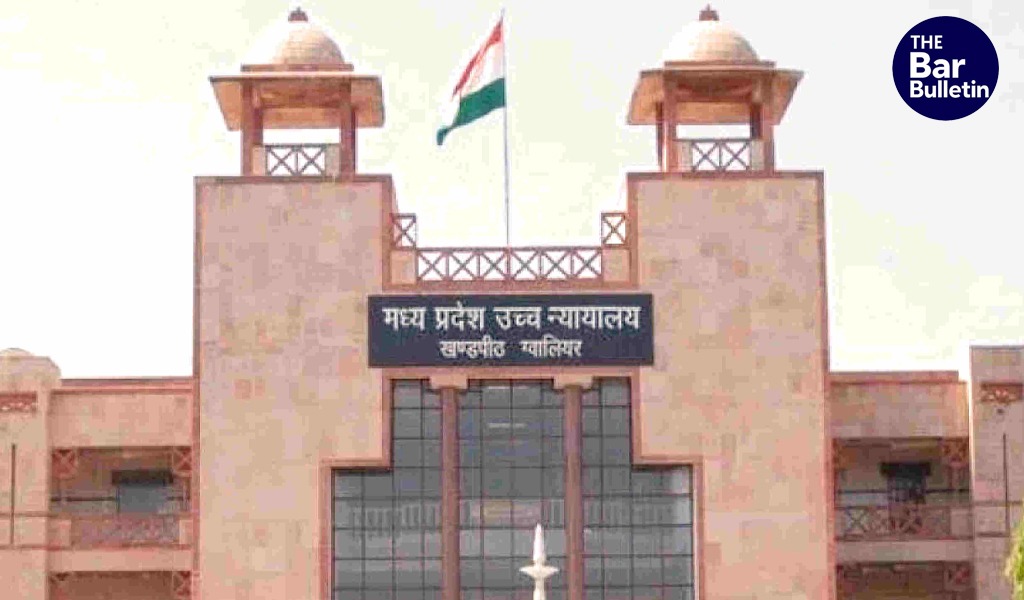

In an intra-court appeal filed before the Madhya Pradesh High Court under Section 2(1) of the Madhya Pradesh Uchcha Nyayalaya (Khand Nyayapeeth Ko Appeal) Adhiniyam, 2005, against an order dated 29-04-2026 by a Single Judge in the appellant’s writ petition seeking directions upon respondents to grant him terminal benefit including family pension provided in the Madhya Pradesh Civil Service (Pension) Rules, 1976, a Division Bench of Justice G.S. Ahluwalia and Justice Anuradha Shukla dismissed the petition.
The appellant’s wife was a permanent employee at the post of chowkidar in the Department of Tribal and Welfare. She passed away on 17-08-2022 during the course of employment and it was alleged that due to the respondents’ arbitrary actions, the family pension and other benefits payable to the appellant had not been paid. The Additional Collector, Gwalior, by an order dated 29-12-2022, issued a certificate regarding legal heirs of the deceased employees specifying her legal representatives, wherein the appellant’s name did not reflect as her husband’s name. Hence, the respondent’s case was that the appellant was not the deceased employee’s husband and was not entitled to any dues.
The Single Judge held that the appellant had failed to prove that he was the deceased employee’s husband, but liberty was granted to him to initiate proceedings to establish his relationship and then raise his claim before the competent authority. Challenging the impugned order, the appellant submitted that the person mentioned to be the deceased employee’s husband in the said certificate was her first husband, but in November 1998 they had been divorced. It was asserted that thereafter, the deceased employee performed court marriage with the appellant on 11-09-2000, and that even in her death certificate, the appellant’s name reflected as the husband.
The appellant also submitted that the deceased employee had also given an affidavit for change of nominee in which she had disclosed the appellant to be her husband. It was asserted that the appellant’s name reflected as the deceased employee’s husband in even in the GPF account.
The Court referred to the service book wherein the husband’s name was different and took note of a letter by the District Organizer in which an explanation was called from the deceased employee to clarify why her husband’s name appeared to be different. In her reply, the deceased employee specifically stated that her husband’s correct name was the one which appeared in the service book.
It was brought to the Court’s notice that no application was ever filed by the deceased employee for change of nominee. The Court noted that in the deceased employee’s son’s wedding invitation, the name of the husband was the one mentioned in the service book and found it clear that as per the deceased employee, the appellant was not her husband. Further, the Court took note of an application by the appellant before the Commissioner, stating that the appellant had married the deceased employee by executing an agreement of marriage. A copy of the notarized marriage agreement was also annexed with this application.
Referring to Section 5 of the Hindu Marriage Act, the Court stated that none of the parties to the marriage should have a living spouse at the time of marriage. It was stated that no decree, either under Section 13 or Section 13A of the HMA was obtained by any of the parties to end the deceased employee’s first marriage, and that divorce cannot take place merely on execution of a notarized agreement of divorce. Hence, the Court found that the first marriage of the deceased employee continued to subsist in absence of a decree for divorce.
The Court found it clear that no court marriage had taken place and stated that the appellant could not cite even a single instance to show the existence of such custom in the society as mentioned in the notarized agreement. It was held that marriage is not a contract under Hindu law and hence, it cannot be performed by executing a notarized agreement of marriage.
The Court held that the appellant had failed to prove his marriage with the deceased employee and that she remained to be the legally wedded wife of her first husband. It was stated that even assuming that the appellant was in a live-in relationship with the deceased would not give any legal flavour to such an illegal relationship. Thus, the petition was dismissed.
Appearances
For Appellant – Mr. Mahabir Prasad Sharma
For Respondents – Mr. Ankur Mody (AAG)