
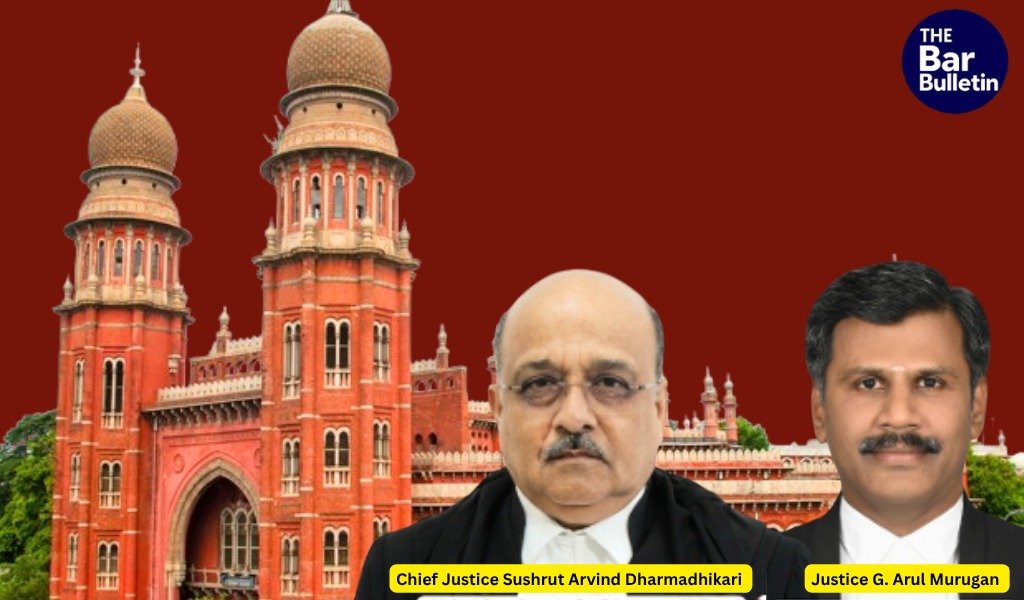

The Madras High Court dismissed the petition by a practising advocate, who has asked to do what Parliament has not. Essentially, the High Court has refused to create an ‘Election Expenditure Security’ requiring MLAs who voluntarily resign to deposit the cost of the bye-election they trigger, and bar them from contesting any election for five years.
The Bench drew a clean line between enforcing an existing right and inventing a new one. Flagging a separate Article 14 concern, the Bench said that a court-ordered scheme targeting six named MLAs by the timing of their resignations would be inherently arbitrary. The right to resign a seat is itself a constitutional feature and cannot be burdened with extra-statutory conditions by judicial order. The High Court confirmed that the gap between sound policy and enforceable law remains one for Parliament to fill.
The Division Bench comprising the Chief Justice Sushrut Arvind Dharmadhikari and Justice G. Arul Murugan observed that the reliefs sought did not fall within the enforcement of an existing right through an interim measure, but amounted to the creation of two new and substantive features of electoral law that do not presently exist anywhere in the Constitution or in the Representation of the People Act, 1951, namely a security deposit calculated with reference to actual public expenditure on a bye-election, and a five-year bar on contesting future elections.
The Court observed that the petitioner himself did not dispute this, having stated in his affidavit that the mechanism he proposed ‘is presently not incorporated into Indian electoral law’. The Court held that what was being sought was the design of a punitive and financial regime that would operate as a fresh disqualification under the Constitution of India and would curtail the statutory right to contest an election, which in the Court’s considered opinion was a matter of legislative policy and not of judicial direction.
Also read Resident Outside Municipal Limits Cannot Seek Court Order for Removal of Illegal Construction: MP HC
Further, the Court observed that the power of ‘superintendence, direction and control’ over the ‘conduct of elections’ under Article 324 of the Constitution of India was held wide enough to cover disclosure of this kind, but the vacuum-filling power exists only where the implementing authority already possesses the underlying constitutional or statutory power, and the Election Commission of India has no such power to add conditions or bars to the list of disqualifications on its own.
The Court further observed that the reliefs sought were directed against six named individuals by name, based on the timing of their resignations, and that assuming arguendo that some mechanism was desirable as a matter of policy, a court-ordered scheme confined to these six persons would run athwart Article 14 of the Constitution of India. The right to resign a legislative seat is itself a facet of the constitutional scheme governing membership of a House, and cannot be burdened with extra-statutory conditions by judicial order, however sound the underlying concern may be.
Briefly, a practising advocate filed a public interest writ petition before the Madras High Court seeking two principal reliefs: first, a direction to the Election Commission of India and the Chief Electoral Officer, Tamil Nadu, to frame an ‘Election Expenditure Security’ mechanism under which any sitting MLA who voluntarily resigns and later wishes to contest the resulting bye-election must first deposit an amount equal to the public money spent on holding that bye-election; and second, a direction to introduce a five-year disqualification barring any MLA who resigns voluntarily, without a compelling reason, from contesting any election to Parliament or a State Legislature during that period.
The petitioner’s case was that following the 2026 General Elections to the Tamil Nadu Legislative Assembly, six elected members resigned their seats within a short span of the results being declared, namely S. Jayakumar, Maragatham Kumaravel, P. Sathyabama, Dr. Esakki Subbaya, C. Vijaya Bhaskar, and M.R. Vijayabhaskar. According to the petitioner, none of these resignations was on account of death, permanent incapacity, disqualification or any other compelling circumstance, and each resignation had necessitated a bye-election under Section 151A of the Representation of the People Act, 1951, funded entirely from the public exchequer.
The petitioner had earlier addressed representations to the respondents urging the two measures, and upon receiving no response, approached the Court under Article 226 of the Constitution of India. He also stated that an earlier interim stay had restrained the Election Commission from announcing bye-elections to five constituencies, but the Commission had since announced bye-elections to Madurantakam and Dharapuram, which were not covered by that stay. He further stated that a political party had announced respondents 9 and 10 as its candidates for the coming bye-elections, and contended that having caused these elections by their own resignations, they ought not to be permitted to contest them.
