
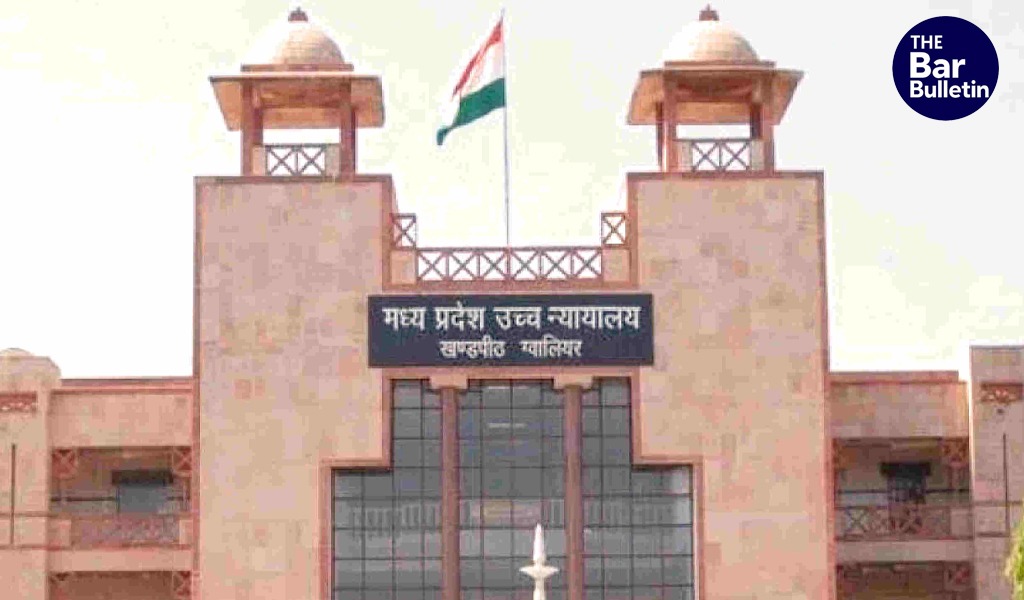

The Madhya Pradesh High Court has held that no writ can be issued against a Member of the Legislative Assembly (MLA) for raising questions in the Legislative Assembly, observing that doing so is a legislative function and cannot be challenged in writ proceedings. The Court further held that private property disputes must be resolved through appropriate civil or statutory remedies rather than under Article 226 of the Constitution.
A Division Bench comprising Acting Chief Justice Vivek Rusia and Justice Pradeep Mittal dismissed a writ appeal filed by Sita Saran Pandey, who sought to restrain revenue authorities from acting on demarcation proceedings concerning land over which he already held a civil court decree. The appellant also alleged that Respondent No. 6, an MLA and Speaker of the Madhya Pradesh Legislative Assembly, had influenced the authorities by raising questions in the Assembly regarding the dispute.
Rejecting the challenge, the Court observed that merely because the respondent was an MLA, a private land dispute could not be converted into a dispute involving the State. It held that raising questions in the Legislative Assembly is a purely legislative act, and no writ can be issued against an MLA on that basis. The Court clarified that the Supreme Court’s decision directing High Courts to monitor criminal cases against MPs and MLAs does not imply that writs can be issued against legislators for their legislative functions.
The Bench further held that the civil court decree obtained by the appellant did not preclude the revenue authorities from conducting demarcation proceedings, particularly when Respondent No. 6 was not a party to the civil suit. It observed that a decree concerning possession or title does not conclusively determine issues relating to land demarcation, which fall within the jurisdiction of the competent revenue authorities.
The Court also declined to issue preventive directions against possible future action by the authorities, holding that a writ cannot be granted merely on the apprehension that an authority may act without jurisdiction. If any adverse order is eventually passed, the aggrieved party would be free to challenge it in accordance with law. Similarly, the Court observed that the appellant could avail appropriate remedies against the FIR already registered against him, but no writ could be issued to prevent investigation or restrain registration of criminal proceedings.
Finding no infirmity in the Single Judge’s order, the Division Bench dismissed the appeal while granting liberty to the appellant to pursue his pending representation before the competent authorities and avail remedies available under law.
