
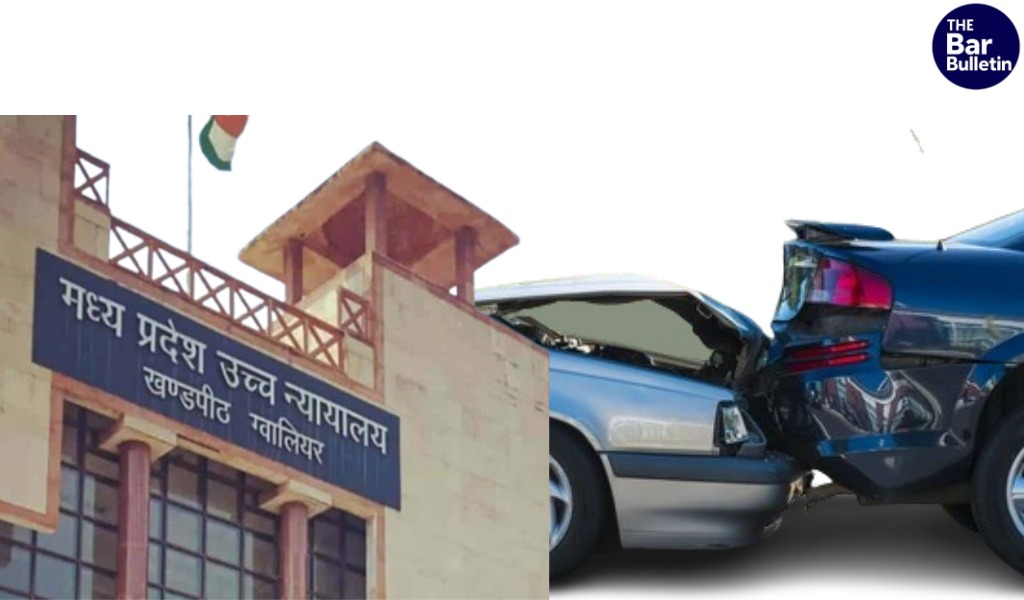

The Madhya Pradesh High Court has upheld an order permitting claimants to amend a motor accident compensation claim from one filed under Section 166 of the Motor Vehicles Act, 1988 (fault liability) to Section 163-A (no-fault liability), even after completion of evidence and at the stage of final arguments.
Justice Amit Seth dismissed a petition filed by ICICI Lombard General Insurance Co. Ltd., which had challenged the Motor Accident Claims Tribunal’s order allowing the amendment application under Order VI Rule 17 CPC read with Section 169 of the Motor Vehicles Act.
The claimants had initially filed a claim under Section 166 seeking ₹44 lakh as compensation for the death in a road accident that occurred on 13 December 2019. After the trial concluded and the insurer had already filed written arguments, the claimants sought amendment of the petition, contending that due to an inadvertent typographical error, the claim had been filed under Section 166 instead of Section 163-A. They also sought correction of the deceased’s annual income to ₹40,000 and deletion of the compensation amount originally claimed. For reference, Section 163A of the Act states that:
163A. Special provisions as to payment of compensation on structured formula basis.
(1) Notwithstanding anything contained in this Act or in any other law for the time being in force or instrument having the force of law, the owner of the motor vehicle of the authorised insurer shall be liable to pay in the case of death or permanent disablement due to accident arising out of the use of motor vehicle, compensation, as indicated in the Second Schedule, to the legal heirs or the victim, as the case may be.
(2) In any claim for compensation under sub-section (1), the claimant shall not be required to plead or establish that the death or permanent disablement in respect of which the claim has been made was due to any wrongful act or neglect or default of the owner of the vehicle or vehicles concerned or of any other person.
The insurer opposed the amendment, arguing that the case had proceeded throughout on the premise of fault liability, specific issues regarding negligence had been framed, evidence had been led accordingly, and permitting conversion at such a late stage fundamentally altered the nature of the proceedings. It also objected to the Tribunal’s consequential deletion of the issue relating to negligence.
Rejecting the insurer’s challenge, the High Court held that the legal position is well settled that a claim petition under Section 166 can be converted into one under Section 163-A, provided both remedies are not pursued simultaneously. The Court referred the Delhi High Court’s decisions in Rukmani Devi v. New India Assurance Co. Ltd., 2008 SCC OnLine Del 626, and United India Insurance Co. Ltd. v. Rita Devi, 2014 SCC OnLine Del 7523, as well as its own earlier decision in Lakhan Puri v. Manoj Kumar, M.P.No. 973/2024 all recognising that such conversion is permissible even during the pendency of proceedings, since denying it would defeat the beneficial object of the Motor Vehicles Act.
The Court also referred to the Supreme Court’s recent decision in Valsamma Chacko v. M.A. Titto, SLP(C) 27621 of 2019, where the Court observed that if fault liability under Section 166 is found to be unsustainable, the Tribunal ought to provide claimants an opportunity to opt for compensation under Section 163-A, even if they have not voluntarily sought such conversion.
The High Court observed that once the claim is converted to Section 163-A, the claimants become bound by the structured formula under the Motor Vehicles Act and cannot claim an income exceeding ?40,000 per annum under the applicable schedule. Consequently, deletion of the issue relating to negligence was only a natural consequence because proof of negligence is unnecessary in proceedings under Section 163-A.
The Court held that the insurer had failed to demonstrate any material prejudice arising from the amendment that would justify interference under Article 227 of the Constitution. Finding no jurisdictional error or patent illegality in the Tribunal’s order, the High Court affirmed the amendment order, dismissed the miscellaneous petition, vacated the interim stay, and directed the Tribunal to proceed with the matter.
“
“The law is well-settled that a claim petition filed under Section 166 of the MV Act can be converted into one under Section 163-A of the MV Act, and such conversion does not, by itself, change the nature of the proceedings in a manner that would cause irreparable prejudice to the opposite party.”
