
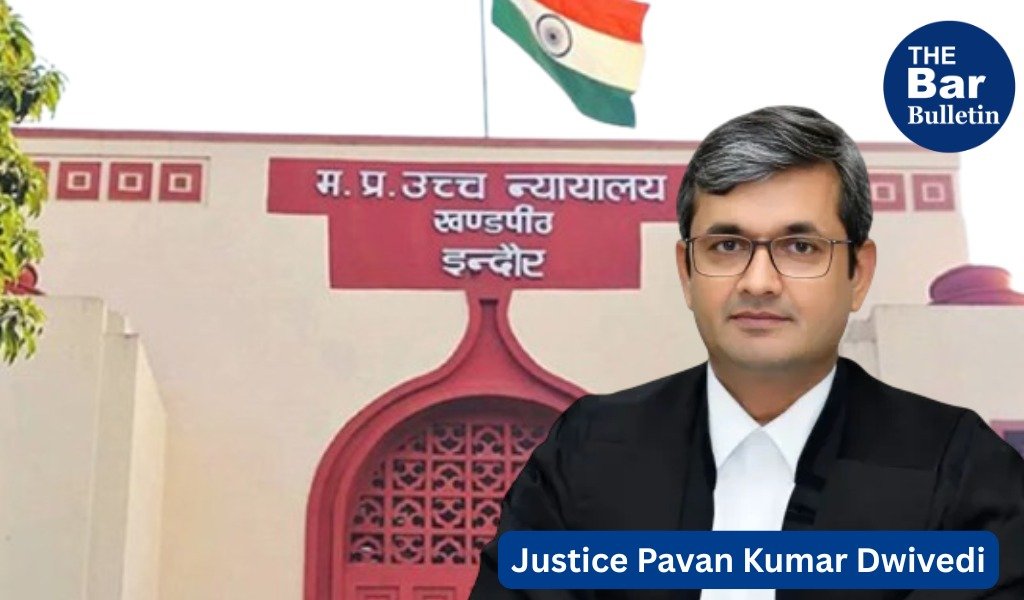

The Madhya Pradesh High Court has quashed an FIR, charge-sheet and cognizance order against a tribal youth who participated in a protest at a police station against the registration of an FIR against members of the tribal community. The Court held that prosecution for an offence under Section 223 of the Bharatiya Nyaya Sanhita (BNS) could not proceed without a written complaint by the concerned public servant, as mandated under Section 215 of the Bharatiya Nagarik Suraksha Sanhita (BNSS).
Justice Pavan Kumar Dwivedi was hearing a petition seeking quashing of an FIR registered at Palsud Police Station in Barwani district on July 6, 2024, along with the consequential charge-sheet and the trial court’s order taking cognizance.
The case arose after an FIR was registered against certain members of the tribal community on June 30, 2024. Aggrieved by the registration, members of Jay Adivasi Yuva Shakti (JAYS) approached the police station seeking its cancellation. Seven persons, including the petitioner, allegedly gathered at the police station with banners and raised slogans without obtaining prior permission for the protest.
The police registered an FIR under Section 223 of the BNS, alleging violation of a prohibitory order issued by the District Magistrate under Section 144 of the Code of Criminal Procedure. Following investigation, an additional offence under Section 126(2) of the BNS was included in the charge-sheet. The trial court subsequently took cognizance of both offences.
The petitioner argued that Section 215 of the BNSS bars a court from taking cognizance of an offence under Section 223 of the BNS unless a written complaint is made by the public servant concerned or an authorised public servant. No such complaint had been filed by the District Magistrate. He further contended that the allegations under Sections 223 and 126(2) arose from the same transaction and could not be separated to circumvent the statutory requirement.
Accepting the contention, the High Court observed that the FIR itself showed that the Station House Officer had acted as the complainant, despite the absence of any written complaint from the District Magistrate, whose order was allegedly violated.
The Court held that Section 215 of the BNSS makes a written complaint by the concerned public servant mandatory for taking cognizance of offences under Sections 206 to 223 of the BNS. It further held that the allegations under Sections 223 and 126(2) formed an integral part of the same transaction and could not be split into separate transactions to avoid the statutory bar.
Relying on the Supreme Court’s decision in Devendra Kumar v. State (NCT of Delhi), the Court reiterated that where offences requiring a complaint by a public servant are intrinsically connected with other offences arising from the same transaction, courts must examine whether separating them would defeat the protection under the statutory provision.
The High Court also examined the spot map prepared by the investigating officer. It found that the seven persons had gathered at a location some distance away from the police station building and that even the spot map did not disclose the commission of an offence under Section 126 of the BNS.
In a further observation, the Court noted that the petitioner was a student who had secured distinctions in four out of five subjects in his Class 12 examination, completed a Diploma in Elementary Education and cleared the Primary School Teacher Selection Test. It observed that such a student should not be unnecessarily dragged into criminal proceedings, potentially affecting his career, for accompanying six others who were protesting against the registration of an FIR against members of the tribal community.
Accordingly, the High Court allowed the petition and quashed the FIR, the resultant charge-sheet and the trial court’s order dated December 16, 2024, taking cognizance in the case.
