
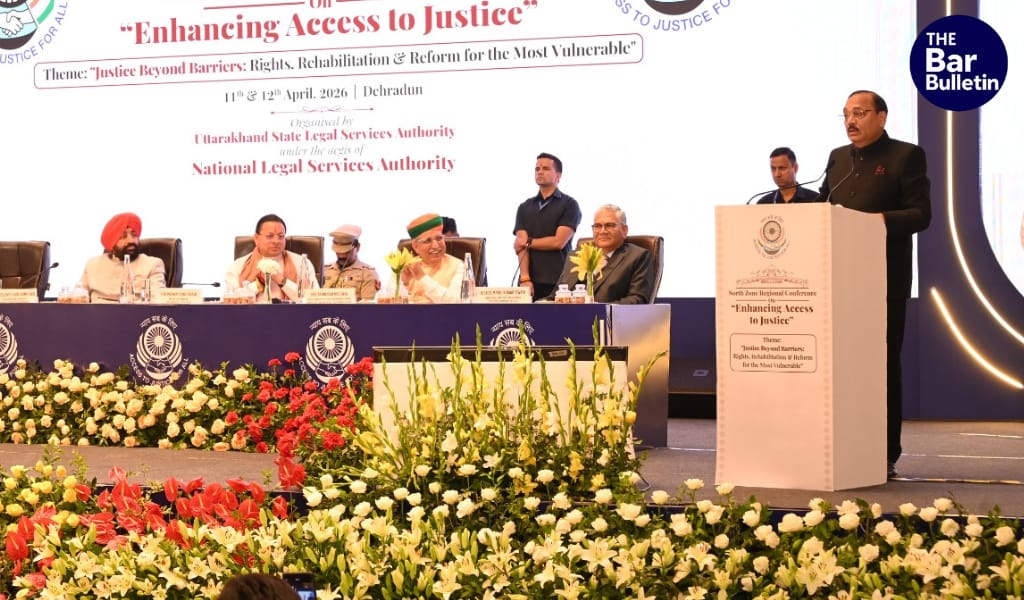
The second day of the two-day North Zone Regional Conference on “Enhancing Access to Justice”, organised by the National Legal Services Authority (NALSA) in collaboration with the Uttarakhand State Legal Services Authority (UKSLSA), was held at Taj Mussoorie Foothills, Dehradun, Uttarakhand, marking the conclusion of the Conference with focused deliberations on inclusive and human-centric justice delivery.
The Conference witnessed participation from States and Union Territories across the North Zone, including Chandigarh, Delhi, Haryana, Himachal Pradesh, Jammu & Kashmir, Ladakh, Punjab, Uttarakhand and Uttar Pradesh, reflecting diverse regional representation and a shared commitment towards strengthening access to justice.
The programme was graced by His Excellency Lt. Gen. Gurmit Singh, PVSM, UYSM, AVSM, VSM (Retd.), Hon’ble Governor of Uttarakhand. The session also witnessed the august presence of Hon’ble Mr. Justice Surya Kant, Chief Justice of India & Patron-in-Chief, NALSA, Shri Pushkar Singh Dhami, Hon’ble Chief Minister, Government of Uttarakhand, Hon’ble Mr. Justice Vikram Nath, Judge, Supreme Court of India & Executive Chairman, NALSA, Hon’ble Mr. Justice S.V. Bhatti and Hon’ble Mr. Justice Satish Chandra Sharma, Judges of the Supreme Court of India, Shri Arjun Ram Meghwal, Hon’ble Minister of State (Independent Charge), Ministry of Law and Justice, Government of India, Hon’ble Mr. Justice Manoj Kumar Gupta, Chief Justice, High Court of Uttarakhand & Patron-in-Chief, UKSLSA and Hon’ble Mr. Justice Manoj Kumar Gupta, Judge, High Court of Uttarakhand & Executive Chairman, UKSLSA. The programme was also attended by Hon’ble Chief Justices, Executive Chairpersons, SLSAs, and Judges of the participating High Courts, officers of SLSAs and members of the District Judiciary.
Delivering the Key-Note Address, Hon’ble Mr. Justice Surya Kant observed that “the real barrier to justice today is not the absence of laws, but the gap between rights and their accessibility.” He emphasised that access to justice must move beyond formal legal entitlements and be anchored in the lived realities of citizens, particularly those at the margins. Highlighting NALSA’s expanding outreach across diverse and often remote regions, His Lordship underscored the need for legal services institutions to respond with sensitivity, adaptability and institutional innovation, describing such efforts as platforms for “constitutional listening” that bridge the distance between rights and their effective realisation.
Hon’ble Mr. Justice Vikram Nath observed that access to justice must evolve beyond physical access to courts into a framework defined by reach, awareness and trust. Emphasising that justice must move closer to the citizen, he highlighted initiatives such as the Nyaya Portal, best practices documentation and Mobile Utility Vehicles as instruments of last-mile delivery. He commended grassroots innovations such as the “One Village, One PLV” model of Uttarakhand and underscored the growing role of community mediation in fostering participatory, responsive and preventive justice systems. Invoking Mahatma Gandhi, he noted that the true measure of justice lies in how effectively it reaches the last person in need.
His Excellency Lt. Gen. Gurmit Singh, Hon’ble Governor of Uttarakhand, stressed that justice must be timely, affordable and accessible even in remote regions, cautioning that delays erode public trust.
The Hon’ble Chief Minister, Government of Uttarakhand, emphasised the need to ensure timely justice to the last person, highlighting ongoing reforms and the importance of removing barriers to access.
The Hon’ble Minister of State (Independent Charge), Ministry of Law and Justice, Government of India, noted that sustained grassroots legal aid efforts, though incremental, have transformative impact, contributing to the constitutional vision of justice for all.
Hon’ble Mr. Justice Manoj Kumar Gupta briefly underscored the need for mandatory victim support mechanisms, in line with Laxmi v. Union of India, and highlighted NALSA’scontinued focus on women- and child-centric legal aid initiatives.
Hon’ble Mr. Justice Manoj Kumar Tiwari delivered the vote of thanks, expressing sincere gratitude to all dignitaries, participating High Courts and delegates for their valuable contributions to the Conference.
The session also witnessed the launch of the UKSLSA’s Nyay-Mitra Portal by Hon’ble Mr. Justice Surya Kant and the release of an E-Booklet on Best Practices & Legal Aid Initiativesby Hon’ble Mr. Justice Vikram Nath, followed by audio-visual presentations showcasing ongoing initiatives.
The Hon’ble Governor inaugurated Anti-Drug Units in schools in Uttarakhand, marking an important step towards strengthening preventive awareness and institutional mechanisms to address substance abuse among youth.
As part of the programme, Multi Utility Vehicles (MUVs) were also flagged off for District Legal Services Authorities and UKSLSA, aimed at strengthening last-mile outreach and enhancing the mobility and effectiveness of legal services institutions in delivering legal aid to remote and underserved areas.
The second day of the Conference featured two thematic technical sessions addressing critical dimensions of access to justice:
The third technical session on “Justice for Acid Attack Survivors: Compensation, Rehabilitation & Dignity-Centric Support” was chaired by Hon’ble Mr. Justice S.V. Bhatti, Judge, Supreme Court of India, with Hon’ble Mr. Justice Devendra Kumar Upadhyaya, Chief Justice, High Court of Delhi, as Co-Chair and featured Ms. Laxmi Agarwal, Founder, The Laxmi Foundation and Dr. Navpreet Kaur, Co-Founder, The Laxmi Foundation. The deliberations underscored the need for a humane and victim-centric approach to justice delivery, emphasising that rehabilitation must extend beyond formal processes to meaningful engagement and sustained support systems.
The session highlighted the importance of ensuring safe and sensitive institutional spaces, recognising victims as individuals of agency and resilience and strengthening their inclusion within the justice process. Referring to Laxmi v. Union of India, emphasis was laid on enforceable rights relating to compensation, medical care, and institutional support, alongside the need for a coordinated, multi-stakeholder framework and proactive outreach to ensure dignity, rehabilitation and long-term reintegration of survivors.
The fourth technical session on “Strengthening Legal Protection & Support Systems for Women and Children” was chaired by Hon’ble Mr. Justice Vikram Nath, Judge, Supreme Court of India & Executive Chairman, NALSA, with Hon’ble Mr. Justice Sanjeev Kumar, Judge, High Court of Jammu & Kashmir and Ladakh & Executive Chairman, Jammu & Kashmir Legal Services Authority, as Co-Chair and featured Ms. Manju Dhaundiyal, Consultant (Women and Children Issues) and Ms. Sampurna Behura, Executive Director, India Child Protection.
The deliberations emphasised the need for a holistic and coordinated approach to safeguarding the rights of women and children, focusing on strengthening legal and institutional frameworks, addressing implementation gaps and enhancing outreach and awareness mechanisms. The session underscored the importance of convergence between legal services institutions, law enforcement agencies and community stakeholders to ensure timely and effective support, while reinforcing a rights-based and child-sensitive approach to justice delivery.
The deliberations across the Conference reiterated that access to justice must be understood not merely as the availability of legal remedies, but as a function of awareness, accessibility, responsiveness, and trust. The role of Legal Services Authorities in bridging systemic gaps and ensuring meaningful justice delivery to the most vulnerable sections was emphasised throughout.
The Conference concluded with a shared commitment to advancing innovative, inclusive, and people-centric approaches to justice delivery, in furtherance of the constitutional mandate of ensuring equal access to justice for all.