
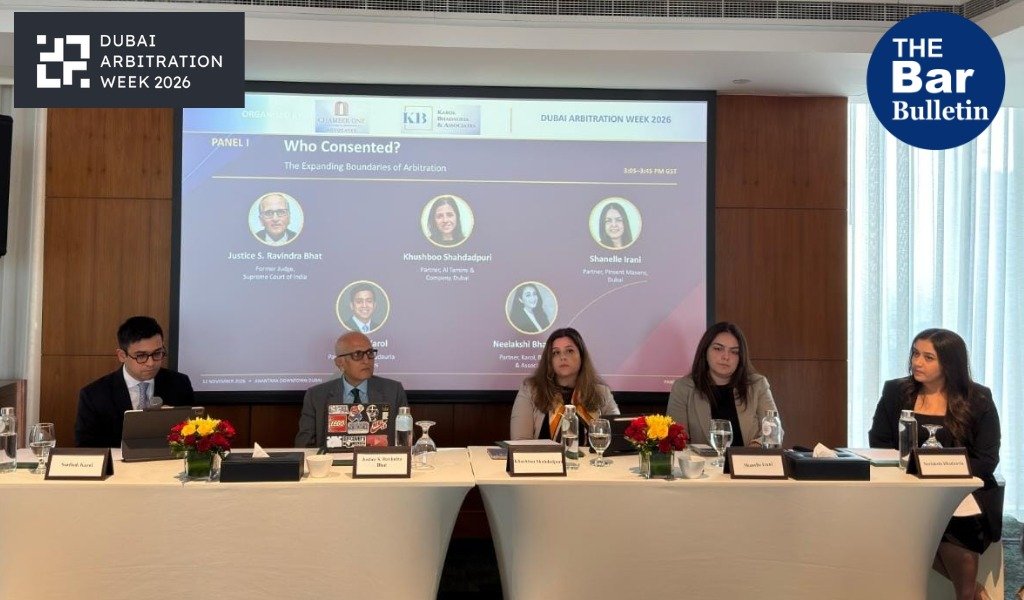

Former Supreme Court judge Justice S. Ravindra Bhat has said that the Group of Companies Doctrine, which allows non-signatories to be brought into arbitration proceedings, has evolved from an examination of corporate group structures to a more focused inquiry into the specific transaction and the non-signatory’s involvement in it.
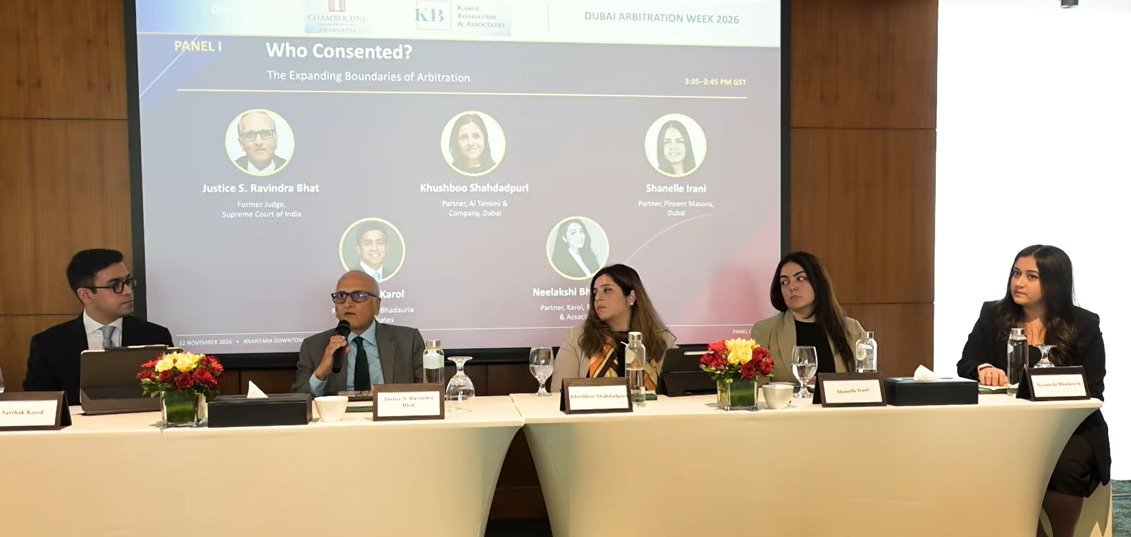
He was speaking at a panel discussion titled “Who Consented? The Expanding Boundaries of Arbitration Agreements” during Dubai Arbitration Week 2026 on November 12. The session, titled ‘Beyond the Arbitration Clause: Consent, Courts & The Battle for Jurisdiction’, was organised by Chamber One Advocates and Karol, Bhadauria & Associates as part of Dubai Arbitration Week 2026. The first panel, ‘Who Consented? The Expanding Boundaries of Arbitration Agreements’, was moderated by Sarthak Karol, Partner at Karol, Bhadauria & Associates, and featured:
● Justice Ravindra Bhatt, former Supreme Court judge;
● Khushboo Shahdadpuri, Partner at Al Tamimi & Company, and
● Shanelle Irani, Partner at Pinsent Masons.
The welcome address was delivered by Neelakshi Bhadauria, Partner at Karol, Bhadauria & Associates, who introduced the session and its panellists.
Responding to the moderator’s opening question on the rationale for extending arbitration agreements to non-signatories in modern multi-party commercial transactions, Justice S. Ravindra Bhat emphasised that consent remains the fundamental requirement for binding a non-signatory to an arbitration agreement. He explained that substantial participation in the negotiation, performance or termination of a contract may indicate a mutual intention to be bound by the arbitration agreement.
Tracing the origins of the Group of Companies Doctrine, Justice Bhat referred to the 1982 ICC decision in Dow Chemical v. Isover-Saint-Gobain, explaining that the doctrine drew from French civil law and was subsequently adopted in India. Responding to moderator Sarthak Karol’s question on the rationale for extending arbitration agreements to non-signatories in modern multi-party commerce, Justice Bhat said that the issue became increasingly relevant as corporate structures and commercial transactions grew more complex following India’s economic liberalisation in 1991.
He traced the development of the Indian position from Sukanya Holdings v. Jayesh H. Pandya (2003), where the Supreme Court held that a non-party could not be brought into arbitration without consent, to Chloro Controls India Pvt. Ltd. v. Severn Trent Water Purification Inc. (2013), which recognised the Group of Companies Doctrine in India. He observed that the approach in Chloro Controls was subsequently refined by the five-judge Constitution Bench in Cox and Kings Ltd. v. SAP India Pvt. Ltd. (2023).
Consent can be inferred from conduct and correspondence
When Sarthak Karol asked Justice Bhat how much weight courts and tribunals should give to conduct as opposed to a formal signature, Justice Bhat said that the law had now stabilised around an evidence-based inquiry into the transaction. He explained that an arbitration agreement need not always be established through a formally signed contract, as consent may also emerge from correspondence, exchanges between parties or other binding commercial arrangements.
He referred to Section 7 of the Arbitration and Conciliation Act, 1996, which requires an arbitration agreement to be in writing, but pointed out that written consent could take different forms. For instance, an exchange of letters could result in a binding arrangement. He also referred to a situation where a party makes an assertion in a statement of claim that an arbitration agreement exists and the other party does not deny it.
Justice Bhat further discussed the distinction between consensual and non-consensual grounds for extending an arbitration agreement to a non-signatory. Referring to Cox and Kings, he said that the non-consensual route could involve piercing the corporate veil, but cautioned that this must be done carefully and in relation to the particular transaction, rather than as a general disregard of separate corporate personality.
He also explained that the inquiry into whether a non-signatory could be bound would depend on the nature of the corporate arrangement and the extent of its engagement with the transaction. Referring to family-owned business groups, he observed that interconnectedness between entities and the extent of their involvement in a transaction could be relevant in determining whether they could be brought into arbitration.
At the same time, he pointed to situations at the other end of the spectrum, such as where shareholders in a joint venture seek to be added to arbitration proceedings even though the joint venture itself is already a party. He said that the outcome would depend on the circumstances of each case.
UAE courts adopt differing approaches to non-signatories
Responding to Sarthak Karol’s question on how UAE courts approach the extension of arbitration agreements to non-signatories, Khushboo Shahdadpuri, Partner at Al Tamimi & Company, explained that some UAE onshore court decisions had extended arbitration clauses to non-signatories to avoid inconsistent decisions in disputes involving connected upstream and downstream contracts.
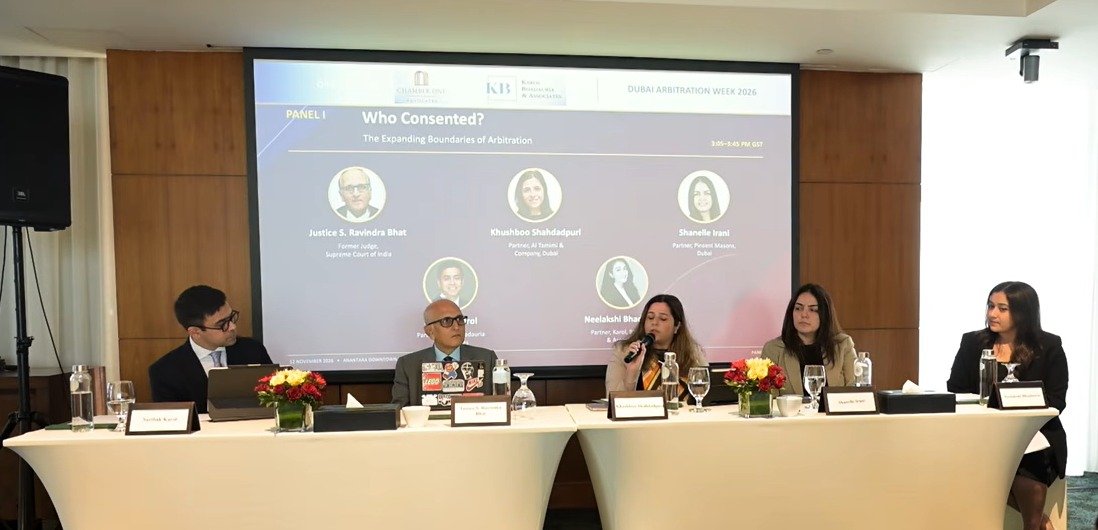
She said that large construction and energy projects frequently involve multiple contracts, with upstream agreements containing litigation clauses and downstream agreements providing for arbitration. This can result in connected disputes being heard before different forums. She described the approach adopted by some MENA courts as a practical attempt to prevent parallel proceedings and inconsistent outcomes.
“
“What we have seen from the jurisprudence emerging from the MENA courts is that they have extended the arbitration clause to non-signatories to avoid inconsistent decisions, so that disputes can then be adjudicated in one forum, the courts or the arbitration, depending on which agreement is really the linchpin of the whole dispute. And it’s a very bold move. It’s a very practical move as well,” Shahdadpuri said.
She contrasted this with the approach of the DIFC and ADGM courts, which she described as more conservative and rooted in the principle of consent. She also cautioned that enforcement of an India-seated award against a UAE affiliate may not be straightforward, as UAE courts could examine the question of consent under their own laws and public policy.
Separate legal personality remains a key consideration
When Sarthak Karol asked why certain jurisdictions remain cautious about extending arbitration agreements to non-signatories, Shanelle Irani, Partner at Pinsent Masons, identified consent, separate legal personality and enforcement as the principal considerations.
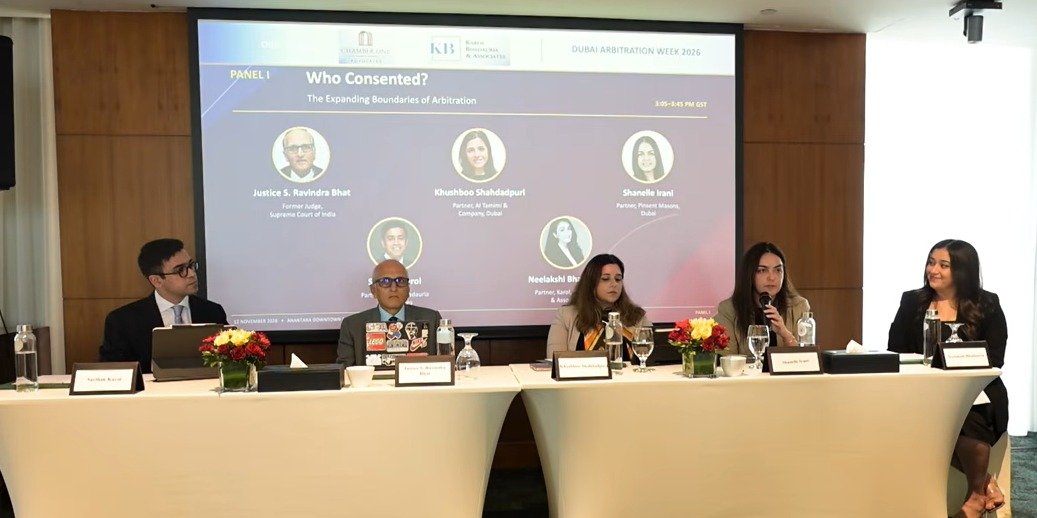
She explained that a parent company and its subsidiary cannot automatically be treated as legally interchangeable merely because they operate within the same corporate group. She referred to the approaches adopted in jurisdictions such as the United States, Singapore, Switzerland and Germany, where courts have been reluctant to disregard separate corporate personality merely on the basis of group association.
“
“The reluctance comes from consent, one, the fact that arbitration is a creature of consent. And effectively, the legitimacy of arbitration or the consent comes from the arbitration agreement. The second one is obviously separate legal personality. This is particularly important in a corporate group. The fact that a parent owns a subsidiary or several companies operate in one economic group does not mean that they are automatically legally interchangeable. And if we were too quick to say that the commercial reality of the group is sufficient to bind every affiliate or parent or subsidiary to an arbitration agreement, then the point of having separate companies would be lost,” Irani said.
Participation in a transaction is not necessarily consent to arbitration
During a subsequent discussion on the evidence required to bind a non-signatory, Sarthak Karol asked Shanelle Irani whether documents such as board minutes, evidence of contractual performance or email exchanges between employees could establish consent.
Ms Irani cautioned that the applicable law would determine whether conduct could be relied upon to extend an arbitration agreement. She drew a distinction between evidence showing participation in a commercial transaction and evidence demonstrating consent to the arbitration agreement itself.
She explained that tribunals could examine email exchanges, involvement in contract negotiations, instructions issued by the non-signatory, delivery of services, invoices, receipt of payments, contractual notices and corporate approvals. However, she cautioned against treating these factors as a checklist, stating that the evidence must be assessed holistically to determine whether there was a mutual intention to bind the non-signatory to arbitration.
“
“The tribunal will look at everything holistically to see whether a party, all the parties, so the signatories and the non-signatories, had mutual intention to bind the non-signatory to the arbitration agreement and not just participate in the transaction. And whether those facts meet the test of consent under whatever the applicable law is. And the last qualification I’d say is the most important, which is the evidence comes after the legal question. So first you have to decide what theory of law you’re using to bind the non-signatory and then figure out what the evidence is to support that,” Irani said.
Drafting dispute resolution clauses at the transaction stage
On how companies could avoid disputes over non-signatories, Sarthak Karol asked Shanelle Irani whether better drafting could prevent entities from subsequently being drawn into arbitration proceedings.
Ms Irani said that better drafting was necessary but might not be sufficient, and advised companies to design their dispute resolution arrangements alongside the transaction. She recommended identifying all entities likely to be involved in the transaction, ensuring consistency in arbitration clauses across related contracts, and selecting institutional rules that permit joinder and consolidation.
She also cautioned that differences in institutional rules, language, appointment mechanisms and applicable laws across connected contracts could result in parallel proceedings and contradictory arbitral awards.
Shahdadpuri added that the SIAC Rules contain provisions allowing the same tribunal to manage separate proceedings involving common questions of law and fact, even where consolidation is not possible. She said this could help reduce the risk of inconsistent decisions across related disputes.
Participation in arbitration and waiver
Towards the end of the discussion, Sarthak Karol asked Justice Bhat what guidance he would give an arbitral tribunal considering whether to bind a non-signatory to an arbitration agreement.
Justice Bhat said that participation without a timely objection could have implications for a subsequent jurisdictional challenge. He added that the doctrine continued to be tested in arbitration proceedings and court cases, including in matters in which he had been involved as an arbitrator. He described it as an evolving area of law, with its contours continuing to develop through adjudication.