
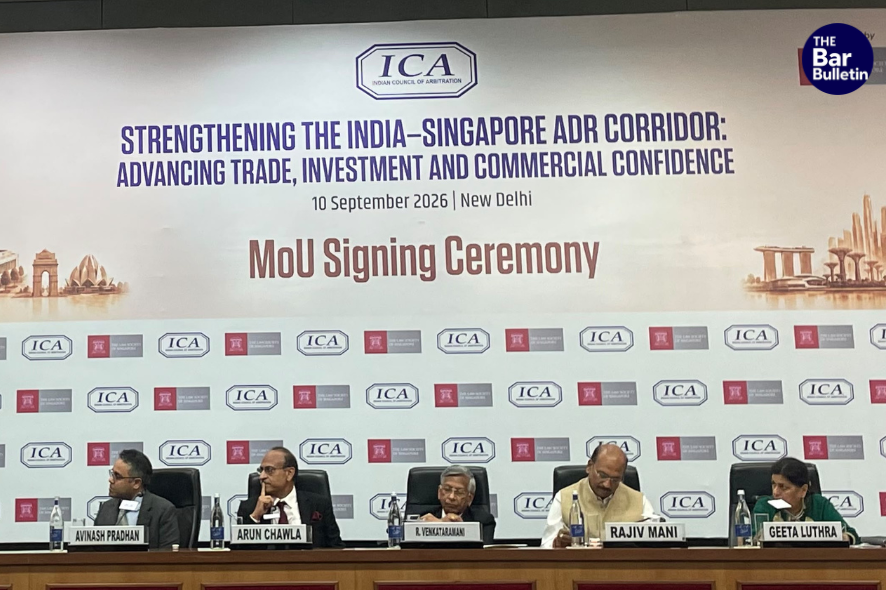
The India–Singapore ADR corridor can play a significant role in strengthening commercial confidence, facilitating cross-border trade and investment, and positioning Asia as a leading centre for international dispute resolution, speakers said at a strategic dialogue organised by the Indian Council of Arbitration (ICA).
The event, held as part of the MOU signing ceremony organised by the Immigration & Checkpoints Authority (ICA), brought together senior legal and arbitration professionals from India and Singapore. The programme was moderated by Mr. Arun Chawla, Director General, ICA. It featured addresses by Mr. Avinash Pradhan, Head (International Arbitration Practice) and Co-Head of South Asia Desk at Rajah & Tann Singapore and Co-Chair, International Relations Committee, The Law Society of Singapore; Mr. Simon Wong, High Commissioner of Singapore to India; Dr. Rajiv Mani, Secretary, Legislative Department and Department of Legal Affairs, Ministry of Law and Justice; Mr. R. Venkataramani, Attorney General for India; and closing remarks by Ms. Geeta Luthra, Vice President, ICA and Senior Advocate, Supreme Court of India.
In his opening remarks, Mr. Arun Chawla highlighted the intrinsic relationship between commerce and disputes, describing them as Siamese twins, conjoined, inseparable and travelling together. He emphasised that the objective of a modern commercial system should not be to eliminate disputes, but to ensure that they are resolved efficiently, fairly and predictably. He also underlined the emergence of a “virtuous cycle” between commerce and dispute resolution, with effective ADR mechanisms serving not merely as remedies after commercial relationships break down, but as an important factor in encouraging investment, trade and economic growth.
Mr. Chawla stressed the potential for closer India–Singapore cooperation through institutional collaboration, professional exchanges and stronger links among arbitral and mediation institutions, lawyers, arbitrators, mediators and businesses. Such cooperation, he noted, could make cross-border dispute resolution faster, more predictable and cost-effective.
Mr. Avinash Pradhan emphasised that commercial confidence depends on fair and efficient dispute resolution that reflects business realities. He described India and Singapore as possessing complementary strengths, with India offering scale, talent and a large commercial market, while Singapore brings neutrality, procedural predictability and connectivity with ASEAN and East Asian markets. He stressed that the relationship should evolve as a two-way and equal partnership, rather than a feeder route to Western arbitration centres.
Mr. Pradhan identified three priorities for implementation institutional collaboration, investment in legal and arbitration talent, and a user-centric approach to dispute resolution. He called for deeper cooperation among regional arbitral institutions, including SIAC, MCIA, ICA and SIMC, while emphasising the need to train the next generation of lawyers and arbitrators to navigate diverse legal systems and commercial cultures.
Dr. Rajiv Mani described the dialogue as a step forward in implementing the India–Singapore MOU on cooperation in ADR signed in June 2024. He noted that the initiative builds upon the broader Comprehensive Strategic Partnership between the two countries and highlighted ongoing efforts to establish a Joint Consultative Committee to sustain cooperation in legal and ADR matters.
Dr. Mani also highlighted the complementary legal ecosystems of the two countries, their shared common-law traditions and the progress of India’s domestic ADR framework, including the Mediation Act, 2023 and the institutionalisation of mediation through the Mediation Council of India.
In his keynote address, Attorney General for India R. Venkataramani reflected on the changing global economic and financial landscape and its impact on international arbitration. He highlighted the growing adoption of flexible and multi-tiered mechanisms, including Arb-Med-Arb, expedited procedures and third-party funding, aimed at preserving commercial value while ensuring neutrality, predictability and cost efficiency.
A key theme of the Attorney General’s address was the relevance of the Panchsheel principles mutual respect, neutrality, non-interference, equality and peaceful coexistence as a framework for contemporary dispute resolution. He underscored the need for ADR institutions and practitioners to adapt to evolving commercial realities while maintaining fairness and balance in cross-border disputes.
Ms. Geeta Luthra, in her address, discussed developments in international arbitration and the continuing evolution of institutional and statutory frameworks. She highlighted the modernisation of the SIAC Rules, recent amendments to India’s arbitration framework and the emergence of hybrid and multi-tier dispute-resolution mechanisms, including Med-Arb-Med, Arb-Med-Arb, emergency arbitration and third-party funding.
She also highlighted the significance of the Nagaraj judgment (2026) and the Supreme Court’s approach to transnational issue estoppel in the context of enforcement proceedings, as well as the limits of judicial intervention under Sections 34 and 37 of the Arbitration and Conciliation Act. She emphasised the importance of maintaining appropriate boundaries between judicial scrutiny and merits review of arbitral awards.