
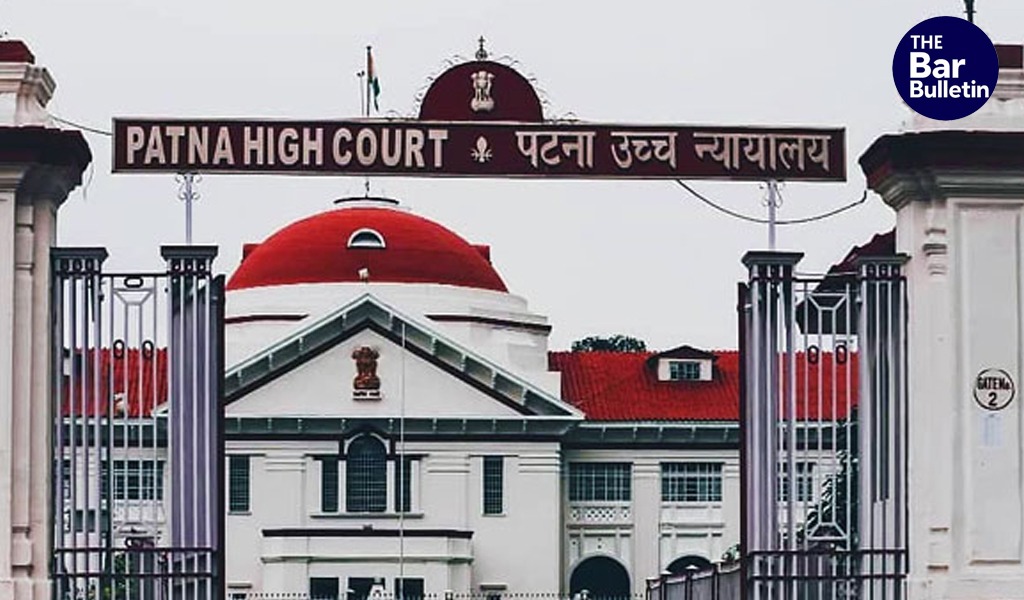

The Patna High Court has held that a superior court can set aside a bail order, even in the absence of post-bail misconduct, where the order granting bail is perverse, illegal, or based on irrelevant considerations while ignoring material evidence on record. In corruption trap cases, neither short custody nor the allegedly low amount of bribe is a legally valid standalone ground for grant of bail when the record prima facie shows demand, acceptance, recovery of tainted money, and positive phenolphthalein test results.
Accordingly, the High Court allowed the application, set aside the bail order dated June 04, 2025, cancelled the bail bonds of the accused, and directed him to surrender before the court below within three weeks, failing which the ADG, Vigilance, Patna was directed to take steps to arrest him.
A Single Judge Bench of Justice Sandeep Kumar observed that drew a clear distinction between two situations: first, ordinary cancellation of bail based on later misconduct such as threatening witnesses or tampering with evidence; and second, setting aside a bail order because the original order itself is illegal, perverse, or based on irrelevant considerations. The Court held that where the bail order ignores relevant material or proceeds on wrong legal grounds, a superior court can interfere even without proving supervening misconduct after grant of bail.
Applying that principle, the High Court found the Special Judge’s order unsustainable. It held that the two reasons used to grant bail, only fifteen days’ custody and the smallness of the bribe amount, were not legally relevant reasons in a trap case under the Prevention of Corruption Act. The Court said that when a public servant is allegedly caught red-handed with tainted money during an ongoing investigation, short custody by itself cannot justify bail, particularly at such an early stage.
Also Read Himachal Pradesh High Court Refuses to Suspend Sentence of Acid Attack Convicts
The High Court also strongly rejected the view that a “very low” bribe amount reduces the seriousness of the offence. It observed that corruption is not judged by degree or amount, but by the act of demand and acceptance of illegal gratification by a public servant. In a trap case, the gravity lies in abuse of public office and breach of public trust, not in whether the amount was small or large. The Court further noted that any issue of triviality under Section 20(3) of the Prevention of Corruption Act may arise at trial in relation to presumption or sentence, but not as a primary ground for grant of bail.
The Court further held that the bail order ignored weighty material already on record, including the recorded conversation, pre-trap and post-trap memoranda, recovery of tainted money from the accused’s person in the presence of independent witnesses, and the positive chemical test results. In the High Court’s view, these materials prima facie established the demand and acceptance of illegal gratification, which are the core ingredients of the offence under Section 7(b) of the Prevention of Corruption Act. The Court also noted that the accused held an influential position in the very institution where the informant was working.
The High Court went further and described the impugned bail order as reflecting complete non-application of judicial mind and even “serious judicial callousness”, because the Special Judge had passed an order contrary to his own recorded observations. It therefore not only set aside the bail but also directed issuance of show-cause to the then Special Judge, Vigilance, Muzaffarpur, asking why appropriate proceedings, including a recommendation for special judicial training, should not be initiated against him.
Also Read Delhi High Court Refuses Fresh Injunction Bid Against “BOULT” in BOAT Trademark Dispute
Briefly, the case arose from a complaint by Jay Ram Singh, a daily-wage driver of the 102 ambulance service attached to Sadar Hospital, Samastipur, who alleged that his wages for December 2024 to March 2025, amounting to about Rs.36,421, were withheld and that Vishwajeet Singh, then Hospital Manager, demanded Rs.4,000 as illegal gratification for releasing those dues, while also threatening removal from service if the amount was not paid. On the basis of this complaint, the Vigilance Department carried out a verification exercise, during which the conversation was secretly recorded and the demand was found substantiated, following which Vigilance Case was registered under Section 7(b) of the Prevention of Corruption Act, 1988.
A trap was then organised on May 19, 2025. The complainant produced Rs.4,000, the currency notes were treated with phenolphthalein, and after the accused allegedly demanded and accepted the money, the trap team apprehended him at Sadar Hospital. The tainted notes were recovered from the upper pocket of his shirt in the presence of independent witnesses, the note numbers matched the pre-trap memorandum, and both the hand wash and shirt-pocket wash turned pink. The FSL later confirmed the presence of phenolphthalein and sodium carbonate. The accused was arrested on May 19, 2025 and remanded to judicial custody on May 20, 2025.
Despite this, the Special Judge, Vigilance, Muzaffarpur, granted regular bail to the accused on June 04, 2025, mainly observing that he had remained in custody for about fifteen days and that the alleged bribe amount was “very low”, even while noting in the same order that the act attributed to him was “not tolerable at all”. The informant then approached the High Court seeking cancellation of that bail. He also alleged that after bail, the accused got reinstated and later reposted, and that there was apprehension of witness intimidation and interference with the case.
