
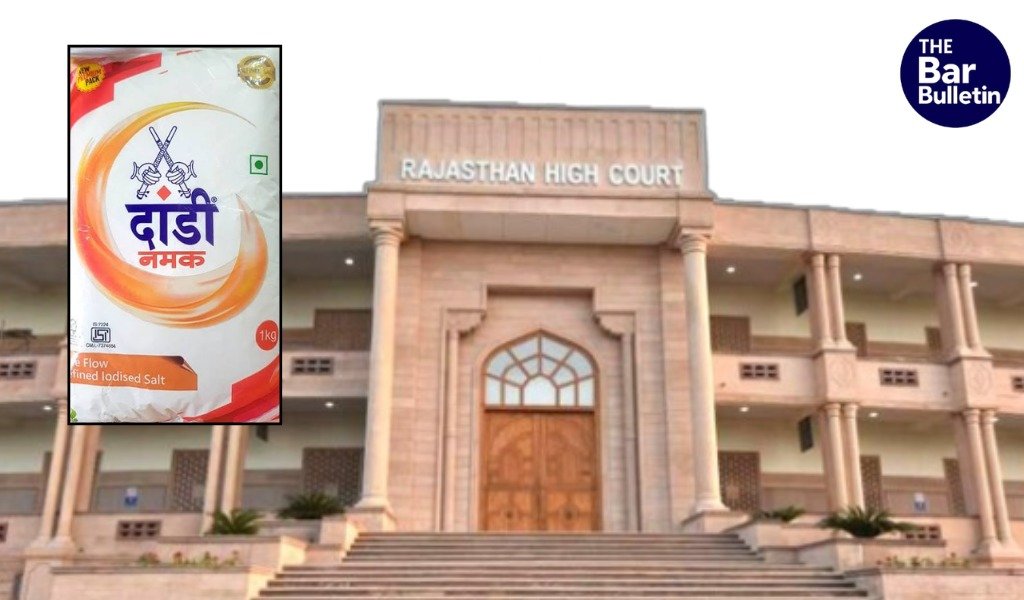

The Rajasthan High Court (Jaipur Bench) has dismissed Section 482 CrPC petition seeking quashing of FIR for offences under Section 420 IPC, Sections 63, 63A, 64 of the Copyright Act, and Sections 103, 104 of the Trademarks Act, holding that the dispute over ownership of ‘Dandi Salt’ and ‘Dandi Namak’ is a factual dispute beyond the scope of Section 482. The Court reaffirmed that copyright registration is voluntary and not mandatory, and protection arises automatically upon creation of an original work, with registration providing only prima facie evidence of ownership.
The Court applied the seven illustrative categories from State of Haryana vs. Bhajan Lal [1992 Supp (1) SCC 335] and the principles from Anukul Singh versus State of U.P. [2025 INSC 1153], holding that the categories are illustrative and not exhaustive, and must balance prevention of abuse of process against ensuring that proceedings are not stultified at the threshold where disputed questions of fact are involved.
The Court also applied the three-judge bench principles from Neeharika Infrastructure Private Limited versus State of Maharashtra and others [2021 SCC Online SC 315], holding that the power of quashing should be exercised sparingly in the ‘rarest of rare cases’, and the court cannot embark upon an enquiry as to the reliability or genuineness of allegations in the FIR. The Court noted that the orders relied upon by the petitioner from the Copyright Board and IPAB were passed in 2011, and the police had already concluded investigation and drawn a charge sheet against the petitioner, making the petition liable for dismissal.
A Single Judge Bench of Justice Ashok Kumar Jain observed that copyright registration is not mandatory but voluntary, and protection arises automatically upon creation of an original work, with registration providing only prima facie evidence of ownership. The Trademarks Act, 1999 governs the registration, protection and enforcement of trademarks, with Section 2(1)(zb) defining trademark, and infringement provides both civil and criminal remedies. The Court also noted that the petitioner had not brought on record any material to show that a copyright or trademark had been issued in his favour, and that there is no mandate requiring registration for an action against infringement of copyright.
The Court applied the principles from Krishika Lula versus Shyam Vitthalrao Devkatta [2016 (1) WLC (SC) Crl 171], observing that no copyright subsists in the title of work and the complainant is not entitled to relief on such basis except in an action for passing off or in respect of registered trademark comprising such titles. Applying Anukul Singh versus State of U.P. [2025 INSC 1153], the Court held that under Section 482 CrPC, a factual dispute and appreciation of evidence are beyond scope. Applying HMT Watches versus M.A. Abida [2015 11 SCC 776], the Court held that Section 482 CrPC cannot be exercised on disputed questions of fact. Further, applying M/s Knit Pro International versus State of NCT of Delhi [(2022) 10 SCC 221], the Court noted that offence under Section 66 of the Copyright Act is cognizable and such cases cannot be quashed under Section 482 CrPC.
The Court further observed that the orders relied upon by the petitioner were passed in 2011, but the investigation was carried out in the FIR registered on May 06, 2012, and arrest was made on March 05, 2016, and the police report clearly indicated that a charge sheet had already been drawn against the petitioner. The Court held that the issue regarding ownership of ‘Dandi Salt’ and ‘Dandi Namak’ is a factual dispute, and it is not mandatory that a party must possess registration under the Copyright Act to claim any right on the title. The dispute regarding infringement is actionable both under civil law and criminal law, with the Copyright Act and the Trademark Act providing for penal provisions and criminal action.
Also read Supreme Court Seeks Clarity on Whether Denial of Sanction Can Impact IPC Offences
Briefly, the petitioner, Sanjay Bhatt, filed a criminal miscellaneous petition under Section 482 CrPC seeking quashing of FIR registered for offences under Section 420 IPC, Sections 63, 63A, 64 of the Copyright Act, 1957, and Sections 103, 104 of the Trademarks Act, 1999. The FIR was lodged by Rakesh, the representative of M/s Indo Brine Industries, alleging unauthorised sale of ‘Dandi Salt’ with imitational trademark, claiming infringement of his copyright and trademark.
The dispute centres on the right to use the trademark ‘Dandi Salt’ or ‘Dandi Namak’, which the petitioner claimed was sub judice on the date of registration of FIR. The petitioner was arrested on March 05, 2016, from Bombay, and the present petition was filed on April 02, 2016. During the pendency of the petition, the police concluded the investigation and drew charge sheet dated June 30, 2017, against Ramswaroop and the present petitioner, while keeping investigation pending against Suresh Dongia under Section 173(8) CrPC. The charge sheet was filed against co-accused Ramswaroop in the Court of Judicial Magistrate on June 06, 2023.
Notably, on May 16, 2016, a coordinate bench had directed that no report under Section 173(2) CrPC be filed against the petitioner, and accordingly the charge sheet was filed only against Ramswaroop Agarwal. The petitioner relied upon an order dated July 23, 2011, passed by the Additional District Judge, Jaipur Metro, dismissing the suit of M/s Indo Brine under Order 7 Rule 11 CPC on jurisdiction grounds, an order dated March 25, 2011, by the Copyright Board allowing an application under Section 50 of the Copyright Act for expunging of registration, and an order dated Nov 23, 2011, by the Intellectual Property Appellate Board in the dispute between Pacs Chemicals versus M/s Indo Brine Industries.
