
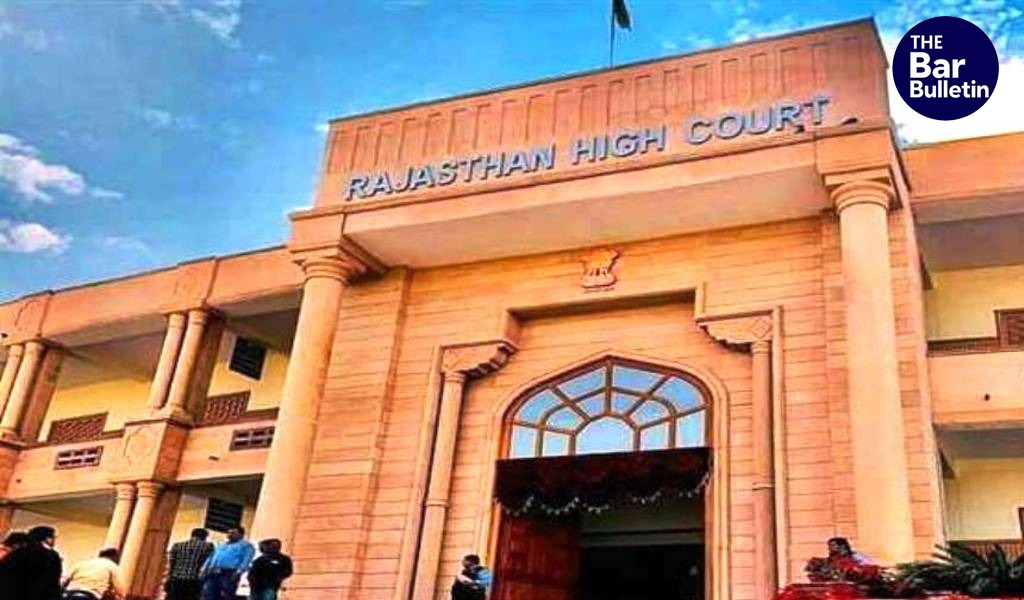

In a petition filed before the Rajasthan High Court seeking directions upon the respondents to issue the no dues certificate to the petitioner for contesting the upcoming Panchayati Raj election of Gram Panchayat Falenda, and to restrain the respondents from insisting upon recovery of the disputed amount allegedly recoverable from the petitioner’s wife, a Single Judge Bench of Justice Anoop Kumar Dhand directed the respondents to issue the no dues certificate to the petitioner for contesting the upcoming Panchayati Raj Elections.
The petitioner submitted that his wife was elected as Sarpanch of Gram Panchayat Falenda from 1995-2000, and that after an enquiry, an order of recovery was issued against her. Upon failing to deposit the due amount, the proceedings of auction/attachment of her property were initiated against which she preferred a writ petition and an interim order was passed on 16-09-2009 whereby the respondents had been restrained from auctioning off her property and the petition was pending for adjudication.
Presently, the petitioner wished to contest the forthcoming Panchayati Raj election and required a no dues certificate for the same. However, the respondents refused the same stating that certain amount was due to be recovered against his wife and until she cleared the dues, the no dues certificate would not be issued to the petitioner. Hence, the present petition was filed.
ALSO READ: Unauthorized Temple on Nursery Land Cannot Continue; Delhi HC Dismisses Plea for Regularisation
The Court stated that a surety or guarantor can definitely be held liable to deposit the due amount, if any, owed by the person against whom the recovery proceedings have been initiated. However, it was found that the petitioner was neither a surety nor a guarantor of his wife for the recovery amount. The Court said that if the erstwhile Sarpanch fails to pay the due amount, the respondents would be at liberty to proceed against her directly to recover the due amount, but they cannot recover the same from her husband, the petitioner.
It was stated that a Public Representative is the only one liable and responsible for their disgraceful act or misconduct. The Court failed to understand how recovery proceedings could be initiated against the family members of any Public Representatives. The Court said that both husband and wife were separate entities and that they could not be held liable for their spouse’s misconduct unless they had also indulged in the same. The present case was found to be a classic example of non-application of mind by the respondents and the Court stated that such action on their behalf was unwarranted.
Thus, the petition was allowed and the respondents were directed to issue no dues certificate to the petitioner for contesting the upcoming Panchayati Raj elections.
