
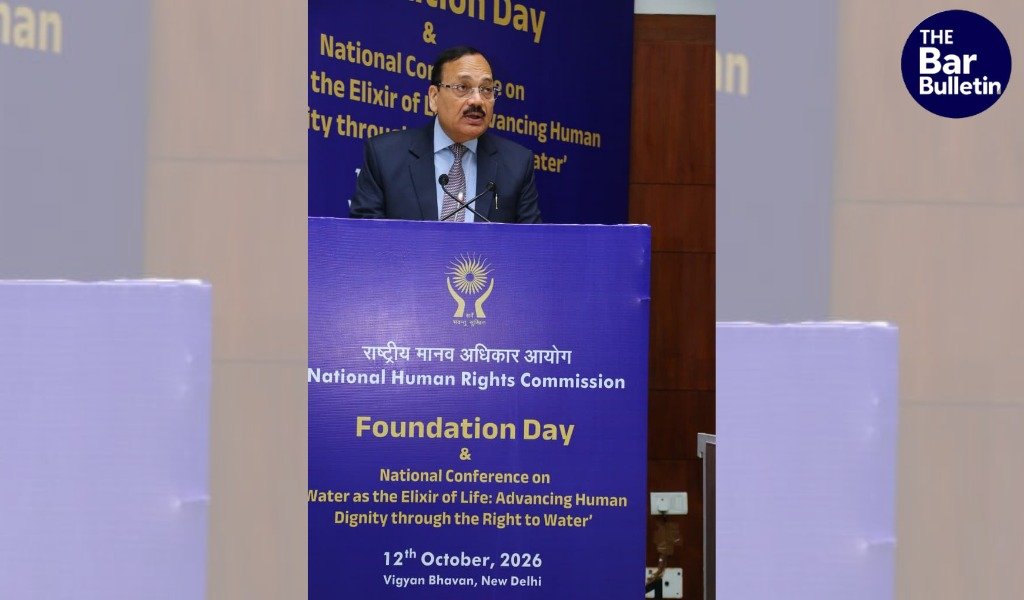

Chief Justice of India Surya Kant on Monday emphasised that access to safe and reliable water is integral to human dignity and the effective enjoyment of fundamental rights, stating that the constitutional guarantee of the right to life extends beyond mere protection against deprivation to ensuring conditions necessary for a dignified existence.
Addressing the National Human Rights Commission’s Foundation Day celebrations and a one-day conference on “Water – The Elixir of Life” on October 12, the CJI said water must be understood not as an isolated entitlement but as a basic condition for the fulfilment of other rights, including health, education, livelihood and dignity.
“
“Water sustains health, makes education possible, protects dignity and shapes the conditions in which families live and work. A home maker who spends hours each day fetching water loses out on time that could otherwise be spent on education, employment or rest. The future of a farmer is at stake if there is no water for irrigation. A community without reliable access to water cannot fully enjoy the dignity that our Constitution promises,” he said.
The CJI observed that the meaning of human rights has expanded considerably over the years, with Article 21 of the Constitution evolving from protection against the deprivation of life and personal liberty into a guarantee of a life lived with dignity. He noted that the right to health, food, shelter, livelihood and a clean environment are now understood as essential components of that dignity.
‘A pipe that runs dry cannot fulfil the promise that the pipe represents’
Highlighting the need to move beyond infrastructure creation and assess actual access to water, CJI Surya Kant acknowledged India’s efforts to expand drinking water access, including through household tap connections in rural areas. However, he stressed that the existence of a tap does not necessarily translate into meaningful access if water is unsafe or unreliable.
“
“But the next question must be a more demanding one: is the water safe, reliable and available when the family needs it? A mere tap is not the same as access to water. A pipe that runs dry cannot fulfil the promise that the pipe represents. And water contaminated with arsenic, fluoride or other harmful substances is not a service; it is a threat to life and health,” he said.
Referring to the recognition of safe drinking water and sanitation as human rights by the United Nations General Assembly in 2010, the CJI said the principle was consistent with India’s constitutional understanding of human dignity and the right to life.
He also stressed that responsibility for ensuring access to safe water could not rest with any single institution. Governments must build and maintain water supply systems, courts must intervene when constitutional rights are violated, and human rights commissions must investigate complaints, identify systemic failures and bring otherwise overlooked concerns to institutional attention. Civil society and international institutions, he added, also have important roles to play.
‘A right that works for the powerful but fails the powerless is a privilege’
Speaking about the broader mandate of the NHRC, CJI Surya Kant said the effectiveness of human rights institutions must be assessed by their ability to reach people who are least able to make their voices heard.
“
“Our Constitution asks us a very practical question, and it is this: how does the last person in the line live? A right that works for the powerful but fails the powerless is not a right in true sense. It is a privilege with better branding,” he said.
He referred to undertrial prisoners unable to meet their advocates, migrant workers without documents, elderly persons abandoned by their families, persons with disabilities facing barriers, and women whose work remains invisible to the systems intended to protect them.
The CJI said State Human Rights Commissions were particularly important in a country as large and diverse as India because they could reach the places where violations occurred, hear complaints in the language in which they were made and understand local circumstances.
He also highlighted the NHRC’s role in addressing custodial torture and deaths, bonded labour, industrial exposure to silicosis and violations affecting marginalised communities. Human rights protection, he said, must go beyond identifying violations to securing accountability, meaningful relief and changes that prevent recurrence.
CJI Surya Kant further warned that the depletion of aquifers, pollution of rivers and contamination of drinking water sources impose a burden on future generations that played no part in creating these problems.
“
“The right to water must therefore be understood not only as a right of the present, but as a responsibility towards the future. If human rights are ultimately about protecting human dignity, then that protection must extend across time. We must leave the posterity not merely a Constitution that promises rights, but a country in which those rights remain possible to enjoy,” he said.
CJI also noted that the NHRC had registered more than 24 lakh cases and disposed of over 23 lakh cases during its 33-year existence, with a disposal rate exceeding 98 per cent, describing these figures as representing instances in which grave violations had been brought into public view.
He also welcomed the launch of the NHRC India mobile application and the digitisation of its records, saying these steps would make it easier for citizens to file complaints, track their progress and access information.
Concluding his address, CJI Surya Kant called for the NHRC to continue expanding its reach and strengthening its impact, so that human rights protections translate into tangible improvements in people’s lives.