
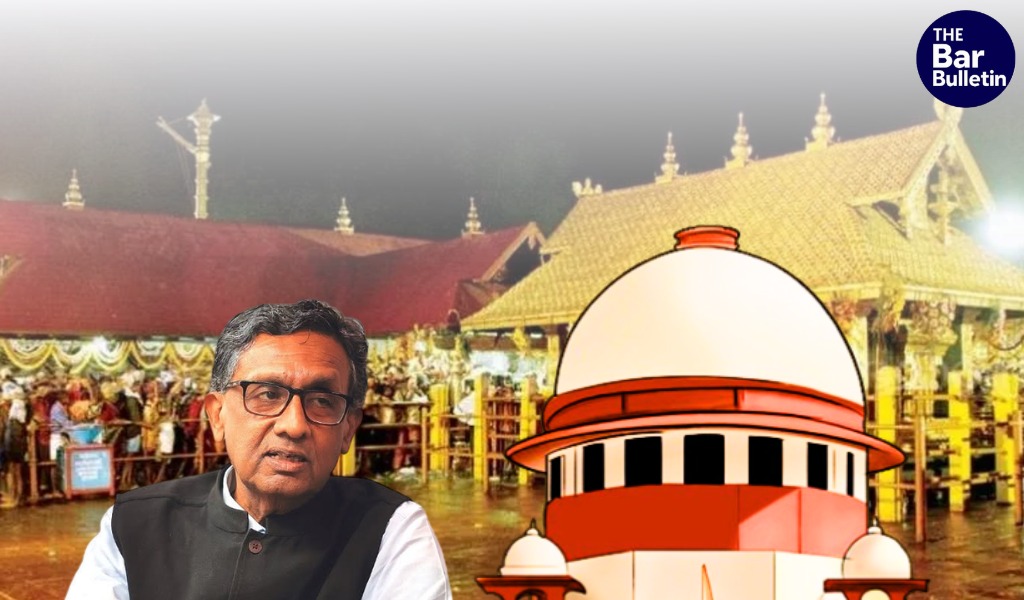
The Supreme Court 9 Judge Constitution Bench hearing the reference on the scope of religious freedom under Articles 25 and 26 on Wednesday heard the submissions of Advocate Dr Mohan Gopal. He urged the Court to recognise “social justice movements within religion” and reinterpret existing jurisprudence to give greater primacy to individual conscience over institutional religious authority.
Appearing before the nine-judge Bench, Mr Gopal argued that the constitutional debate cannot be reduced merely to a conflict between fundamental rights under Part III and denominational rights under Article 26.
“We have been assuming that there is Part III standing alone and then there is Article 26 on the other side, and there is a battle only between these two provisions. This is not true,” he submitted.
Referring to 19th century social reform movements led by figures such as Sri Narayana Guru, Jyotiba Phule and Periyar, Mr Gopal argued that constitutional interpretation must create space for reformist voices arising from within religious communities themselves. He referred to little-known draft proposal submitted by Dr. B.R. Ambedkar to the Fundamental Rights Sub-Committee in August 1947 concerning the right to religion. He pointed out that Ambedkar’s draft guaranteed “liberty of conscience” and the right to “profess, preach and convert” religion, notably omitting the word “practise”.
According to Gopal, the constitutional interpretation over the last 75 years has “silenced” internal reformist voices within religion.
Chief Justice Surya Kant observed that reforms within a religious denomination could also stem from voluntary decisions taken within the community itself. Mr Gopal, however, submitted that existing jurisprudence often privileges institutional clergy over individual believers and devotees.
“Faith in God should not be replaced by faith in the clergy..no person shall be compelled to become a member of any religious association, submit to any religious instruction. This is the heart of the freedom of conscience, that I’m not bound to obey the clergy. The clergy and I are equal. He can persuade me, I have respect for him.
We all have respect for clergy, they’re learned people. But they cannot compel us to submit to any religious instruction. And that religious instruction includes also the idea that someone cannot enter here, somebody cannot go there or perform any act of religion.”
He also criticised definitions of Hindu identity evolved in judicial precedent, arguing many communities had been categorised as Hindus without voluntary acceptance of theological doctrines.
“We were not subsumed into religion, we were consumed by religion,” he remarked.
To this, Justice BV Nagarathna pointed out tha Hinduism has also been judicially recognised as a “way of life”. She stated:“It is not necessary for a Hindu to mandatorily go to a temple… Even then, their psyche is such that they are Hindus. It is a way of life”
Mr Gopal further argued that freedom of religion under Article 25 should not be viewed solely through the lens of organised religion and established rituals.
Describing Indian religious practice as “autotheism”, he submitted:
“Each one of us decides what is sacred to me and how do I pursue it.”
In concluding submissions, Gopal cautioned against allowing any religious denomination to claim immunity from constitutional guarantees under Part III merely by characterising practices as religious matters.
“Religion cannot be used to deprive someone else of their civil liberty..Please do not let faith in the clergy defeat faith in God originating in the individual conscience.”
Appearances:
Advocates Dr Mohan Gopal; Vaibhav Choudhary AoR; Mayank Singh