
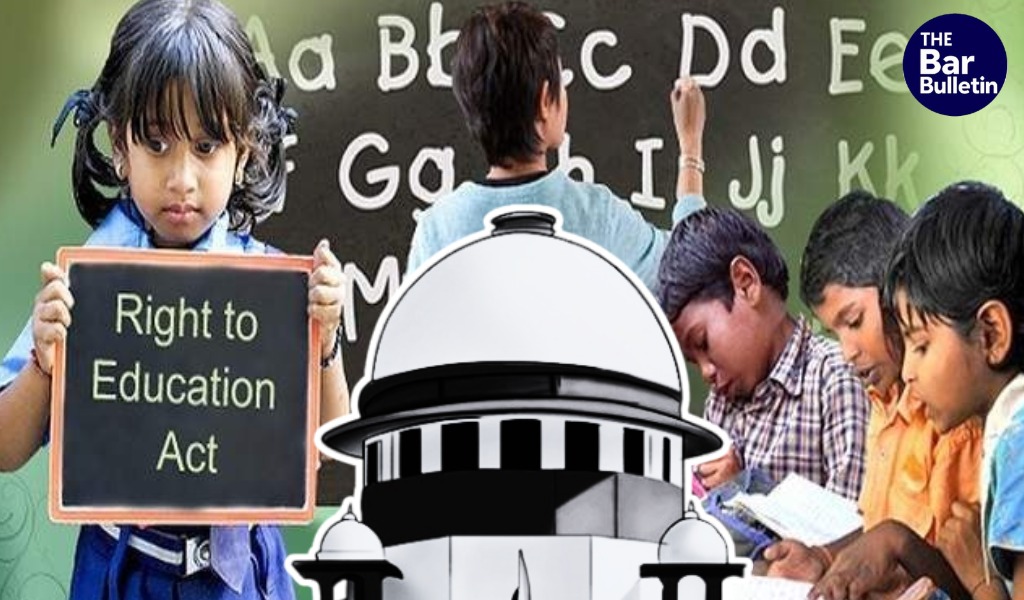

The Supreme Court has asserted that, although the Court will not itself formulate educational policy, the constitutional and statutory framework, including Articles 19(1)(a), 21A and 350A of the Constitution, read with Section 29(2)(f) of the RTE Act, 2009 and reinforced by NEP 2020, the State is required to take effective steps toward providing education in a language intelligible to the child, particularly the mother tongue or local/regional language, as far as practicable.
The Court treated the right to meaningful and comprehensible education as linked to the right to quality education and to the freedom under Article 19(1)(a) to receive information in a meaningful form, and therefore held that executive inaction in this area cannot be justified merely by absence of an existing policy or by the fact that the language is not included in the Eighth Schedule.
More specifically, the Court held that where the Union’s constitutional, legislative and policy instruments recognise the necessity of imparting education in a language understood by the child, a corresponding obligation arises on the State to create and implement an appropriate policy framework; failing which, the Court may issue directions compelling the State to operationalise that mandate, even though the Court will not prescribe the detailed contents of that policy itself.
A Two-Judge Bench of Justice Vikram Nath and Justice Sandeep Mehta observed that the specific prayer relating to inclusion of Rajasthani in REET 2021 had become infructuous because that recruitment process had already concluded and no effective direction could be issued without unsettling a process that had attained finality. However, the Bench held that the controversy could not be treated as wholly academic because it raised broader questions of constitutional significance concerning recognition of language in education and public employment.
The Bench noted that Articles 21, 21A, 41, 45, 51A(k) and 350A collectively affirm education as a constitutional entitlement and public duty, and that quality education is linked to the medium through which it is imparted. Reference was made to Section 29(2)(f) of the RTE Act, 2009, which requires the academic authority, while laying down curriculum and evaluation procedure, to take into consideration that the medium of instruction shall, as far as practicable, be in the child’s mother tongue.
The Bench further observed that NEP 2020 gives primacy to the mother tongue, home language, local language or regional language as the medium of instruction at the foundational and preparatory stages, and treats this not merely as a pedagogical preference but as reinforcement of the constitutional vision underlying Articles 19(1)(a), 21, 21A, 41, 45, 51A(k) and 350A. Reference was made to earlier precedents to reiterate that education must be intelligible and meaningful, and that the freedom under Article 19(1)(a) includes the right to receive information and, at the primary stage, a child’s freedom to be educated in a language of choice.
Significantly, the Bench observed that despite this constitutional, statutory and policy framework, there was a substantial deficit in implementation at the State level. It stated that continued inaction in operationalising mother tongue-based education risks infringing fundamental rights and that the State’s position, restricting teaching only to Eighth Schedule languages and defending the absence of policy as a reason for inaction, was unsatisfactory and reflected failure to translate constitutional assurances into concrete action. The Bench also noted that Rajasthani is already taught as a subject in universities in Rajasthan, which undermined the State’s stand that it lacked institutional or pedagogical acceptance.
Accordingly, the Bench set aside the impugned High Court order and directed the State of Rajasthan to formulate an appropriate and comprehensive policy for effective implementation of the constitutional mandate relating to mother tongue-based education, to recognise and accord due status to Rajasthani as a local/regional language for educational purposes, to progressively facilitate its adoption as a medium of instruction beginning at the foundational and preparatory stages, and to take affirmative and time-bound steps to introduce Rajasthani as a subject in all schools, government and private, in a phased manner. The State was directed to file a compliance affidavit by 25 September 2026.
Briefly, an appeal had been preferred against the Rajasthan High Court’s order dated 27 November 2024 dismissing a PIL which had sought directions to include Rajasthani language in the syllabus for recruitment to the post of Teacher, Grade III, Level I and Level II under REET 2021, and also to direct the State to impart education to children in Rajasthani or the relevant local language. The High Court had dismissed the PIL on the ground that a writ of mandamus could issue only where the petitioners established an enforceable legal right and a corresponding failure by the State to discharge a statutory duty.
The appellants contended that Rajasthani speakers constituted a linguistic minority in Rajasthan for purposes of Article 350A, that the right to choose the medium of instruction is implicit in Article 19(1)(a) read with Article 21A, and that exclusion of Rajasthani, while other languages such as Gujarati, Punjabi and Sindhi were included in school curricula, was arbitrary and offended Article 14.
Opposing the same, the State argued that education and recruitment were being conducted only in respect of languages recognised in the Eighth Schedule to the Constitution; since Rajasthani had not been included in the Schedule, no policy decision or administrative framework existed for adopting it as a medium of instruction or compulsory subject. The State further submitted that Article 350A is merely directory and does not create an enforceable right by mandamus, and that NEP 2020 is only an executive policy statement without statutory force.
Appearances:
Dr. Manish Singhvi, Sr. Adv., Apurv Singhvi, Adv., D. K. Devesh, AOR, Shalini Haldar, Adv., Jitesh Saluja, Adv., Shashank Kumar Saurav, Adv., Suprabh Kumar Roshan, Adv., for Appellants
Shiv Mangal Sharma, A.A.G., Sonali Gaur, Adv., Saurabh Rajpal, Adv., Nidhi Jaswal, AOR, Ajay Singh, AOR, for Respondents
